


Refine your search for walks in Parence (rivière)
Parence (rivière) walks


 From Le Tripoulin to La Vive Parence
 Visorando Member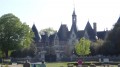
 6.31 mi
 +351 ft
 -331 ft
 3h 10
3h 10
 Easy
Easy
 Departure from Bonnétable (Sarthe)
Spared by land consolidation, the commune of Bonnétable, best known for its medieval castle and deciduous forest, is much loved by walkers for its typical sunken paths and pleasant wooded countryside.
The Butte de Montrentin as seen from Torcé-en-Vallée
6.47 mi
+66 ft
-69 ft
3h 00
 Moderate
Departure from Torcé-en-Vallée (Sarthe)
Moderate
Departure from Torcé-en-Vallée (Sarthe)
This walk, with little variation in elevation and no great difficulty, will allow you to explore the southern part of Torcé. The paths – sometimes tree-lined, sometimes sunny, and very often sandy – will take you to the foothills of the Butte de Montrentin.
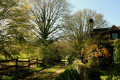
La Fosse aux Saneux in Sillé-le-Philippe
 Tourism professional
 9.40 mi
+256 ft
-246 ft
4h 35
Moderate
Departure from Sillé-le-Philippe (Sarthe)
9.40 mi
+256 ft
-246 ft
4h 35
Moderate
Departure from Sillé-le-Philippe (Sarthe)
The first mention of the parish under the name “Siliaco Philippi” dates back to the years 1145–1187. From the Middle Ages onwards, the parish seigneury was annexed to the Château de Passais, which itself fell under the barony of Touvoie, owned by the bishops of Le Mans, situated on the border between Savigné-L’Evêque and Saint-Corneille. Sillé-le-Philippe gave rise to the creation of a linear village; long remaining modest in size, it is now expanding due to its proximity to the Le Mans conurbation. This development also benefits the hamlet of Chanteloup (situated on the old royal road from Le Mans to Paris via Mortagne, now the RD 301), which once boasted several cafés and inns.
Palet de Gargantua Circuit
 5.19 mi
+79 ft
-72 ft
2h 25
Easy
Departure from Torcé-en-Vallée (Sarthe)
5.19 mi
+79 ft
-72 ft
2h 25
Easy
Departure from Torcé-en-Vallée (Sarthe)
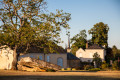
Known successively as Ecclesia de Torciaco, then Torcey and Notre Dame de Torcé, the former parish has been called Torcé-en-Vallée since 1926. The documents first mentioning it relate to the construction of the priory and the church. However, it is clear that Torcé’s history predates this, as evidenced by the megalith located at the western entrance to the village, known as the ‘Dolmen de Torcé’ or ‘Palet de Gargantua’. Human occupation may date back to the Middle Neolithic period.
Walks near Parence (rivière)
From Saint-Germain-de-la-Coudre to Nogent-le-Rotrou
 Association / Club / Walk leader
 17.44 mi
+1,299 ft
-1,280 ft
10 hrs
17.44 mi
+1,299 ft
-1,280 ft
10 hrs
 Very difficult
Departure from Saint-Germain-de-la-Coudre (Orne)
Very difficult
Departure from Saint-Germain-de-la-Coudre (Orne)
This walk is the eighth and final stage of an eight-day, 220km route, the Tour des Collines du Perche.
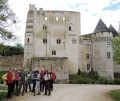
Setting off from Saint-Germain-de-la-Coudre, you will first pass through the Bois de la Bretèche, situated on a plateau on the left bank of the Huisne, which you will cross at Le Theil. The route, offering plenty of panoramic views, will take you to Nogent-le-Rotrou at the foot of Château Saint-Jean. All that remains then is to walk through the historic districts of Le Pâty.