Country:

 City:
City:


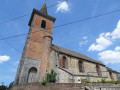
Park in the cemetery car park, where you can see a hornbeam hedge.
(S/E) Take the small flight of steps leading down towards the church and you’ll arrive in front of the insect hotel.
Near the privet, you’ll spot the black redstart’s nest box. Close by is the weeping birch and, to its left, on a post, the blue tit’s nest box.
Walk alongside the church, following the hedge of purple beech trees, and look out for the town hall with its weather vane and the coat of arms featuring three shamrocks. Cross the county road at the pedestrian crossing and head up Rue de l’Église to the right for about a hundred metres.
(1) Turn left into Ruelle de Namur.
As you walk along this narrow lane, you’ll come across an ash tree, a pollarded hornbeam, a little owl nesting box, black elder, a hazel tree, a black alder and a goat willow.
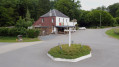
As you come out of this lane, head right towards the statue of the Virgin Mary and make your way to the roundabout.
(2) Turn left and take the Chemin du Faulx.
On this path, there’s no weather vane or birdbox, but on your right you’ll see the remains of the Gallo-Roman aqueduct that carried water from Floursies to Bavay. At the end of the path, you’ll see further remains of this aqueduct. A little further on, you can still spot the stork, provided it hasn’t started its migration yet!
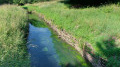
(3) At the four-way junction, turn right onto the Chemin des Quarante. Continue to the small stream and keep to the right.
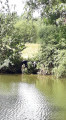
The little bridge and its bench provide a spot to rest near the nesting box for the Eurasian pygmy woodpecker.
Along the way, you’ll come across a white willow, a pedunculate oak, a dog rose, a hawthorn, a European spindle, a hazel, another white willow, a warty birch and a sparrow nest box.
Turn right at the conifer towards the Chemin du Trieu Audin.
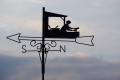
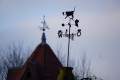
A few weather vanes brighten up your walk: the dwarf gardener, the bricklayer, Cupid and then, after the bend, the owl. On the post, a house martin’s nest box and, on the other side of the street, a coal tit’s nest box. You’ll also spot a few plants: rowan, blackthorn, dogwood and another weather vane, the gardener.
Head towards the junction with Rue des Écrolies, an anagram of Écoliers.
(4) Turn right.
Discover some new weather vanes: the fishermen on one side and, on the other, the mushroom picker, the ploughman, the hunting dog chasing a hare, the compass rose and, right at the bottom, the cockerel.
You’ll come to a small square which, in the Middle Ages, belonged to a village called Maingersart, which was later merged with our present-day town.
(2) Walk down Rue Haute.
To guide you along the way, you’ll see another weather vane, some storks, and a succession of trees: a small-leaved lime, a soapberry tree, a sweetgum and, opposite them, another weather vane: a second cockerel.
(5) Turn left onto Rue de Maubeuge, cross the small square running alongside the village hall, walk past the sports ground and, as you continue, look out for a third rooster and then, a little further on, a stag fight.
Cross the main road and look out for a fourth rooster on one of the roofs of the farm buildings opposite. Turn back until you reach the junction with Rue Haute.
(5) Turn left onto Chemin de Lay Duy.
First, at the entrance, an ornamental plum tree. In the foundations of the house, small mounds: these are the remains of the ancient pillars of the Gallo-Roman aqueduct (the ‘tournelles’). You’ll also come across a black elder and, on the right, another rooster, followed by the lantana viburnum and the field maple.
From there, between the houses, try to spot the weather vane on the roof of the last house towards Boussières (a horse).
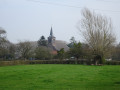
Turn sharply right onto Rue de Boussières and let the church tower guide you. At the three-way junction, turn left to reach the cemetery car park (S/E).


 AONB
AONB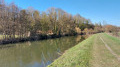

 Moderate