Country:

 City:
City:


Murs-et-Gélignieux can be reached from Belley via Peyrieu or from Saint-Genix via Brégnier-Cordon. In the hamlet of Gélignieux, take the Chemin de Fontanette towards Fay. Just before the entrance to a quarry, park near a water reservoir on the left-hand side of the road.
(S/E) From the reservoir, walk back down about twenty metres and turn right onto the path known as the Sentier de la Pierre, which climbs steadily northwards in a series of wide hairpin bends. The gradient then steepens as you enter the forest, climbing north-westwards up the slope and skirting a rocky outcrop before emerging into the meadows of Rongère.
Climb up through a first meadow, then, after a few trees, a second one.
(1) At the top, avoid turning right onto the service track which leads directly back to the Route de la Grande Montagne (and forces you to follow the tarmac), but take the earthen embankment which slopes down onto a small meadow sloping northwards, at the foot of which a path begins. This path descends steeply, then veers to the right to wind down a series of terraces at the foot of a scree slope before joining the Route de la Grande Montagne at the level of its hairpin bend.
(2) Climb a few metres and immediately turn left onto the Sentier du Grand Thur, which starts at the same level. It crosses a few paths leading down to the left. Make sure to stay on the path, which climbs gently as it crosses the western face of the Montagne d’Izieu.
Below the Grand Thur, the slope becomes steeper; then, after a right-hand bend and a short descent, the path climbs sharply to the left up a steep slope through a gully between two rocky peaks, emerging at a major junction on the wooded plateau of the Grand Thur.
(3) The forest limits the views: first, take a round trip north-west to the geographical summit of the Grand Thur, marked by a triangulation point, then head north along a good path to a viewpoint overlooking the Gland valley.
(4) Return via the same route or by turning right twice along a narrow path on a small ridge. Follow the main access track southwards for a few dozen metres (the standard access route from the Route de la Grande Montagne).
(5) At the foot of the first descent, turn left onto the north-easterly forest track. It follows the wooded ridge for a while, then turns right and descends to join another forest track coming from the right. Take this track to the left to climb back up and cross a threshold.
(6) Just past this ledge, leave this well-marked path, which descends to the right, and take a less defined, straight and level path heading north. It comes to a gully: continue straight on to descend via a track through this gully and veer left to climb back up along the bottom of the thalweg to the ridge.
There, two parallel paths lead off to the north-east: one along the north-western flank of the ridge through the forest, the other (GPS track) along the south-eastern flank, which is grassier but more overgrown. The two paths join to form a proper path leading down into the forest.
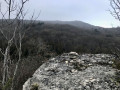
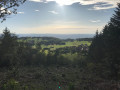
(7) At one point, an open, rocky section of the ridge is visible on the left; climb up there via a short, return path for a final viewpoint overlooking the Bugey. 100 m further on, before the 705-point mark, the path turns right to descend and join a wider forest track coming from the right. Follow it to the left and continue descending straight ahead, ignoring the paths branching off to the left, then crossing the gravelled section of the Route de la Grande Montagne. Follow theGR® 59 markings for a while. Ignore several more junctions until you reach the one where the marked path veers off to the left.
(8) Take the path on the right, which climbs slightly and, at a cairn, turns downhill towards Fay. This path, known as the R8 (due to a wreck located along its route), winds its way down through Les Carteries and then Côte la Clef before heading more directly down the slope, passing the R8 and joining the correct stony path coming from La Pierre du Regardeur. Take this path on the right, which leads to the hamlet of Fay on the road known as the Chemin de Veyle.
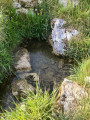
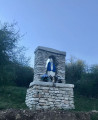
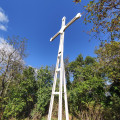
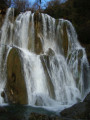
(9) Turn right to descend along the south-western slope. The road becomes a country lane that is increasingly hard to follow towards Bionnaz and ends in a meadow where the path climbs up to the right. Leave the main path to take a track at the foot of this meadow which crosses a copse to reach more grassy areas, allowing you to descend gradually towards the Route de Fay. Just before the road, head up to the right to visit the statue of the Virgin Mary and rejoin the road at the Source Merveille.
(10) Return to the starting point either via the road or along the left bank across grassy ground, following the route of the buried gas pipeline, until you reach the entrance to the quarry (S/E).



 ), I think it’s best to continue down the track after point 6, take the path a little further down on the left, and then head back up towards point 7. This only adds about 150 metres to the distance and a few metres of elevation gain, but makes the walk much easier.
 Visorando Member


 Difficult