Country:

 City:
City:


Depart from Murs-et-Gélignieux, on the right bank of the Rhône, downstream from Belley and opposite Saint-Genix-les-Villages. Park either in the main town or a little further east at the junction with the old railway line.
(S/E) Return by road to the main town and take the gravel forest road with a barrier opposite Impasse du Rhône (near the corner of the cemetery), which heads north-east. After about 50 metres, turn left and climb towards the statue of the Virgin Mary overlooking Murs.
(1) Continue behind the statue and take a path climbing north-east, then continuing level. You will come to a slightly better marked path: do not go up it to the left, but turn right to reach a crossroads, about twenty metres from the end of the gravel forest road you left below.
(2) Climb left up the path heading due north, which ascends the semi-wooded slopes to a threshold where it continues level, remaining well below the ridge on the eastern slope.
The path becomes a forest track that descends the eastern flank in a hairpin bend to a junction where you must climb left to a hairpin bend.
(3) Turn left onto the forest track towards Golet de l'Epeney and after about 200 m, before a slight descent, don't miss a path on the right that heads straight towards the ridge. Easy to follow although not very well marked, it joins a pleasant ridge path running along the edge of the Mont Gela cliff before turning right and descending gently to join another path.
(see alternative route in Practical Information).
(4) Take this path to the left; it curves widely to the right and descends first to the south-east, then veers left to the north-east to reach the edge of the rocky outcrops bordering the valley leading from Golet du Gela. Further on, the path veers left again to the north-west to join Golet du Gela, preceded by a ruin.
(5) From the pass, take the path opposite to the north-east and after a few metres, climb up to the left on a path to the north-west which leads to a rock on the cliff overlooking Golet and Fay. Take the path north along the ridge, which is quite overgrown with branches from devastated boxwood trees. The route, which is not very obvious on the ground, gradually veers to the right as it continues to climb slightly. The path then follows a limestone bench to exit the forest into a partially grassy open space.
Do not continue east or north-east along the IGN route, which no longer exists (if it ever did), as the vegetation makes it impassable. Instead, descend south-south-east along the relatively grassy ridge where a path can be seen on the other side of a rocky outcrop until you meet the path ascending from Golet.
(see alternative route in Practical Information).
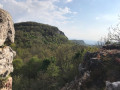
(6) Climb this path on the left; it joins the wooded plateau of Vorina. The slope levels out and after an S-bend, the path joins the ridge: continue straight on to the viewpoint at the edge of the cliff.
(7) Return to a sunken path that descends steeply and then veers to the left to reach the edge of a flat clearing (woodcut).
(8) To visit Tavollet Castle and return, cross this flat area, heading for the start of a path opposite. Take this path and immediately turn left onto a path climbing the ridge leading to the castle ruins. Descend via the same path.
(8) Take the path, which becomes a track, and head left towards the south-west. Almost all the tracks in the area lead back to Fay: the suggested route stays close to Mont Gela: at the first crossroads, go up briefly on the left and follow the most obvious path to the south-west: it is a series of steps and descents to an area of old quarries. As you approach the bottom, take the path on the left across the meadow to join the path coming from Fay at the foot of Golet du Gela.
(9) Take this good path on the left and make the steep but quick climb to Golet, with a hairpin bend towards the end.
(5) Back at Golet du Gela, do not take the paths you took before, but descend straight down the thalweg opposite (eastwards) off the path (recent fluorescent red arrows). The undergrowth is pleasant and easy to walk through. The slope gradually becomes steeper, but a path then begins to emerge in the forest. The fluorescent arrows make it easier to find your way, and further down, the path becomes an old track that has been badly damaged by erosion.
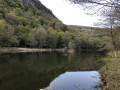
It leads to the bottom of the valley, where you join a beautiful flat forest track that you follow eastwards to the end of the Marais des Planches, along the northern bank of which you walk.
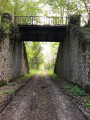
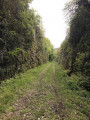
(10) At the crossroads, you are on the route of the old Virieu to Brégnier-Cordon railway line: turn right and follow this track through the Combe: sometimes along the edge of the pond, sometimes between rocks, it passes under an old road bridge and leaves the Combe to pass near livestock buildings and join the Murs road after a barrier opposite the starting car park (S/E).


 Visorando Member

 Difficult