You are in a protected area! See the regulations in the practical information section.


 Country:

 City:
City:


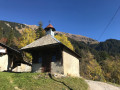
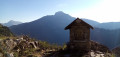
Departure from the Saint-Théodule Chapel.
In the village of Abondance, head towards Lac des Plagnes. After passing through several hamlets, turn left towards Follebin, then Les Séchets. Shortly before the end of the road, turn right towards Saint-Théodule. The road is unpaved: park in the small car park 100 metres after the chapel.
(S/E) Go straight up the steep track opposite the car park (north) which leads to the chalets of Trélesbœufs. Keep following the track which climbs the most until you reach the last chalet, which you go around on the right.
(1) Continue north through an alpine pasture area where there are many herd tracks. The slope levels out and gradually turns north-northwest. One of the tracks becomes more distinct than the others: this is the path, which is confirmed by red dots. Follow these markings. The path climbs to a grassy hillock where it levels out (and even descends slightly) to the left before gradually climbing again to the foot of a wide corridor with trees between rocky areas. The well-marked trail winds its way up this steep corridor to the Belair ridge at an altitude of 1694m.
(2) Turn right onto the path coming from Enquernaz to climb the wide grassy ridge to a pass at 1783m.
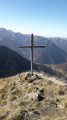
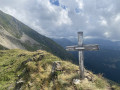
(3) Then turn right onto a path climbing Montagne de Pertuis, heading south-east. The path stays on the right side of the ridge, then when the slope gets steeper, cross to the right to reach a rockier area, the Lanches des Praults. It climbs eastwards in this area of boulders (red dots) to reach the ridge. Climb up this ridge to the right, which becomes grassy and narrow again, to reach the Sommet de Pertuis and its white cross, which is clearly visible for much of the route.
(4) From the cross, you can see the end of the route to the east: follow the ridge, which is a little exposed at first, starting at the same level and leading to a large slope from the summit. The route climbs this slope, which forms a half-rocky, half-grassy ridge, via a path marked with red dots, running alongside a scree-covered couloir on the left (Combe de Pertuis). Climb up to an area of larger rocks: the trail then climbs up a corridor between these rocks, leaving them on the right. After a few switchbacks, you will reach a clearly visible cairn on a grassy ridge, which marks the end of the difficult section.
The less steep path then climbs towards the summit, which can be reached either by following its south-west ridge directly or by joining the normal route on the right as it emerges from a canyon.
The central summit has a 360° orientation table, while the actual highest point is a few metres away, marked by an antenna.
(5) The descent begins southwards through a rocky canyon that cuts across the summit. At its exit, the path begins a steady descent through grassy terrain on the Crête de Coicon. At around 2200m, a rock on the ridge is bypassed on the right, requiring a few switchbacks to descend this small ledge.
(6) The ridge then turns south-east, flattens out for a while (altitude 2071m) before continuing its descent. Enter the wooded area to reach a good path running perpendicular to it.
(7) From this point, the rest of the return journey is entirely on a pastoral track suitable for 4x4s (part of the Tour du Mont Grange). Follow the path on the right, which descends gently to the Lenlevay chalets.
(8) At the crossroads after the chalets, descend to the right towards the Chalets du Jouly and the oratory. Pass these chalets and continue on the track that winds its way past the Chalets du Bailly and then the Chalets du Covillet. Cross the Cheneau de Grange and reach the Oratoire des Trables. Continue under the oratory to quickly reach the car park (S/E).


 and it feels good not to suffer on the way down.
 Visorando Member

 Very difficult
 Easy
Easy  Moderate