Country:

 City:
City:


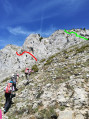
Start from the hamlet of Le Sauvage. At the upper exit of the village of Abondance (towards Châtel), take the steep little road on the left leading towards Le Mont (signposted). Pass the hamlet of Le Mont, turn right, pass some chalets, take a stony track and park at the edge of the forest (small car park, information board).
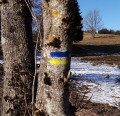
Signposts and marker posts are situated at intervals between the start and the Chalet de la Raille. After that, the route follows poorly marked paths or mere tracks.
(S/E) Follow the stony track through the woods, which heads east-north-east towards the Chalet de La Raille. Just outside a small right-hand bend, immediately after a ‘2’ painted in red on a white background on a rock (forest plot number), look out for the start of a narrow stony path: the return route will end here.
(1) Continue east-north-east, ignoring a few turnings on the right. After a signpost, the track turns sharply. At a place called La Lavanche, the track turns sharply to the right and runs along the edge of the forest (on the right) and the mountain pasture (on the left). The slope levels out and curves around a promontory. Pass the Chalets de Crébin and Trosset in turn, then reach the Chalet de la Raille.
(2) Climb up a well-trodden track through the pastures heading west, aiming for a gap between two rows of spruce trees. Depending on the time of year, you’ll need to pass under (or over) an electric fence once or twice. Pass by the base of an old spruce stump and emerge onto a grassy ridge.
Look out for a gully opposite with a clearly visible path—which you’ll take later—and a large rock with a sort of hole in it. Keep to the right to stay at the same level (do not descend opposite to reach the gully, as you’d then have to climb back up through the scree). You’ll come across a faint path beneath the spruce trees. Cross a small rocky area and arrive at the foot of the couloir.
(3) Climb up the couloir along a faintly marked path which is very steep and where you’ll often need to use your hands. Climb as high as possible and, when the slope becomes far too steep, leave the couloir to the left. Do not stray from the edge of the couloir (watch out for the sheer drops on the left) and veer right to reach a small promontory. Continue north-west over very steep grassy slopes. Go round a notch on the left (using your hands from time to time) and reach a ridge.
(4) Follow this exposed ridge to the left (west). Cross a small rocky escarpment (a short, easy bit of scrambling). Continue along a grassy ridge until you emerge onto a stony area that abuts the summit walls.
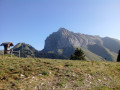
(5) Aim for the central rock face, which has a sort of dark cavity. Enter a narrow rocky gully, then follow the small rocky ledge situated below the cavity. Pass a first rock outcrop (a short climbing move) and continue climbing up to the right. Pass a second rock outcrop (a large climbing move), descend a few steps and immediately climb up to the right into a stony gully. Reach a ridge and follow it to the left until you reach the summit.
(6) Begin the descent via the same route. At the bottom of the gully after the summit, keep to the left so as not to miss the rock piton (with a sheer drop to the right). You will reach the stony area at the foot of the summit walls.
(5) Then descend to the right (west), following a track through the scree. Do not descend too far down; aim for the entrance to the Couloir du Féraillon, which is situated to the right (upstream) of a small group of young spruce trees at the top of a ridge.
(7) Enter the couloir via a marked but very steep path. Several hundred metres further on, you’ll come to a good scree slope; follow it. Just before the couloir turns left, make a short traverse to the right (cairn, yellow marker) and ignore a two-way arrow on the left. Then continue due south, alternating between sections of good scree and steep tracks.
Emerge onto an overgrown forest track and make a first turn left then right to follow a stony path that descends (cairns). You’ll reach the track you took on the way up.
(1) Take the track on the right and quickly return to the starting point (S/E).



 ).
). Visorando Member
 Average
 Difficult