


Refine your search for walks in Meuvette (rivière) - Affluent de l'Avre
Meuvette (rivière) - Affluent de l'Avre walks


 Tour of the Perche Hills
 Association / Club / Walk leader
 289.61 mi
 +14,616 ft
 -14,731 ft
 8 days
 Difficult
 Departure from Nogent-le-Rotrou (Eure-et-Loir)
The Tour des Collines du Perche will take you on a journey through the Perche regions of Orne and Eure-et-Loir, with its bocage, hills, valleys and forests (offspring of the famous Forêt des Carnutes), all set against the backdrop of its many manor houses, churches, chapels and a thousand other sites.
You are sure to be amazed by the diversity of the landscapes you will pass through during a journey that takes you through typical Perche towns and villages, steeped in history.
Walk around the Bois de la Saucelle in La Puisaye
 Visorando Member
 7.00 mi
+69 ft
-79 ft
3h 15
7.00 mi
+69 ft
-79 ft
3h 15
 Moderate
Departure from La Puisaye (Eure-et-Loir)
Moderate
Departure from La Puisaye (Eure-et-Loir)
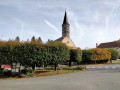
Starting from the village of La Puisaye – whose village centre has recently been beautifully refurbished, complete with its wash house and a leisure area near the town hall and the church – this circular walk takes you through woods and fields around the Bois de la Saucelle, which should not be confused with the neighbouring village of the same name. With its long forest lanes, the return route along the Meuvette takes you past the Étang de Rouge, a prime spot for recreational fishing home to carp and enormous catfish.
Water seeps at Les Ressuintes
 8.09 mi
+164 ft
-164 ft
3h 50
Moderate
Departure from Les Ressuintes (Eure-et-Loir)
8.09 mi
+164 ft
-164 ft
3h 50
Moderate
Departure from Les Ressuintes (Eure-et-Loir)
This very wet area drains water from the Senonches Forest. There are numerous streams and ponds. The route starts by following the Meuvette valley. The stream originates in the nearby private woods and flows through the Haron and Rouge ponds.After passing through a cultivated area, the return journey is along small roads. This walk is best done in winter, when the nearby forest paths are difficult to navigate.The commune is backed by private woods and bordered to the west by the walls of the park of the former château of the Marquis de La Borde, which became the Citroën Test Centre in the 20th century.Between the park and the forest, old farmhouses have been converted into attractive second homes, well maintained and decorated with flowers in summer. The village has a church which, since the 12th century, has undergone many vicissitudes.At the rear, the communal wash house has been restored, and a public space welcomes walkers who wish to take a moment's rest.
Circular Saint-Lubin-de-Cravant in the footsteps of a "Fauve"
 5.26 mi
+243 ft
-240 ft
2h 40
5.26 mi
+243 ft
-240 ft
2h 40
 Easy
Departure from Saint-Lubin-de-Cravant (Eure-et-Loir)
Easy
Departure from Saint-Lubin-de-Cravant (Eure-et-Loir)
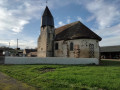
These circulars will not take you into the bush in search of large predators, but along good paths through woods and fields on the outskirts of the Perche, in this transitional region known as the Thimerais. You will pass through the landscapes that inspired the painter Maurice de Vlaminck, who founded Fauvism at the beginning of the 20th century with his friends Derain and Matisse.Having settled in La Tourillère, near Rueil-la-Gadelière, 100 years ago, the artist fell in love with this region, which he tirelessly explored until his death in 1958 in search of places of inspiration.These circular loops take you through the landscapes "where the wind bends the trees and chases the clouds across a dark sky" that captivated the painter.This route starts in Saint-Lubin de Cravant, where the church inspired the painter. It follows the Meuvette valley, which was once canalised. The Avre Aqueduct crosses the valley on imposing arches. It supplies Paris with drinking water.
 Manou, from Chemin du Moulin à Vent to Saint-Pierre de Cernières.
 56.07 mi
+787 ft
-1,010 ft
8 hrs
Difficult
Departure from Manou (Eure-et-Loir)
56.07 mi
+787 ft
-1,010 ft
8 hrs
Difficult
Departure from Manou (Eure-et-Loir)
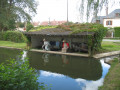
This circuit begins in the heart of the Senonches Forest on wide, easy-to-ride paths, starting from the Rond de Condé, followed by a passage through La Ferté-Vidame and its rich historical past.Don't miss Moussonvilliers and its washerwomen at work at the Ruisseau de Grenouille wash house.Afterwards, cross various waterways, each one different from the other, including the Rivière de Saint-Maurice, the Avre, the Iton, the Risle, the Cauche and the Sommaire, the most difficult to cross.
From Senonches to La Ferté-Vidame
 11.71 mi
+167 ft
-72 ft
5h 30
Moderate
Departure from Senonches (Eure-et-Loir)
11.71 mi
+167 ft
-72 ft
5h 30
Moderate
Departure from Senonches (Eure-et-Loir)
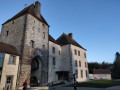
This first stage connects Senonches to La Ferté Vidame. Through the national forest, the route takes you to the village of La Framboisière, the Château de la Hézière, near which there was once a glassworks, and, via a long forest road, leads to La Puisaye. After skirting the Étang de Rouge, the path crosses farmland and arrives at La Ferté-Vidame, the stronghold of the Duke of Saint-Simon, famous chronicler of the court of Versailles. At the entrance to the park, in the Pavillon Saint-Dominique, home to the tourist office, the Maison Saint-Simon presents his life and work. A walk in the park allows you to contemplate the vast views, the ponds and the ruins of the castle of the Marquis de la Borde, which replaced the medieval fortress, the "favourite residence" of the memoirist, in the 18th century. Recently restored, the "little castle" once belonged to King Louis-Philippe, benefactor of the village. The classical-style Saint-Nicolas Church contains the tomb of the duke and his wife.
From Moutiers-au-Perche to La Ferté-Vidame
 17.47 mi
+653 ft
-466 ft
8 hrs
17.47 mi
+653 ft
-466 ft
8 hrs
 Very difficult
Departure from Moutiers-au-Perche (Orne)
Very difficult
Departure from Moutiers-au-Perche (Orne)
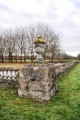
This hike is the third stage of an eight-day, 200 km route, the Tour des Collines du Perche.The route leaves the beautiful village of Moutiers-au-Perche, above the church, and immediately enters the woods. It then passes through a beautiful valley and a long stretch of forest before reaching the grain-growing plains of the Eure valley. It then reaches the woods of Neuilly and the forest of La Ferté-Vidame, which it crosses to reach the small town of La Ferté-Vidame.