Country:

 City:
City:


In the centre of the village of Anjou, park in the small car park opposite the church forecourt (photo 1), at the junction of the Route du Dauphiné (D51) and the Chemin de l’Église.
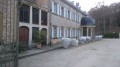
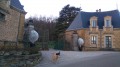
(S/E) Follow the Route du Dauphiné (D51) westwards (towards Agnin and Salaise) for barely 100 metres. Take the first road on the right (Montée du Village). This winds its way slightly uphill between beautiful stone walls and a few fine houses (photo 2), including the Château de Fondu on the left. After an 800-metre climb, pass the Chapelle de la Pitié (photo 3).
(1) 50 metres after the chapel, at the junction, continue slightly to the left, then slightly to the right, following the same road towards “Tour d’Anjou, orientation point”. The road continues to climb, takes a hairpin bend to the right, and you will then see the Tour d’Anjou at the top of the hill (photo 4). 80 metres after this hairpin bend, take the small road on the right which leads back down towards the village (Chemin du Seux). 100 metres further on, turn right at the first road (Chemin de l’Hôtel des Touristes), which descends quite steeply towards the chapel. You’ll come back to the junction near the church (photo 5).
(1) Walk back down the Montée du Village for 60 metres. Just past the chapel, turn left onto the small flight of steps that winds its way round the chapel (Chemin des Croix). You’ll come to a street called Chemin de la Roche; turn right and continue uphill, staying on the narrow street “Chemin de la Roche” for 100 metres. Further up, the road runs alongside a tall, beautiful stone wall.
(2) When you reach a wayside cross to the right of the road (photo 6), take the path (Montée du Château) on the left, signposted “Tour d’Anjou”. Continue up the path for about 100 metres, then, just after the start of a laurel hedge, turn left into the footpath entrance marked by a chicane formed of two wooden barriers. Follow the gravel path which leads to the restored ruins of the Tour d’Anjou, a must-see (photos 7 and 8). Also take in the view of the start of the Bièvre plain behind you. Then continue along the gravel path until you reach the road (Chemin de la Tour), which you take to the left. Walk past the water tower and continue for 150 metres. At the first junction, turn left, then 30 metres further on, turn right at a large fir tree (marked ‘Sapin de la Victoire’).
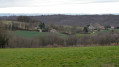
(3) A good hundred metres past this junction, take the path on the right marked in yellow ‘Ville-sous-Anjou 1.7 km’. During the descent, enjoy the unobstructed views of the Pilat massif to the left (photo 9) and of the village of Ville-sous-Anjou and its Madonna opposite (photo 10). Join a path coming from the left and continue the descent. At the bottom, the path gives way to a small tarmac road which leads to the dry ford of the Ruisseau de la Vesciat.
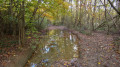
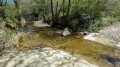
(4) At the bridge spanning this ford (photo 11), turn right, just past the large white house, and walk straight ahead along the dry stream bed (staying in a sort of ditch). The stream bed is tarmac-surfaced again for a few dozen metres before reverting to a shallow ditch lined with moraines. Gradually, the ditch becomes deeper, with large moraines, a few boulders and signs of erosion on the tuff (photo 12). Make sure you stay in the main channel at the bottom of the valley.
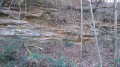
(5) After walking 700 m along the stream bed, just past a small tuff cliff 2 to 3 metres high (photo 13), take a wide (damaged) path on the right which climbs quite steeply. At the start of the path, you can see a fine vertical outcrop of tuff on the right (photo 14). The track, which is wide enough for a tractor, continues to climb. You ascend gently relative to the bottom of the valley on the left. A deep central rutted track makes progress a little difficult for a few tens of metres. Continue climbing along this same track for over 1 km.
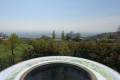
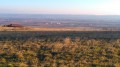
(6) At the end of the track, take the road (Chemin de la Feyta) on the left and follow it for about 1.4 km until you reach a junction by a building. Enjoy the unobstructed views of the Alps opposite, the valley and the Drôme hills to the south (photo 15), with the Pilat massif behind.
(7) Take the hairpin bend to the right and go round the building on your left. Pass No. 1065, then take the small grassy path to the right until you reach a small road (Chemin de Ravassieux), which you should follow all the way to the left.
(8) Follow it to the left and head downhill for just over 100 metres. At the bottom (before the road starts to climb again), take the wide path on the right. When the path joins a small, poorly tarmacked road (Chemin de Bresson), continue straight ahead. At the next two junctions (20 m and 100 m further on), veer slightly to the left to stay on the main road (Chemin des Aubergeons), which runs alongside (on the left) a beautiful stone wall belonging to a large estate, then a wall of pebbles. Continue downhill for several hundred metres.
(9) When the road (Chemin des Aubergeons) bends to the left, take the first road on the right (Stop sign) called Chemin des Chambonnières. Continue along this road until you reach the junction at the top (where several roads meet). Take the road directly opposite, called Montée du Bruchet. 200 metres further on, you’ll reach the first junction by the school.
(10) Turn left onto the road leading downhill (Chemin de l’Église). As you descend, you can admire Anjou Castle on your right (photos 16 and 17), as well as numerous properties. At the bottom of the road, you’ll find the small car park where you started (S/E).




 Visorando Member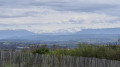

 Easy
Easy