Country:

 City:
City:



Park in the walkers’ car park at Pégairolles-de-l’Escalette.
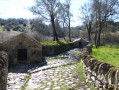
(S/E) From the car park, walk through the village heading north, ignore a path on your right, pass in front of the castle flanked by its four round towers and continue along the Grand Rue. You’ll soon leave the village behind.
(1) Just before the cemetery, turn left onto a wide path with a gate. Read the instructions and carry on. 300 metres further on, as you approach the houses, take the path that curves round to the right and climbs slightly.
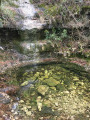
(2) After a kilometre, you’ll see a metal miller’s ladder leaning against a drop of about 2 metres. Leave it there (for now) and carry on straight ahead until you reach a large pool on the River Lergue.
(3) On your right, you’ll see the remains of an old path, which is impassable due to the water level (early May). Return to the ladder.
(2) Climb the ladder and continue to the left along the path, which runs close to the stream in places. Carry on to the hamlet of Le Bronc and its few houses. Running alongside the stone walls, turn right onto a path that climbs and joins a wide track which skirts round the properties.
From there, you will stay on this side of the valley. Continue along this path, which is marked with old red and/or blue markings. Depending on the season, you will have to cross springs or waterfalls coming in from your right.
You’ll see a channel running alongside the path, crossing a hollow via an intact aqueduct arch. Carry on in this way until the marked path veers off to your left.
(4). Carry on down a lovely descent. You’ll reach the edge of the torrent (there are some lovely photo opportunities here) and enter an area where the going is a bit trickier. Follow the path, keeping an eye out for the markings to guide you. You’ll come across some large steps (you may need to use your hands at times), an area with a rope in place to help you get through, then you’ll rejoin a path that runs close to the power line (old pylons lie on the ground) and you’ll emerge below the Pas de l’Escalette road.
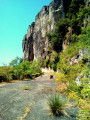
(5) Continue left along the disused road, crossing the Pas de l’Escalette, where the signs are still in place. It’s hard to imagine the traffic that used to pass through this narrow bottleneck until 1994.
You’ll reach the D155; follow it to the right for about 600 metres. It’s very quiet and serves the service entrances to the A75, which you’ll cross above the entrance to the Pas de l’Escalette tunnel.
(6) Take the wide path that heads downhill to the right towards the east and branches off 350 metres further on towards the south-east.
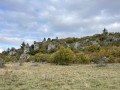
You will walk south-east across a wide plateau with a series of gentle ascents and descents, but the total elevation gain will be no more than 80 metres. You will come across the very old blue markings several times.
(7) After 2.3 km, pass a clearly marked path on your left heading north-east.
200 metres further on, turn right (west) towards a vast open area, cross a sort of gully (100 metres long, 0.5 metres wide and the same in height) and continue south-west along a path that winds its way through the undergrowth. Carry on – the route is quite clear – until you reach the next junction.
(8) Turn sharply right towards the west for about 100 metres, then head left towards the south-east. There are still markings (fairly faded paint).
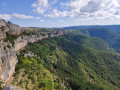
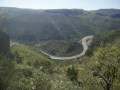
You’ll walk for about 3 km, with very little change in elevation on this plateau overlooking the Lergue Valley.
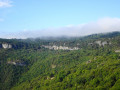
On several occasions, you’ll come close to the edge, but you mustn’t try to go down in this area. Enjoy the view.
The last kilometre (before the next junction) climbs slightly.
(9) At the junction, turn right onto a path which, after 100 metres, begins a steep descent. It’s actually easier than it looks on the map. You can’t go wrong.
At the bottom, just before the house, several signs prevent you from cutting across towards the bottom of the Ruisseau du Vignal (cutting across is dangerous and offers absolutely no benefit).
Join the road, pass under the A75 and continue along this road to the village (S/E).








 Visorando Member


 Difficult