Country:

 City:
City:


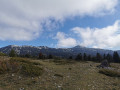
From Villard-de-Lans, follow the road to Col de Rousset. When you arrive at the small Col de Rousset station, park in one of the large car parks available.
(S/E) From the car park, walk through the middle of the resort heading south; you will see a forest road that continues straight towards the unnamed pass above the Col de Rousset resort. Stay in the valley, passing the few ski runs until you reach the pass, where there is a bench from which you can admire the view of the Diois.
(1) From this pass, look for the cairns and wooden posts on the left (red and white markings) that lead first to the mountain pasture and then into the forest. There is no trace of it on the IGN map, but the marked trail starts on a track that you passed to reach the pass, and you will rejoin the trail marked on the map further upstream.
After a few hundred metres in the forest, the trail emerges onto the ridge. Turn right to reach the summit of But Sapiau and its orientation table.
(2) From But Sapiau, follow the ridge of the Plateau de Beure: the path is wide and easy to walk on. At Pas de l'Échelette, the path leaves the ridge but remains on the plateau. A few hundred metres after passing under the Écondus ski lift, you will come to a crossroads.
(3) A sign points to the Cabane de Pré Peyret, so follow this direction. Enter a fairly sparse pine forest and then descend slightly to reach the Pas des Écondus.
(4) Continue on theGR®93, first heading north-east and then east. You will soon arrive at the Hauts Plateaux du Vercors Nature Reserve (signposted). From the sign, theGR® trail becomes less obvious. Stay at the bottom of the valley at first, then follow the large cairns that line the edge of the path, which is initially level and then descends slightly into the sparse forest. The gaps in the forest help with orientation. Behind a small hill, you will reach the Cabane de Pré Peyret.
(5) Continue along the path behind the Cabane de Pré Peyret, which continues eastwards until you reach a signpost.
(6) The sign does not indicate the next stage of the hike, it only gives directions forthe GR®. Leave theGR® and continue straight ahead on a path that climbs and then joins the left slope of a small valley. After about half an hour, you will come to the Plaine de la Queyrie with its pruned tree.
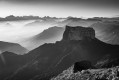
(7) Cross the plain generally to the left. When you reach the plateau overlooking the plain, turn right (off the trail) towards a hillock marked by a cairn. This is the Sommet de Montaveilla, which offers a panoramic view of the region: Grand Veymont, Mont Aiguille, Dévoluy, Hauts Plateaux.
(8) From this summit, descend to the left to reach the Pas des Bachassons (where there is a spring). Cross the pass from right to left to reach the ridge on the left overlooking the Pas des Bachassons.
(9) After Pas des Hollowed-out Tree Trunks, head towards the base of the south ridge of Grand Veymont, which rises up in front of you. There are a few paths on the plateau, but it is fairly easy to find your way as you can see the switchbacks climbing up the south face of the mountain. The switchbacks start above Pas des Chattons.
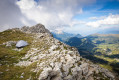
(10) The ascent of the south face is the steepest part of the hike. You will have an increasingly commanding view of the plateaus and Mont Aiguille in the distance. This area is also very popular with ibex. The trail is clearly visible. After the switchbacks, it follows the ridge across to the summit of Grand Veymont.
(11) Then descend the north ridge, first traversing, then winding down to Pas de la Ville. When descending, the passage above Pas de la Ville can be slippery in wet or snowy conditions.
(12) Do not descend to the right towards Gresse-en-Vercors, but instead head west towards the Cabane de la Chau, which can be seen on the plateau. After the scree, the trail reaches the pine forest again.
(13) Do not continue to the Cabane de la Chau: a signpost directs you to turn left and follow theGR®91. This is the most difficult part of the hike to navigate. There are relatively fewGR® markings, so you need to follow the cairns carefully. The forest is not very dense and you can occasionally see the imposing west face of the Grand Veymont, which you cross below.
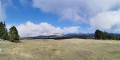
After a long crossing of the plateaus, you arrive at a plain with the Grande Cabane in the centre.
(14) TheGR® route has been modified to protect the environment around this hut. You must therefore follow theGR® which goes around the left side of this plain and then returns to the sparse forest. Continue to follow the cairns to the crossroads not far from the Cabane de Pré Peyret.
(6) Turn right.
(5) Keep to the right to follow the route you took on the way up in the opposite direction to reach the Col du Rousset car park (S/E).



 Visorando Member
 Moderate
 Easy
Easy