Country:

 City:
City:


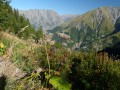
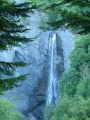
Head to the village of Le Périer on the Col d’Ornon road, either from La Mure via Valbonnais, or from the Col du Lautaret road just past Rochetaillée. At the bridge, turn right towards Confolens. The road is narrow but in fairly good condition. Stop at the car park, opposite a beautiful waterfall (illuminated in the evening).
(S/E) Take the path that climbs to the right at the start of the car park. Yellow markings indicate Rif Meyol 3h30... that’s a bit of an overestimate. It climbs relentlessly but fairly steadily, first along a path then along an (old) forest track.
(1) After passing a shelter, you eventually emerge from the forest. At the last clearings, you need to look out for two things:
- The small rocky ridge with a path running beneath it, which you can just make out on the right.
- Below the summit ridge, the rocky outcrop running parallel to the ridge but fading off to the left. You can make out a clear path that goes round this outcrop. This is the path you need to follow.
Shortly after leaving the forest, the path winds a few more times through the mountain pasture before fading away on a flat area near a spring.
(2). You can make out rather than actually see the path continuing up towards the Rif Meyol Hut. Do not follow this direction, but veer sharply left (north-northeast) to join the main track below the ridge.
Once past a wooded area, the path descends towards a flat area.
(3) Do not attempt to follow the stream you have just reached back up, but use the flat area to cross over and climb the grassy slopes on the opposite side. You will probably come across a grazing area for livestock (nettles and ‘spinach’ or ‘wild sorrel’). Continue climbing straight up towards the end of the ridge you spotted earlier. You will inevitably come across this track which will take you easily to the top.
Just follow it... You’ll reach the ridge without any trouble.
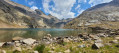
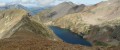
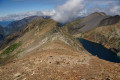
(4). There are still 140 m to go to reach the day’s highest point. The start looks daunting, but the path—which you simply follow, almost right along the ridge—is completely straightforward and never exposed. This gives you plenty of time to admire Lac Labarre and the rugged terrain, or even to look for the shells of belemnites, which are quite common on the grey rocks.
(5) You will soon reach the summit of the Tête des Chétives, a pleasant spot for a picnic with panoramic views. You can also see the descent route ahead of you (east). It heads straight north, but you may also spot switchbacks criss-crossing the steep slopes below the path. This is a shortcut down.
But you need to find the start of it. Then it’s a matter of descending the north-eastern ridge towards Lac Labarre. First along the ridge (with impressive gullies to your left), then veering right to reach Lac Labarre.
(6) From the lake, head back up the marked trail (a variant of theGR®54) towards the Col de la Romeïou.
(7) An exposed traverse awaits you. The path crosses relatively steep slopes that end in ravines and on rocky ridges. This can be daunting for those prone to vertigo. You will then reach a shoulder. Shortly after the last hairpin bend, you should find a path branching off in the opposite direction to your left. This is the famous shortcut glimpsed from the summit. I didn’t see it, but I wasn’t looking in the right place. And you need to approach it with caution given the slopes it traverses.
The main route (marked on the map) will take you across a cirque, then up a ridge at the Rocher de la Grande Église before plunging down to the bottom of another cirque cut through by a high-voltage power line.
(7) At the first junction (2020 m), leave theGR® as it climbs towards the Brèche du Périer to reach the Cabane de la Selle (source of the Tourot). Then follow the path to the left towards Confolens, which will allow you to admire, through the trees, the waterfall flowing into the valley that you cross via a footbridge 200 m further down. From there, simply follow the path to Confolens le Haut (a few restored houses) and a pretty footbridge over the Torrent du Tourot.
Back at the car park (S/E), be sure to stop at the wooden ‘balconies’ to admire the waterfall opposite.

 Visorando Member
 Moderate
 Association / Club / Walk leader
 Difficult
 Extremely difficult