Country:
 City:
City:


Starting point and access: Porte de Pantin.
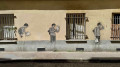
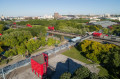
- Metro – Line 5. Take Exit 1 onto Avenue Jean Jaurès (note the mural on the exit staircase depicting a cellist spread across around twenty risers).
- Tram – Line T3b. Walk to Avenue Jean Jaurès and follow it to the metro station entrance.
- Bus – Lines 75 and 151.
The main animal depictions and key features to look out for are highlighted in italics within the description.
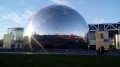
(S) On leaving the metro station, turn right and head towards the Fontaine aux Lions de Nubie (the former watering trough of the La Villette abattoirs). Then take the Galerie de la Villette towards the Cité des Sciences et de l’Industrie and walk alongside the Grande Halle on your right. At the end, climb the steps to take the footbridge spanning the Canal de l’Ourcq, which ends here.
(1) On the other side, carry on straight ahead and walk past a modern sculpture of a seahorse. At the corner of the Cité des Sciences et de l’Industrie (on the right-hand side), turn left and leave the Folie 3 on your right. Then cross the Canal Saint-Denis at the Pont de Flandre lock. On the other side, turn right and walk down a cobbled path overlooking the canal.
(2) At the bottom, take a sharp left, cross the Quai de Gironde and take Rue Dampierre. Then cross Rue Rouvet and pass under the bridge of the old Petite Ceinture railway line. You’ll come out onto Rue d’Argonne; follow it to the right. At the traffic lights, turn left onto Avenue de Flandre. Note the École nationale supérieure d’architecture de La Villette, the entrance to which features a large bronze statue of a woman holding a lamp. Continue straight ahead, passing Rue de Nantes on your left, then Rue de l’Ourcq.
(3) Take the next left onto Rue de Joinville, then the first right onto Rue Gresset (cobbled). At the end, turn left onto Rue de Crimée, then take the first left onto Rue Émélie. Pass under an archway; at the end, rejoin Rue de Joinville and follow it to the right. Carry straight on, cross Place de Joinville (with the Church of Saint-Jacques and Saint-Christophe on your right) then Quai de l’Oise to reach the banks of the Bassin de la Villette.
(4) Turn right and walk along the basin on your left. At the end of the quay (bridge on the left, Square Serge Reggiani on the right), cross Rue de Crimée and follow it to the right alongside a building. At the corner of the building, turn left onto Quai de la Seine. At the next corner, first turn left then right to follow Promenade Florence Arthaud, keeping as close to the basin as possible.
About halfway along the basin, take a footbridge to reach the opposite bank. Follow the Promenade Jean Vigo, keeping the basin on your right. At the end (a large mural by Kelly Miti & Sbuone, 2024, depicting a blue she-wolf suckling two children – Romulus and Remus?), take the footbridge spanning the Jaurès lock. Then turn left twice to cross the Place de la Bataille de Stalingrad, passing a circular building with columns on your right (the Rotonde de la Villette, a former tollgate, built by Claude Nicolas Ledoux in 1784).
(5) Back at the Jaurès lock, turn right to cross the Boulevard de la Villette in two stages and pass under the elevated metro line. Then turn left to cross Rue de La Fayette and follow it to the right. After about thirty metres, take a cobbled lane on the left and head downhill to reach the banks of the Canal Saint-Martin.
(6) Walk alongside the canal on your left, with graffiti-covered walls and then a fire station on your right. Keep as close to the canal as possible and pass under a small road bridge. Continue along the canal (in February 2024, roadworks meant you had to head back up Quai de Valmy). Further on, enter Square Eugène Varlin and walk alongside a lock. Leave the square, cross a street and pass the Pont Maria Casarès on your left. Continue straight on along the canal.
(7) At the start of a left-hand bend in the canal, turn right, cross Quai de Valmy and enter Jardin Villemin. Go round the central bandstand on the right. At the next junction, turn sharply right. At the Fork in the road shortly afterwards, veer left and you’ll soon come to a fountain featuring, from top to bottom, a child riding a fish, two-tailed tritons (the male form of mermaids), a tortoise and an unidentified animal’s head (a seal, a catfish?).
Then head slightly to the right. At the T-junction (drinking fountain), go right. At the next junction, turn left and then immediately right. Carry straight on to reach the garden exit, ignoring the paths on the left.
(8) Then turn left and cross Rue du Faubourg Saint-Martin in two stages. Note, on the corner, a mosaic bird (a dodo?) on the wall and a sun made up of small figures. Then walk alongside Gare de l’Est on your right. Look up to see several allegorical sculptures: the city of Verdun, with the Meuse and the Marne below, then the city of Strasbourg, with the Seine and the Rhine below. At the corner of the station, turn left, cross Rue du 8 Mai 1945 in two stages and follow Boulevard de Strasbourg. Cross Rue Saint-Laurent.
(9) At the traffic lights, cross Boulevard de Magenta and turn right into Rue de la Fidélité (a Mauritian grocery shop with two images of a dodo on the façade). At No. 18, the second-floor window grilles feature birds, and on the third and fourth floors, there are two niches with statues of Hermes and Aphrodite.
At the next junction, turn left into Rue du Faubourg Saint-Denis. Continue straight on and cross Rue des Petites Écuries on the right-hand side. About fifty metres further on, turn right into Cour des Petites Écuries. There are numerous mascarons on the façade of No. 7, including lion heads. Turn left as the street bends, then pass under a relatively long archway.
(10) You’ll emerge onto Rue d’Enghien; follow it to the left (there’s a mosaic depicting a snake just past No. 11). At the end, first turn right then left to cross Rue du Faubourg Saint-Denis and enter the Passage de l’Industrie (passing under two porticoes in succession). At the junction, turn right onto Boulevard de Strasbourg. At No. 21, there is a gate and façade decorated with children, plus two caryatids. At No. 23, there are children. At the next junction (lion heads on the corner of the façade), turn right into Rue de Metz.
At the next junction, rejoin Rue du Faubourg Saint-Denis and follow it to the left. At No. 16, an Art Nouveau building with lion heads high up. Continue to Porte Saint-Denis. On the left, on the corner of Boulevard Saint-Denis, a statue of Saint Anthony with a pig at his feet. Opposite, adorning the gate from top to bottom: a cavalry scene in high relief; a lion-headed mascaron; and recumbent lions. Walk round the gate and cross Boulevard Saint-Denis (on the left-hand side) or Boulevard de Bonne Nouvelle (on the right-hand side). On the other side of the gate, note the decorations of the same type as the previous ones (without the recumbent lions).
(11) Follow Rue Saint-Denis, cross Rue d’Aboukir on the right-hand side, then turn right into Rue Sainte-Foy. At the junction immediately ahead, continue straight on along Rue Sainte-Foy. At the end, walk past a small triangular square and enter the Passage du Caire.
As you exit the passage, turn round and note the Neo-Egyptian façade with bas-reliefs depicting horse-drawn chariots. The neighbourhood dates from Bonaparte’s return from the Egyptian campaign in 1798. With your back to this façade, turn left to cross Rue du Caire and enter Rue des Forges. Turn right twice along this street, then turn left into Rue du Nil.
(12) At the end, turn left onto Rue des Petits Carreaux. Cross Rue Réaumur (wooden dovecote on the left) and continue along Rue des Petits Carreaux (at No. 10, a sign for a coffee merchant dating back to times that are, thankfully, long gone). At the next junction, continue along Rue Montorgueil. At No. 86, there is a calf sculpture above the front of a cheese shop. Take the first left onto Rue Greneta (there’sa restaurant with a beautiful old façade on the corner). At the next junction, turn right and cross Place Goldoni (there’s a mural featuring birds on the right).
At the T-junction (witha mosaic depicting a snake on the left), turn right onto Rue Tiquetonne. Cross Rue Française on the left-hand side and note a large design of a bee on the façade of No. 33. At the next junction (above a butcher’s, a stained-glass fresco depicting a stag in the forest), rejoin Rue Montorgueil and follow it to the left. Cross Rue Étienne Marcel and continue straight ahead along Rue Montorgueil (a large snail and eight small ones on the sign at No. 40, with mascarons on either side of the street). At the end, turn right, walk past the chancel of Saint-Eustache Church and you’ll immediately find the “Les Halles” metro and RER station on your left (E).
To get back home:
- Metro – Lines 1, 4, 7, 11, 14.
- RER – Lines A, B, D.

 Visorando Member
 Moderate