Country:

 City:
City:


Access: from Geneva, take the A40 motorway, exit 16 (Bonneville), then the D1203. From Bonneville, continue towards Le Grand Bornand (D12 then D4). From Le Grand Bornand, climb up to Le Chinaillon, cross the village and continue to the Col de la Colombière, where you can park near the restaurant. You can also reach the pass via Le Reposoir (from Cluses).
(S/E) The path starts next to the Col de la Colombière restaurant (signposted Lac de Peyre).
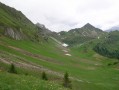
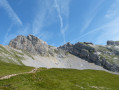
At the first bend, continue to the right; the climb is quite steep from the outset. Follow the track to the Colombière chalets, then turn left (signposted "Lac de Peyre"). The path becomes rockier and steeper. On your right is Pointe Dzérat (or Pointe Est du Midi). The trail runs along a scree slope at the foot of Pointe Dzérat. After a steep section, the rocky terrain gives way to grassy slopes. Leave the trail to the right towards the lake and continue straight ahead. The path is sometimes uneven, but if you are unsure, head for Pointe Blanche.
(1) At the basin-couloir with Pointe Blanche in your sights, turn left (south-west) as soon as possible, avoiding the scree if possible to reach a grassy ridge. You will soon see Lac de Peyre below, nestled in a small basin (altitude 2,080 m). there are several small bodies of water, the lake being the largest.
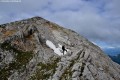
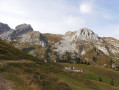
Once on the ridge, climb up and scale a few easy rocky steps to reach a scree slope at the foot of Pointe Blanche. You will see cables on the left (ropes with knots), with a vertical cavity higher up on the right; the Pellier Passage begins here, with a sloping chimney that you climb up.
You will quickly pass a cavity with a cross (erected in memory of the first ascent of this passage in 1877 by Alexis Pellier). A little higher up, the chimney widens and the slope becomes less steep. After a very steep wall with good holds, which pulls slightly to the right, you will reach the southern ridge (cairn).
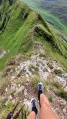
(2) Then head south (magnificent gendarme on the right) to make an ascending traverse of a beautiful stony and rocky slope. Instead of heading directly towards Pointe Blanche, climb up to your right as soon as possible to reach the top of the ridges, so that you can enjoy the landscape more quickly: don't get too close to the edge, it's a sheer drop!
Superb view of Balafrasse, Pointe du Midi, Tour du Bargy, Grand Bargy, Pointe Dzérat, the Aravis with Pointe Percée in the foreground, Mont Blanc...
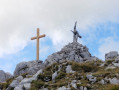
Then follow the ridges towards Pointe Blanche, scrambling as best you can; after a small rocky depression, one last climb and you will reach the summit of Pointe Blanche with its two crosses, at 2,438 metres.
(3) Splendid panorama with the aforementioned peaks and massifs, the Chablais (Môle), the Salève, Lake Geneva, the Jura, the Pointe d'Andey, Rochers de Leschaux, and all the others, including, of course, the Pic de Jallouvre.
For the descent, follow the ridge on the Col de Cenise side; shortly before the grassy plateau, descend steeply, approaching the foot of the Pointe Blanche cliffs, which you follow for a short distance before heading horizontally down the slope towards the Col du Rasoir. The path is not always obvious and the stony ground is very unstable, so watch your step.
Follow a fairly indistinct path that winds its way down a steep scree slope until you reach a small passage where a few steps of downclimbing are unavoidable. During this part of the descent, try to avoid rolling stones as much as possible, out of consideration for walkers who may be below you and whom you will soon be joining!
(4) At Col du Rasoir, take the path that descends to the left on the south side. Stay on the left, on the Pointe Blanche side, before descending steeply towards the centre of the huge scree slope. There are cairns at regular intervals, which are a great help in finding your way to the bottom of the Combe du Rasoir scree slope, where you will find a more clearly marked path.
You will soon see the return of the Via Ferrata on the right, before reaching the grassy slopes and a path that winds downhill and eventually turns left to return to the Col de la Colombière (S/E).


 Visorando Member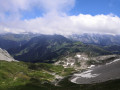
 Moderate
 Difficult
 Extremely difficult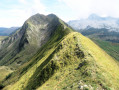
 Association / Club / Walk leader