Country:

 City:
City:


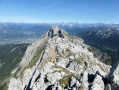
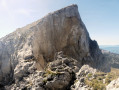
Please note: following a rockslide in mid-October 2025, the path leading to the summit of Pointe du Midi (between points (6) and (7)) has been partially washed away. According to a comment seen on the Camptocamp website, access is possible via the left-hand side, but this route is more difficult: click here to read it.
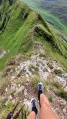
I walked the route on 6 September 2026 and found that the path had been washed away for about twenty metres after the access point to the ridge. The alternative route follows a narrow, fairly exposed ledge, where there is no room for error (though the handholds on the rocks are fairly secure); it is marked with cairns. However, as this seemed too risky to me, I preferred to alter the route, stopping at the secondary summit, which already offers a beautiful view. For those who aren’t afraid of a bit of a challenge and wish to reach the summit, I suggest viewing the estimated route of the alternative route by clicking here ( I cannot guarantee its accuracy).
The walk starts from the Col de la Colombière (please note that parking can be a bit of a headache on busy days).
(S/E) Take the path towards the Grotte de Montarquis and Lac de Peyre.
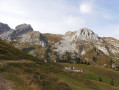
(1) At the Chalet de la Colombière, carry on to the right towards the Grotte de Montarquis (the path on the left is the one you’ll take on the way back). After a few short ascents and descents along a route that’s a bit uneven in places, you’ll reach the ruins of Montarquis (an alpine chalet destroyed in 1962 by an avalanche).
(2) The slope then becomes noticeably steeper, and you arrive right in the middle of the Montarquis valley; you then turn right, following the foot of the cliff (be aware of the risk of rockfalls, which is not negligible).
(3) After passing by a small cave, you come to asecond cave, corresponding to the Montarquis cave, with a relatively wide entrance: I’d encourage you to take a few steps inside.
Continue along the path (unmarked from this point) towards the pass (unnamed, but clearly visible). Once you reach the ridge, head almost straight on towards a small summit (another unnamed spot).
(4) From here, you can enjoy the view: nearby, the Pointe Dzérat and the Pointe du Midi; to the north-east, the Tour du Bargy; and to the south-east, towards the Pointe d’Almet and the Aravis Range. We retrace our steps back to the pass, where we spot a well-marked path on the left, leading downwards, and reach the bottom of the Combe Sauvage.
(5) Carry on straight ahead, heading uphill, along a barely visible track through predominantly grassy terrain. A little further up, the path suddenly turns left, winding its way up a moderate slope; then, not far on, turn right towards a clearly visible gully on a steep slope. At first, you skirt a scree slope on your right; as you proceed, the terrain becomes increasingly rocky.
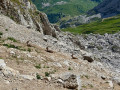
You reach the Cu Déri couloir; extreme caution is required due to a real risk of rockfall in this area; whilst it is certainly possible that the rocks may be dislodged by ibex or by unstable ground, I would advise you, to begin with, to avoid dislodging any rocks beneath your feet as far as possible (and, when in a group, it is best to walk close together rather than spread out). To make the ascent up this fairly steep slope easier, I recommend taking the left-hand side of the couloir, which is less slippery and offers more stable footholds (at times it is even better to take one or two climbing steps along the edge). Watch out for a chasm at the top of the couloir (which can be avoided by keeping to the left).
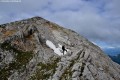
(6) You reach the pass (Porte d’Enfer): head right, uphill, towards the ridge line. The path comes to an abrupt end following the collapse of the cliff in mid-October 2025. Continue to the right towards the secondary summit.
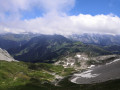
(7) From the summit, you can see the peak and its cross. Depending on visibility at the time, there are stunning 360-degree views: nearby, the Bargy Range; a little further away, the Aravis Range; Mont Blanc to the east; and La Tournette and Lake Geneva further to the west. Take care around the nearby cliffs , which drop sheer.
Join the path below, without going back over the ridge (the easier route), then return to the Porte d’Enfer.
(6) Head right into the gully, following the descent, then, at the bottom, turn right uphill, heading for the foot of the cliff (watch out for the potential risk of falling rocks), then the ridge line. In rocky terrain, follow the cliff along a route that is only moderately visible at times.
Once you reach the ridge, follow it to the left, staying more or less close to it, along a clearly visible path, all within an exposed landscape, mainly on the Cenise slope to the west.
(8) The Pointe de Balafrasse, which is moderately marked, comes into view. To reach it, turn right towards the nearby ridge line.
Carry on along the path and, not far on, you’ll rejoin the path leading to the Col de Balafrasse. From there, continue to the left on a gentle descent, heading towards the lake
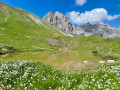
(9) You reach Lac de Perye, a lovely spot for a short break. You then head due east and take a path leading downhill. The route follows one of the many tracks, with slopes of varying steepness. After a short while, you reach the Chalet de la Colombière, which you passed on the way out.
(1) We continue to the right to return to the Col de la Colombière (S/E).


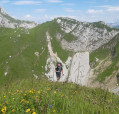

 The Cu Déri sector (5) - (6) is indeed very complicated and requires a clear head. I would advise against doing it in the opposite direction. For our part, after starting on all fours, we walked along the right-hand side of the rock face for a short while before returning to the centre towards the end. On the first section, we had a few scares due to rocks slipping under our feet, so we made sure that one of us climbed while the other stayed in a safe place, and so on.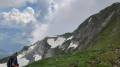
 Visorando Member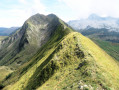
 Very difficult
 Moderate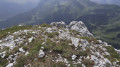
 Difficult