


Refine your search for walks in La Neuville-en-Hez
La Neuville-en-Hez walks


 In the Hez Forest
 Visorando Member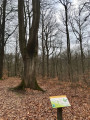
 7.76 mi
 +643 ft
 -636 ft
 4h 10
4h 10
 Moderate
 Departure from La Neuville-en-Hez (Oise)
The Hez-Froidmont forest was created in 1869 by combining the Hez (1,413 ha) and Froidmont (259 ha) state forests with the Saint-Lucien, Saint-Thibault and La Verrière reserves, which were originally owned by the church. Covering a single area of 2,796 hectares (with the exception of the Belle Fille valley, which is 100 metres away from the forest and represents a small 10-hectare canton), it stretches 9 kilometres from east to west and 6 kilometres from north to south.
Mont César and the Bresles Marshes
 7.47 mi
+361 ft
-344 ft
3h 45
Moderate
Departure from Hermes (Oise)
7.47 mi
+361 ft
-344 ft
3h 45
Moderate
Departure from Hermes (Oise)
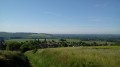
Discover two contrasting natural environments: the dry limestone grasslands covering the hill of Mont César and the marshes below. A varied route through the forest, poplar groves and fields.
Route de la vallée de Monnet à Ansacq
 7.59 mi
+312 ft
-295 ft
3h 45
Moderate
Departure from Ansacq (Oise)
7.59 mi
+312 ft
-295 ft
3h 45
Moderate
Departure from Ansacq (Oise)
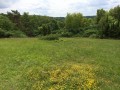
Ansacq is a village located at the beginning of a small, narrow, green valley cutting into the southern edge of the Clermont massif, gradually widening to open out onto Angy, in the Thérain valley, a small, narrow, green valley.
Merlemont Castle and Saint-Arnoult Abbey
5.87 mi
+486 ft
-499 ft
3h 05
 Easy
Departure from Warluis (Oise)
Easy
Departure from Warluis (Oise)
Hike in the Merlemont Woods, with lots of woods and little road traffic.
From Cires-lès-Mello to Chantilly via Saint-Leu d'Esserent
 12.36 mi
+459 ft
-390 ft
6h 05
12.36 mi
+459 ft
-390 ft
6h 05
 Difficult
Departure from Cires-lès-Mello (Oise)
Difficult
Departure from Cires-lès-Mello (Oise)
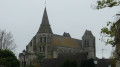
Tenth stage of the Grand Tour of Île-de-France via the GR®11, connecting the Cires-lès-Mello railway station to the Chantilly-Gouvieux railway station, around the River Oise and two of its tributaries, the Thérain and the Nonette. The built heritage here is remarkable, between the abbey church of Saint-Leu d'Esserent and, of course, the town and estate of Chantilly.
Around Saint-Vaast-lès-Mello
11.54 mi
+509 ft
-515 ft
5h 45
Moderate
Departure from Saint-Vaast-lès-Mello (Oise)
A beautiful hike with wooded areas, plains, quarries where stones were extracted for the construction of Notre-Dame de Paris, many ponds, two wash houses, two chapels, the church of Saint-Vaast, the Rivière le Théroin (a tributary of the Oise), and the Flandre stream.
Wash houses, ponds, Fauna and Flora trail in Saint-Vaast-lès-Mello
 5.40 mi
+197 ft
-226 ft
2h 40
Easy
Departure from Saint-Vaast-lès-Mello (Oise)
5.40 mi
+197 ft
-226 ft
2h 40
Easy
Departure from Saint-Vaast-lès-Mello (Oise)
Visit Saint-Vaast-lès-Mello on a lovely walk and discover its wash houses, beautiful views of the quarries and ponds along the scenic Fauna and Flora Trail. The route also passes through the peaceful hamlet of Barisseuse.
Across the fields between Le Tillet and Foulangues
 4.75 mi
+105 ft
-105 ft
2h 15
Easy
Departure from Cires-lès-Mello (Oise)
4.75 mi
+105 ft
-105 ft
2h 15
Easy
Departure from Cires-lès-Mello (Oise)
An easy hike through fields, allowing you to discover the pretty village of Foulangues with its stone houses, small church and the Pavillon du Tillet, a half-timbered house.
Medieval walk in Beauvais
 3.45 mi
+30 ft
-30 ft
1h 35
Easy
Departure from Beauvais (Oise)
3.45 mi
+30 ft
-30 ft
1h 35
Easy
Departure from Beauvais (Oise)
Beauvais has a rich history, with many reminders of the past in the heart of the city, which this urban route invites you to discover. You will appreciate the many half-timbered houses, cobbled streets, the Romanesque Church of Saint-Étienne and, as a highlight, the Gothic Cathedral of Saint-Pierre, which rises skywards in a single sweep.
Via the Bois des Moines to Campremy
 7.49 mi
+223 ft
-236 ft
3h 40
Moderate
Departure from Campremy (Oise)
7.49 mi
+223 ft
-236 ft
3h 40
Moderate
Departure from Campremy (Oise)
Circular route from Campremy to Grand-Mesnil via Farivillers.
Around Montagne du Roc
 6.36 mi
+479 ft
-463 ft
3h 20
Moderate
Departure from Brenouille (Oise)
6.36 mi
+479 ft
-463 ft
3h 20
Moderate
Departure from Brenouille (Oise)
Hike through beautiful rolling countryside, quiet villages and the banks of the Oise.
Beauregard Circuit via the Bois de Viville.
4.06 mi
+272 ft
-256 ft
2h 05
Easy
Departure from Dieudonné (Oise)
A peaceful and pleasant walk through a charming valley and well-maintained woodland.
From Anserville to Fosseuse and back
 7.88 mi
+384 ft
-387 ft
3h 55
Moderate
Departure from Anserville (Oise)
7.88 mi
+384 ft
-387 ft
3h 55
Moderate
Departure from Anserville (Oise)
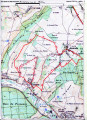
This is a beautiful walk at the entrance to the Oise, in the valleys between Anserville and Fosseuse. The walk takes you through fields and woods. The region is surprising in this area, with its gently sloping hills and succession of small woods and fields. It offers a variety of very pleasant views.
From the banks of the Oise to Bois Saint-Michel
 12.13 mi
+840 ft
-810 ft
6h 20
Difficult
Departure from Précy-sur-Oise (Oise)
12.13 mi
+840 ft
-810 ft
6h 20
Difficult
Departure from Précy-sur-Oise (Oise)
Most of the hike takes place on flat ground and in woodland, with a long stretch along the edge of lakes. It offers beautiful views of the Picardy countryside and the Oise valley. Passing through Précy-sur-Oise, Blaincourt-lès-Précy, Saint-Leu-d'Esserent and Villers-sous-Saint-Leu, you can discover some of the region's heritage gems.
Via Anserville from Fosseuse
4.58 mi
+230 ft
-230 ft
2h 20
Easy
Departure from Fosseuse (Oise)
An easy walk with surprising landscapes. Despite its proximity to Bornel, you will find yourself in beautiful woodlands, fields and hills. Here you will find peace and quiet and birdsong. There is a small section of tarmac that is difficult to avoid, but most of the route is on quiet, green paths.
On Mont Alta
 AONB
AONB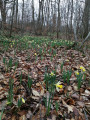 4.08 mi
+164 ft
-177 ft
2h 00
Easy
Departure from Aumont-en-Halatte (Oise)
4.08 mi
+164 ft
-177 ft
2h 00
Easy
Departure from Aumont-en-Halatte (Oise)
Discover the armoured boundary stones along the forest trails...
Route between Aumont-en-Halatte and Senlis
9.58 mi
+384 ft
-407 ft
4h 45
Moderate
Departure from Aumont-en-Halatte (Oise)
Former capital of the Sylvanectes Gauls, Senlis was known as Augustomagus in the 1st century, during the reign of the Roman Emperor Claudius.
From the 3rd century onwards, thanks to its walls, the Gallo-Roman enclosure of Senlis was one of the best-preserved in northern Gaul. The date of construction has still not been determined. What remains certain, as was already established in the 19th century, is that the fortifications were built after the passage of the Germanic hordes in 275–276, and after the year 278, withstanding the barbarian invasions and later the Norman raids.
Senlis boasts a history spanning ten centuries of virtually uninterrupted royal presence. The town was the site of a Merovingian and later Carolingian castle or palace from the early Middle Ages onwards; although it has completely disappeared and there is no definitive archaeological evidence, it is mentioned in numerous ancient deeds and documents.
The western part of the Halatte State Forest
 10.15 mi
+358 ft
-331 ft
5h 00
Moderate
Departure from Aumont-en-Halatte (Oise)
10.15 mi
+358 ft
-331 ft
5h 00
Moderate
Departure from Aumont-en-Halatte (Oise)
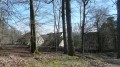
This hike allows you to discover the biodiversity of the western part of the Halatte National Forest, including the different species of coniferous and deciduous trees that make it up. The route winds through a hilly massif that offers some beautiful views.
Loop from Aumont-en-Halatte
9.62 mi
+371 ft
-367 ft
4h 45
Moderate
Departure from Aumont-en-Halatte (Oise)
A fairly easy hike from Aumont-en-Halatte with a slight elevation gain, in the Halatte National Forest, skirting the village of Fleurines. Two beautiful viewpoints along the route, best enjoyed in summer when the weather is warm.