Country:
 City:
City:


Start: Hachenburg railway station
(S) At Hachenburg railway station, we turn left, following the ‘K’ sign, and walk up Bahnhofstraße to Neumarkt. Here we turn left and continue on to Wilhelmstraße.
(1) Our route takes us to the Alter Markt, which is picturesquely framed by magnificently restored half-timbered houses from the 17th and 18th centuries. This is also where Germany’s oldest stone inn, the Hotel Zur Krone, is situated.
The inn was built in 1439, renovated in the late Renaissance style in 1531 and fitted with a stone bay window. The current gable dates from 1585 and is adorned with a Moor’s head. The building also housed the seat of the tax court, which was located in the bay-windowed room on the first floor. Next to the Hotel Zur Krone, visitors can explore the Catholic Church of the Assumption of Mary, originally a Franciscan church, which was built between 1734 and 1738, extended between 1907 and 1909, and fitted with a tower. In 1738, the Archbishop of Prague, Count von Manderscheid-Blankenheim, donated the wooden high altar. Beneath the church lies a monks’ crypt containing 19 gravestones dating from 1754 to 1811.
A little further on lies the Protestant castle church, which is connected to the castle by an arched passageway. The tower and chancel date from the 15th century, whilst the nave was built in 1775.
In the centre of the market square, a gilded, double-tailed lion sits enthroned atop the fountain, symbolising the alliance between the House of Sayn and the House of Wittgenstein.
We continue our walk along Friedrichstraße, past old half-timbered houses.
(2) Then, at the end of the street, we reach the castle.
The first castle was built between 1180 and 1212. The castle was also partially destroyed in the devastating town fire of 13 October 1654; in its place, Count Georg Ludwig and his son Wilhelm Ludwig had a new castle built between 1716 and 1746. The Baroque palace, comprising five wings, is arranged in a horseshoe shape around the inner courtyard and the extensive castle gardens beyond. The oldest parts date back to the 16th century. The palace is not open to the public.
We cross the junction of Alexanderring and Leipziger Straße and now walk through the castle gardens.
(3) Here we pass the stone coffin grave from Oberzeuzheim, which has been placed on display. Shortly afterwards, we reach the street Am Burggarten and the Westerwald Landscape Museum.
The main building of the Westerwald Regional Museum is the former Baroque hunting lodge of the Counts of Sayn-Hachenburg. It houses the museum’s geological, mineralogical and prehistoric collections. The remaining buildings are laid out in the style of an open-air museum. Among other things, visitors can explore a barn, a bakery, an oil mill and a village school.
(4) We then cross Leipziger Straße and, after a short stretch along Dehlinger Weg, reach Adolphweg. At the end of this, we take a flight of steps to a roundabout, cross the L288 there, turn onto Alte Frankfurter Straße, pass the Hormann country inn, then the hospital, and leave the town behind us. Looking back, we catch another glimpse of the castle towering above the town.
(5) We then enter the woods and, a short while later, walk past the Helenenruh refuge.
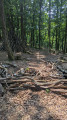
We walk through the woodland.
(6) Then we see the village of Gehlert on our right; we turn left and walk along the edge of the woodland. Shortly afterwards, we turn right and head towards the Hachenburg wind turbine. Just before the wind turbine, we turn left and make our way through the extensive Hachenburg municipal woodland until we reach the L288.
(7) We cross the road. From here on, we walk through the Alpenroder Forest. Eventually, we reach a crossroads and spot a barbecue hut on the left in the woods. Our route continues straight ahead and then turns right at the next junction.
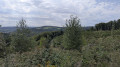
(8) After a long stretch of walking, we leave the forest just before Dehlingen. A lovely view opens up over the villages in the Nister Valley and the Stöffel, a basalt cone – formerly 492 metres high – situated between the Enspeler Bach and the River Nister (see Stage 11).
We then turn left, head downhill towards Dehlingen, but soon veer left again, re-enter the woods and continue downhill. After a right-hand bend and a left-hand bend, we come upon the outskirts of Dehlingen on our right.
(9) We, however, turn left and continue through the Hirzbach valley. In this area to the left of the Hirzbach, copper, lead and iron ore were mined at the Urwald mine between 1869 and 1900. The area has since been reforested.
(10) Eventually, we come to a railway bridge spanning the Hirzbach. We walk under the bridge, approach a tarmac road, turn right just before it and continue along the railway line on a forest path. The path leaves the forest, turns left, crosses the L281 and the River Nister.
We now approach Korb along a small tarmac road. The first houses of Korb come into view ahead of us. To our right, the Wäschbach stream runs alongside us; until 1818, it formed the boundary between the counties of Sayn-Hachenburg and Nassau-Oranien. After a short distance, the Kölner Weg approaches a fork and turns left uphill. If we now continue straight on, we reach Unnau-Korb station after about 500 metres. (E)
 Association / Club / Walk leader
 Visorando Member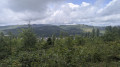
 Easy
Easy