


 Country:
 City:
City:


Start: Intersection of Bismarckstraße and Langenbacher Straße
The name Mons sanctae Mariae (Mount of St. Mary) first appeared in 1258. Until the 18th century, Marienberg, which was laid out in a ring around today's Protestant church, consisted of Obermarienberg and Untermarienberg in the valley. In 1815, Marienberg passed to the Duchy of Nassau. in 1866, Prussia annexed the Nassau territories because they had supported Austria in the German War. As a result of the basalt industry and its recognition as a climatic health resort in 1936, Marienberg experienced a considerable economic upswing. Since 1967, Marienberg has been allowed to call itself a "spa town".
(S) We start this stage at the intersection of Bismarckstraße and Langenbacher Straße in the centre of the village and continue along Wilhelmstraße to the tourist information office, a beautiful half-timbered house. On the first floor, you can visit the Bad Marienberg local history museum. Documents and exhibits on the history of the High Westerwald are on display.
(1) Büchtingstraße branches off to the left from Wilhelmstraße, named after Robert Büchting, who was district administrator (1896-1906) of the Oberwesterwald district and one of the initiators of the Cologne Way. The Europa-Haus is also located here.
(2) Continuing uphill, we come to the Protestant church.
Around 1100, St. Mary's Church was built here on what was probably a pre-Christian place of worship. The original church burned down in 1813 after being struck by lightning. All that remains is a late Romanesque baptismal font. Between 1819 and 1821, the current late-classical building was erected, a simple hall structure. The unfinished tower was given its lantern roof in 1900.
The K then leads past some beautiful half-timbered houses, out of the village and to the Marienquelle spring.
(3) From there, the trail winds down to Nassauische Straße. A little later, we cross the Schwarze Nister. Then we turn right and continue on forest paths to Langenbach.
(4) We walk a short distance on the K56 past a factory and hike across a car park towards the Nister.
(5) We cross the river via a footbridge, walk through a wooded area and then along a meadow path to a crossroads. The Kölner Weg turns left here. On a gently ascending grassy path, we reach the Kölner Weg and cross the K70.
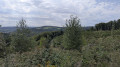
(6) We then continue our hike below the 471-metre-high Kackenberger Stein. The trail initially runs along the edge of the forest and offers more views of Bad Marienberg.
(7) But then, at a fork, it unexpectedly turns left into the forest and climbs uphill.
(8) Finally, we reach Dreisbach, turn right at a chapel onto the K65 and walk through the village on Kapellenstraße, Brunnenstraße and finally Nistertalstraße (K64), which leads towards Büdingen.
(9) Behind a cemetery, we leave the K64 and turn left into the forest. The path is gravel at first, but then we enter a tall forest. Basalt was also quarried in this area in the past.
(10) Attentive observers should not miss the entrance to the former basalt quarry, which branches off to the left of the path and leads to a small lake.
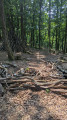
We walk straight ahead for a long time in the deciduous forest. Finally, the path turns to the left.
(11) However, the K sign directs us straight ahead on a path. It then winds its way through a spruce forest and meets a tarred road, which we turn left onto, before turning right again a little later.
(12) The K now leads over the Götzenberg (501 metres), which offers us a beautiful view into the distance.
(13) We pass the first houses of Stockum-Püschen on the left and walk across a meadow towards the Götzenberghalle, which we follow until we come to two iron sculptures in front of the hall. We then continue to the Stöffel basalt massif (505 metres).
The high-quality basalt deposits at Stöffel were mined from 1900 onwards. Mining has now been completely abandoned. The entire area has been turned into a tertiary and industrial adventure park, the Stöffel Park. From a viewing tower on the hiking trail, you can enjoy an excellent view of the enormous basalt quarry. The basalt massif became famous due to the discovery of a group of fossilised extinct European rodents, which were named after the place where they were found, the Stöffel or Enspel mouse. They lived 25 million years ago. These were mouse-like animals capable of gliding, with thin membranes stretching from their front to rear limbs.
(14) From the observation tower, we walk to the road from Stockum-Püschen to Enspel, cross it and walk downhill through the forest on the outskirts of the village to a playground.
(15) There, the path turns left across the playground into the village. We walk to the K71, where we turn right.
(16) This takes us to Rotenhain railway station. Shortly after the level crossing, we leave the K71 and continue right along a meadow path, keeping to the edge of the village of Rotenhain, and see the parish church of St. Martinus in the distance.
First mentioned in 1289, the church has a large nave dating from 1743, which was extended in 1938/39. The basalt stones of the plastered tower come from the former "Alte Burg" (old castle) nearby. Since the 1980s, the rounded front wall of the church interior has been decorated with a mosaic of over 50,000 stones with religious motifs, which is unique in the Westerwald.
Finally, we walk a short distance along the K61 on the outskirts of the village, then turn right into Im Ahlengarten and arrive at a car park and the Burgschänke.
(17) From the car park, it is worth making a short detour to the left to the "Alte Burg" (old castle ), the remains of which were found in 1997 during earthworks. Excavations to date confirm that the castle dates from the first half of the 13th century. Only the foundation walls, the well and the moat remain. To preserve the remains of the castle, the walls have been filled in again and their course has been recreated with a concrete wall.
We return to the car park and the Kölner Weg and walk a short distance along the Strafße to Lochum, then turn left into a large wooded area. The path leads us to a crossroads, which we follow to the left.
(18) After a long walk, we finally reach the Vierherrenstein
Where areas such as districts, bailiwicks and counties once collided, representatives of the individual territories met at the border to express their neighbourly friendship over a snack at a table. This meant that they mutually recognised the boundaries as agreed. If one party did not agree, they parted ways without a snack. At this point, where we now stand, the territories of Rotenhain, Lochum, Wölferdingen and Linden bordered each other, as recorded on the boundary stone.
We continue to the right, then left at the next intersection through a beautiful forest until we approach Dreifelden on a sloping road. The 123-hectare Dreifelder Weiher pond shimmers brightly across the way. No matter which direction you approach Dreifelden from, the unmistakable white tower of the Protestant Trinity Church dominates the landscape. It is probably the oldest preserved stone church in the Westerwald.
The first church was built around the year 1000. The four-storey Romanesque tower with apse probably dates from around 1200. The existing church hall was extended to form a three-aisled nave. During the Baroque period, the interior of the church was altered. The church ceiling is modelled on the Romanesque style, and the pulpit dates from 1699. A very sensitive extension was carried out between 1956 and 1959. Until the Reformation, it was a pilgrimage church. The village of Dreifelden itself was first mentioned in documents in 1319.
The hiking trail descends towards Dreifelden.
(19) Via Birkenweg, we reach Wiedbachstraße and cross the young Wied river (E).
Seven ponds belong to the Westerwald Lake District. At Dreifelden, we come across the Dreifelder Weiher, also known as Seeweiher, the Hoffmannsweiher and the Haidenweiher, and at Freilingen and Steinen, the Brinkenweiher, Postweiher and Hausweiher. The Wölferlinger Weiher is located off the beaten track near Wölferlingen. The Dreifelder Weiher, which is fed by the Wied, is about 2 kilometres long and up to 800 metres wide.
The name "pond" is misleading. They are actually man-made lakes. As early as the 12th century, monks from neighbouring monasteries intensively farmed fish and created ponds, including the Dreifelder Weiher. Count Friedrich III zu Wied (1618-1698) had the existing ponds enlarged and additional ones created from 1650 onwards. This required the purchase of large areas of land in the valley of the Wiedbach stream. In 1655, extensive construction work began on the dam at the Dreifelder Weiher. To this day, the ponds are fished out every autumn, which means that the water is drained, the fish are flushed through the sluices in the dams and collected in the fish ponds behind them. The drained ponds are then ploughed, fertilised and prepared for stocking the following year.
 Association / Club / Walk leader
 Visorando Member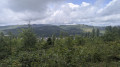
 Easy
Easy 

