Country:
 City:
City:


Start: Heimbronn, Wilhelmstraße
(S) In Heimborn, we continue our hike by descending to the Nister.
(1) At a shelter, we turn left, find ourselves back on the Cologne Trail and shortly afterwards cross the Kleine Nister via a footbridge. A few metres away, the Kleine Nister flows into the Nister on the right. Our path now approaches the Nister flowing on the right again, runs through the forest and along the river until the first houses of Heuzert appear on the opposite side of the valley.
(2) Later, we pass an old stone bridge on the right side of the path. After another 300 metres or so, we leave the Nisterweg, turn left and climb steadily uphill until we finally reach a cross path.
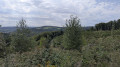
(3) There we turn right. A few metres further on, an inconspicuous sign points to a viewpoint, tempting us to make a short detour. We therefore leave the Kölner Weg and scramble up a stony path on the right-hand side of the slope until we find a bench on a tiny peak. Here, a wide view of the landscape opens up.
Back on the Kölner Weg, we continue through the forest to the Hartenberg. On this section of the trail, numerous unusually large anthills line the spruce forest.
(4) We continue our hike along a wooded ridge, cross the K19 and then follow the K20 for a short distance towards Limbach. After a few hundred metres, we turn right onto a forest path.
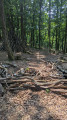
(5) This leads us to another viewpoint, the Hohe Ley, a bizarre slate formation from the Devonian period. We follow a path strewn with roots on the slope, which later turns into a grassy path. Ahead of us, beyond the valley formed by the Kleine Nister, numerous wind turbines appear. The Kölner Weg then leads across a slightly hilly open space with a magnificent view.
(6) A little later, it plunges back into the forest and leads to the historic slate mine Schieferkaul, which is located almost directly on the Cologne Trail and can be visited.
The former Schieferkaul roofing slate mine was the largest in the Kroppacher Schweiz. It belonged to the Marienstatt monastery and was first mentioned in a document in 1548, when it was leased to the Asterter Leyendecker (roofers). When the monastery was dissolved in 1803, the Schieferkaul mine was closed. Roofing slate is a sedimentary rock from the Devonian period 350 million years ago. It consists mainly of clay and silica. The slate from this quarry contained few easily soluble and weathering components. This meant that it was able to fulfil its protective function on the monastery roofs for up to 100 years.
We then continue on the Kölner Weg, a path winding down into the Nister valley.
(7) Later, the trail turns right again along the Nister. Shortly before Marienstatt Monastery, we come to a forest nature trail and pass a hydroelectric power station belonging to the monastery.
(8) Then the Marienstatt monastery appears on the left behind the trees.
The monastery's foundation is based on a legend. The abbot of the Cistercian monastery in Kirburg had a vision of the Virgin Mary, who recommended that he move the monastery to the spot where he would find a flowering thorn bush in the Nister valley in winter. The foundation stone of the new monastery was laid in 1222. The construction of the abbey church lasted from 1227 to 1425. In terms of art history, the church can be classified as early Gothic. All the essential elements are present: pointed arches, buttresses and ribbed vaults. And yet the harmonious church is a transition between Romanesque and Gothic. The walls lack the lightness of later Gothic churches. However, it is also the first Gothic church on the right bank of the Rhine in Germany. Behind the Romanesque altar table, the interior of the church houses one of the most valuable monuments of Rhenish sculpture, the Ursula shrine, which probably dates from 1350.
The monastery was under the authority of the archbishops of Cologne. In the Middle Ages, it was one of the most famous places of pilgrimage. Marienstatt was secularised in 1803. In 1888, Bishop Klein of Limburg and Abbot Kalkum of Wettingen succeeded in buying back all the monastery buildings and returning them to the Cistercian Order. In the same year, Pope Leo XIII elevated the monastery to an abbey.
The Marienstatt brewery is located on the monastery grounds. Shortly afterwards, we pass a small chapel on the left, which was built in 1935/36.
(9) A few steps further on, we leave Marienstatt Monastery via an old stone arch bridge that spans the Nister. The bridge still has a medieval core. On the other side of the river, we turn left, walk along a car park and pass under the K21 road. Soon after, we pass the former monastery fish ponds. The fish ponds, which have long since silted up, can still be recognised by the remains of the dams. We continue walking through the forest along the Nister on the left.
(10) Then we reach the Nistermühle mill.
The mill was first mentioned in 1324. The current buildings date from 1913. The mill ceased operation in the 1950s. In 1944, Konrad Adenauer hid here briefly from the secret police, but was discovered and arrested. You can enter the courtyard and see a commemorative plaque.
We then walk uphill, cross the B414 over a bridge, turn left on the other side and after about 200 metres turn right. Ahead of us lies Hachenburg and its castle, towering high above the town.
(11) Our route now leads through a steep meadow directly towards the first houses of Hachenburg. The K leads us to the Au (Sieg)-Limburg railway line. A little later, we come to a level crossing, which we cross, and then turn left towards Hachenburg station (E).
 Association / Club / Walk leader
 Visorando Member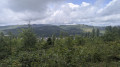
 Easy
Easy