Country:

 City:
City:


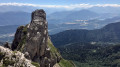
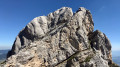
(S/E) At the car park at the end of the Bordeaux forest road, go through the barrier and continue along the forest track which climbs southwards. At the first hairpin bend, a sign indicates the path leading to the Baraque des Clos. This path winds its way westwards through the forest before heading south-west.
On leaving the forest, it crosses two scree slopes before reaching the Baraque des Clos.
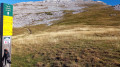
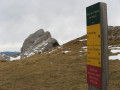
(1) Pass this shelter and you will soon reach a junction where a sign points towards the Pas de l’Œille. Follow this by turning left onto the upper path heading south. After a few bends, you will reach a second sign pointing towards the Pas de l’Œille to the north-west (do not follow this).
(2) At this sign, take the path on the left heading south-west. After 300 m, the track winds in wide switchbacks as it climbs towards the cliff. At the foot of the cliff, it turns into a comfortable but exposed ledge, see this view. Shortly afterwards, a cave suitable for a bivouac shelter opens up at the foot of the cliff.
(3) Continue along the ledge, still heading south, and join the path ascending from the Col de l’Arzelier. Turn right (north) onto this path (note that the IGN topographic map – including the online version – is particularly inaccurate at this point; see the ‘Practical Information’ section) to climb up towards the base of a gully of slippery scree. A few cairns mark the path, which crosses two rocky ledges before turning west and zigzagging up the gully leading to the Col des Deux Sœurs.
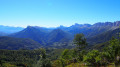
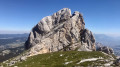
(4) From the pass, the Grande Moucherolle is visible (see this photo) to the west, as is the path leading to its base via the mountain pastures beneath the ridges separating it from the Deux Sœurs. Take this path, which climbs gently westwards, taking care of the ibex that often block it.
Shortly after a small pass, the path reaches the base of a steep, exposed couloir with good handholds for the final ascent of the Grande Moucherolle. Be careful: just before the secondary summit, the track appears to head down to the right to bypass a scarp (a snow-covered couloir late in the season). Do not follow this track but head straight up over easy rocks that lead to the summit ridge.
Cross this comfortable ridge, keeping your balance, and reach the summit.
(5) From the summit, retrace your steps to descend the rocks and reach the small pass marking the start of the path taken on the way up. Instead of following this path, stay on the ridge and follow it as close as possible to the edge of the cliff, due east, towards Agathe, the larger of the Deux Sœurs. You will thus reach the secondary summit of Agathe (2,167 m). From there, descend by sight across the alpine pasture among the ibex, heading towards a wide track, clearly visible to the north.
Once on the track, turn right onto the path that continues from the track and climbs towards the Col des Deux Sœurs. This path goes round a doline (karst sinkhole), the bottom of which is often covered in snow.
(6) Go round this karstic cave of the Deux Sœurs to join a faintly cairned and poorly marked track heading due north along the western flank of the ridges of the Vercors’ eastern balcony. Continue north on this track, which climbs gently before passing a small pass and entering a valley.
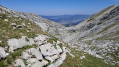
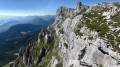
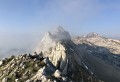
Descend, still heading north and keeping to the left-hand side, down this initially grassy valley until it joins a large scree slope. The path crosses this scree slope along the slope and climbs briefly to reach the sharp limestone pavement of the Pré de l’Achard (see this photo). A few cairns mark the route.
Cross the sharp limestone pavement, still heading north, which leads to a karstic cave marking the upper part of the Clot d'Aspres. The valley floor is blocked there by a small limestone cliff.
(7) Climb up to the right (east) to rejoin the main track, which heads north again and descends beneath large boulders towards the ruins of the Clot d'Aspres sheepfolds, of which only the bases of the walls remain visible.
(8) After visiting the ruins, retrace your steps for a few metres and take the wide path that climbs due east towards a small pass facing the ridges of the Gerbier (see this photo). Continue east on this well-marked path, which descends slightly towards the summit of the Grande Combe and joins the Sentier Péronnard there.
Turn right onto this path to climb the south-facing valley. After a few rocky sections, the path emerges from the valley at the foot of grassy slopes on the left.
(9) Leave the path and climb these slopes by sight, heading east towards the ridges and a small pass beneath the rocky cliff marking the southern end of the Gerbier ridges (see this photo).
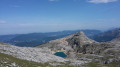
Once at the pass, turn right to follow the ridge running south as closely as possible, staying on its crest. The sloping peak of the Œille (not named on the IGN map, elevation 2105 m) serves as a landmark (see this photo).
This will take you to the pass known as the Pas de l’Œille.
(10) From the pass, take the steep path that winds down to the south. The path crosses some smooth rocks that are particularly dangerous in wet weather (a few bolts allow you to secure yourself if you have a rope). Once you reach the large scree slope at the foot of the pass, the path heads south along the slope, returning to the sign seen on the way up.
(2) Then retrace your steps along the path taken on the ascent, passing the Clos hut.
(1) Continue on to reach the car park (S/E).





 Visorando Member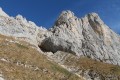
 Difficult
 Moderate