Country:
 City:
City:


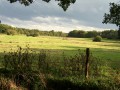
The starting point is on a path alongside the D27, near a place called Le Perron, between Migné and Méobecq. The route follows aPR® marked "Circuit n°7: Étangs, forêts et buttons" (Ponds, forests and hills) and marked in yellow.
(S/E) Head north towards the place known as Le Perron.
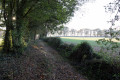
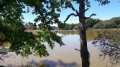
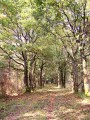
(1) At Le Perron, take the path westwards, lined with old oak trees, then a pond on the left and meadows divided by hedges on the right. Please note that the path can be very wet at this point. Reach the edge of the Lancosme Forest.
(2) Continue straight ahead through the woods until you reach the RD14.
(3) Cross carefully to find the path opposite. After walking about 600 m along this stone-paved lane, you will come to a crossroads with several paths.
(4) Take the path furthest to the left. You will come back to the RD14, which you should follow to the right for about 100 metres.
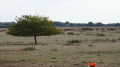
(5) Turn onto the first path on the left. The expanse of meadows, divided into buttons (small sandstone mounds) and ponds, offers a typical Brenne landscape. The path runs along the dyke of a pond: this passage, below the dyke, is often very wet. Join the RD58.
(6) Cross over and continue on the path opposite, towards the hamlet of Trois Fourneaux. Keep left at the three-way junction and continue to the hamlet of Beauvais.
(7) Continue straight ahead. Before the Françaisière farm, the passage is tricky because it is very wet.
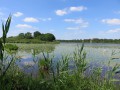
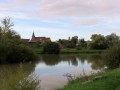
(8) The following section of tarmac road leads to the Étang du Coudray, a superb lake with aquatic vegetation typical of Brenne. On the right, the view of the Grand étang de Migné allows you to see the old mill on the lake's dyke.
(9) When you reach the RD27, turn left, taking care to watch out for heavy traffic.
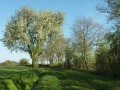
(10) Take the first path on the right. You are now back among the natural hay meadows and buttons, then you wind your way between various bodies of water. Pass Beaugu and reach the RD58.
(11) Cross the road again and continue along the path opposite until you reach the hamlet of La Loge with its sandstone buildings, characteristic of the Brenne region.
(12) After crossing this hamlet, turn left twice to reach the path that crosses a shorter, drier moor and return to the starting point (S/E).





 Visorando Member
 Easy
Easy