Between crests and rivers, a circular in Plantaurel

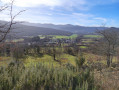
A circular loop in Plantaurel: greenways, woods, ridge views, the Touyre and Hers rivers, and history with the Saint-Roch Chapel and the Castella de Laroque d'Olmes. Something to satisfy all hikers.

Details

9418074
Creation:
Last update:
Last review:
  • Walking
    Activity: Walking
  • ↔
    Distance: 14.05 km
  • ◔
    Average duration: 4h 50 
  • ▲
    Difficulty: Moderate

  • ⚐
    Back to start: Yes
  • ↗
    Ascent: + 277 m
  • ↘
    Descent: - 272 m

  • ▲
    Highest point: 576 m
  • ▼
    Lowest point: 428 m

Photos

Description of the walk

Park on Place du Castella opposite the church, easy parking, in Laroque d'Olmes,

(S/E). Walk down Rue de l'Église, admiring the peaks of Monts d'Olmes and Montségur opposite, then turn immediately right onto the small square. There, take thefirst street downhill on the left, Rue Paul Vaillant Couturier, to reach the D620 towards La Bastide sur l'Hers more or less straight ahead. Follow Avenue Pierre Semard on the left for about 400 metres and leave the bridge over the Touyre.

(1) Turn right onto a small road that runs alongside the river and turns into a path at Guillouti.
Continue along the right bank until you reach some houses. Do not go up the Voie Verte for now, but stay to its right on a grassy track that opens up below to join the Entounadou crossroads and theGRP® Holmes.

(2) Turn left onto theGRP® and follow the yellow and red markings. Pass in front of the Grotte de Dreuilhe at the foot of a huge rock. You will rejoin the Touyre for a short while before passing under the Voie Verte. Then take the Voie Verte, which is the old railway line, and continue to the junction of the Voie Verte,GR® andPR® de Dreuilhe with a picnic area.

(3) Leave the Voie Verte and continue to the left to climb the Chemin de la Bouiche. At the start, only a mountain bike sign n°8 indicates the route, but very quickly theGR® de Pays markings take over. The climb is very steady on a wide track, sometimes paved with stones. Higher up, a sandy plateau in the middle of the forest allows you to enjoy the tranquillity of the place, just before reaching a nameless pass with no view.

(4) Begin a steady descent to discover the magnificent and peaceful Mérens, as well as a magnificent view just before arriving at the Ferme de La Bouyche.

(5) Descend the small road (Chemin de La Bouyche) which plunges steeply towards Ivry sur l'Hers to reach the road from La Bastide-sur-l'Hers to L'Aiguillon. Turn right onto the D16, then left across the Hers river and enter the hamlet of Camp Redon. At the exit, after the first houses, you will find a crossroads with a signpost:GR® de Pays –PR®GR®7(Red and White) – VTT 8 and 9.
Turn left and climb the road to reach a new crossroads marked by a sign.

(6) Leave the road and turn left again to descend towards the Hers.
Pass a junction on the right, going backwards and uphill, without a sign: this is the GR®.
Continue straight ahead and follow the red and white markings that go around a huge rock and find a house near the river where a track starts. Follow it to reach the hamlet of Fontcirgue, formerly a renowned spa resort.

(7) Leave the bridge below on your left and continue straight ahead on the road. Pass a fishing promontory for people with reduced mobility and, shortly before the bridge, you will reach the La Bastide sur l'Hers picnic area, where there are two tables available.

(8) Cross the bridge and then the road junction to take the lane that opens up opposite the market hall on the right, clearly marked with a sign for mountain biking. Turn into thefirst street on the left, which offers a view of a small bridge on the greenway. Pass underneath it, turn immediately left but do not go up the greenway. Keep to the right to find the Route du Cimetière.

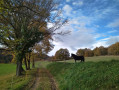
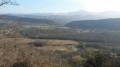
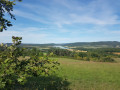
(9) Immediately turn right and climb up this small road, which turns into a grassy track a little further up. As you climb higher, the landscape opens up and the view becomes magnificent. Reach the pass on the D16 road.

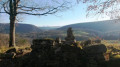
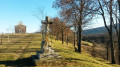
(10) Take the path on the left, marked by a sign. Now walk along a magnificent, slightly uphill and steady wooded ridge. In the distance, you can see the first houses at the top of Laroque-d'Olmes. Above the rocks, a stone cross marks the location of the Saint-Roch Chapel.

(11) Take a short detour to visit this magnificent, secluded spot. Return to the path and continue downhill to pass through Porte d'Amont and return to the Castella car park (S/E).

Waypoints

  1. S/E : km 0 - alt. 482 m - Le Castella car park opposite the church - Touyre (rivière)
  2. 1 : km 0.67 - alt. 455 m - Vers Guillouti
  3. 2 : km 2.28 - alt. 475 m - Crossroads of Entounadou
  4. 3 : km 3.08 - alt. 494 m - Dreuilhe picnic area
  5. 4 : km 4.78 - alt. 576 m - Neck without name or view
  6. 5 : km 5.78 - alt. 529 m - La Bouyche Farm
  7. 6 : km 7.5 - alt. 482 m - Crossing
  8. 7 : km 8.61 - alt. 440 m - Fontcirgue
  9. 8 : km 9.49 - alt. 428 m - Picnic area in La Bastide-sur-l'Hers
  10. 9 : km 9.99 - alt. 441 m - Route to the cemetery
  11. 10 : km 10.95 - alt. 512 m - Road transport
  12. 11 : km 13.02 - alt. 547 m - Chapel of Saint-Roch
  13. S/E : km 14.05 - alt. 483 m - Le Castella car park opposite the church - Touyre (rivière)

Notes

(S/E) Castella de Laroque-d'Olmes rest area: take the time to explore the church grounds, which feature two picnic tables, an orientation table, tourist information panels and a hiking trail sign.
(3) Dreuilhe picnic area.
(8) La Bastide sur l'Hers picnic area.

The Greenway

This greenway is a former railway line that ran between Mirepoix, Chalabre and Lavelanet and was created in 1903. The line connected the industrial valley of the Hers to the national railway network via Bram or Pamiers. The Chemins de Fer du Midi company, commissioned by the State to operate the line, transported passengers, mail and goods. In 1973, the train whistled for the last time on the line... which has now become a greenway, i.e. a multi-activity path.

Camp Redon

Since at least the 17th century, the hamlet of Campredon has had mills powered by water. The supply canal, whose water intake is located about 500 metres upstream, divides into three at the arrival point in order to supply as many factories. A Catalan-style forge and a hammer mill were installed there in the 18th century by the Lévis family. Iron ore from Rancié (now Haute-Ariège) was reduced by fire directly, without going through smelting.

After the Revolution, the Campredon site was sold as national property to Messrs Iché, Debosque and Canal. It then comprised the forge, the hammer mill, a two-stone flour mill, two charcoal kilns and various outbuildings (houses, garden, woods, etc.).

In 1854, Jean-Baptiste Bigou built the first horn comb factory. In 1861, Frédéric Azema set up his own workshop on the turbine of the old hammer mill. The marriage of their descendants led to the creation of the single company Azema-Bigou. Around 1900, a hydroelectric plant was installed. The presence of workers' housing made Campredon a factory hamlet where life and work coexisted. In 1869, the last jet mill in the area (the jet came from the mines of Vilhac) was built in Bel-Air. This site then housed a comb factory and later a fraying factory. From 1900 onwards, the Angélus factory, which no longer exists, housed a comb factory, a spinning mill and a fraying factory. The Richou et Cie and Jouret-Frères factories also manufactured combs in the 20th century.

Jet is a type of lignite, a fossilised wood of an intense black colour, which, once polished, shines and is used to make jewellery and rosaries. It enjoyed its heyday in the mid-18th century and became a semi-luxury item. Exported to America and India, it provided work for hundreds of people.

Fontcirgue

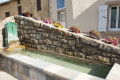
Known since Roman times, the Fontcirgue spring enjoyed its heyday during the Belle Epoque thanks to its thermal baths, which were prized for the quality of their waters. All that remains of this glorious past are two wooden kiosks, now very dilapidated, which were built in 1920. One of them housed a fountain decorated with tritons that still spout healing water, which can be used for bathing or drinking. A spa was established there from the 1830s to the 1860s. The site also housed a lemonade factory. Local residents continue to come and draw this water, which is said to aid digestion.

Saint-Roch Chapel

Built in the mid-16th century on a hilltop offering a 180° panoramic view of Lake Montbel and the peaks of the Massif de Tabe, the chapel was never a parish church, but a place of worship and pilgrimage built during a plague epidemic – hence its patronage of Saint Roch.

Who was Saint Roch?
Born in Montpellier around 1340, he devoted himself to caring for plague victims. Living in great poverty, he left for Rome, where the disease was spreading, and devoted himself to caring for the sick there for three years. He contracted the disease in Piacenza and withdrew to a forest, where a dog came every day to bring him bread. He returned to his homeland and died there around 1378. His life, punctuated by miracles of healing, inspired faith.

From 1510 to 1610, the Wars of Religion devastated and desecrated the chapel, which was restored for the first time in 1649 (particularly its roof). The work carried out in 1871 consisted of raising the walls and the gallery, vaulting the apse, re-roofing the nave and piercing six openings in the walls. The furnishings were replaced with statues in the "Saint-Sulpicien style," named after the merchants who sold religious objects in Place Saint-Sulpice in Paris.

On one wall, a stone tablet under the patronage of Saint Roch bears a prayer addressed to its patron saint.

Above the door is a bas-relief inscribed with the words: "In 1552, on 23 May, the first day of Rogation Days, work began on the small church of Saint-Roch, and the first stone was laid by J. Bosset (known as Mondini), a resident of Laroque."

Inside the chapel, visitors can admire a holy water font dating from 1673, a painting of the patron saint and stained glass windows created in 2000 by Pierre Rivière.

Note:
The first day of Rogation Days is the first of three days of processions preceding Ascension Day, with a view to receiving divine blessing on the work in the fields and the coming harvest. The procession continues to this day...

Church of the Blessed Sacrament in Laroque d'Olmes

Note: Laroque d'Olmes (from Latin) = the Rock of the Elm

Built in the 14th century, it is one of the few Gothic churches in the region. It is also known as the Church of Castella. It stands on the site of an ancient Romanesque church where a treaty was signed between Raymond V of Toulouse and Raymond Trencavel, Viscount of Carcassonne.
Built at the top of the "roque" (rock), on the Castella esplanade where the Porte d'Amont gate once stood, it was also called Notre-Dame du Mercadal and dedicated to St Martin, then to Corpus Christi.
The bell tower has a square base that then becomes octagonal.
On the side of the porch is carved the coat of arms of the church, which shows that the building was constructed thanks to the wealth of the drapery industry: it is composed of four "chessboard rocks" - these figures symbolise towers, perhaps reminiscent of the three silver rocks on the town's coat of arms. Next to it, a parchment indicates that the first stone was laid by "Pierre de Sainte Colombe, damoiseau".
The forged lock on the gate, listed as a historic monument, is decorated with a horse's head.
Since 2004, it has housed the fully restored former organ of the Royal Chapel of the Palace of Versailles.

"Victor Gonzalez" Grand Organ
The acquisition of the organ built by Victor Gonzalez in 1937 for the Royal Chapel of the Palace of Versailles enabled it to be installed in the Church of the Blessed Sacrament. This instrument was dismantled in 1995 by organ builders Boisseau and Cattiaux de Béthines before being restored in 2004 and 2005 and reassembled in the Church of Laroque d'Olmes, on the new wooden gallery at the back of the nave.

Worth a visit

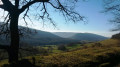
Between (10) and (11) Enjoy the gentle walk along this ridge, which is as smooth as the surrounding hills, all dressed in dark colours in the setting sun. The view stretches out in all directions, but also, in the distance, to the rocky outcrop from earlier. Here, the oak trees grow their branches on one side only.
(11) The Saint-Roch Chapel is well worth a visit for its history, its renovation, its panoramic view and its amenities (picnic table).

Always be cautious and plan ahead when you're outdoors. Visorando and the author of this route cannot be held responsible for any accidents occurring on this route.

The GR® and PR® markings are the intellectual property of the Fédération Française de Randonnée Pédestre.

Reviews and comments

4.8 / 5
Based on 12 reviews

Reliability of the description
4.8 / 5
Ease of following the route
4.8 / 5
Route interest
4.8 / 5
Muc31
Muc31

Overall rating : 5 / 5

Date of your route : May 18, 2025
Reliability of the description : ★★★★★ Very good
Ease of following the route : ★★★★★ Very good
Route interest : ★★★★★ Very good
Very busy route : No

An easy hike offering superb scenery. The whole group enjoyed the route, with little road walking, numerous passages through the forest with magnificent vegetation and several points of interest.

Machine-translated

écho09
écho09
• Edited:

Overall rating : 5 / 5

Date of your route : Jan 05, 2025
Reliability of the description : ★★★★★ Very good
Ease of following the route : ★★★★★ Very good
Route interest : ★★★★★ Very good
Very busy route : No

Route completed on 5 January 2025 with a small group, checking the route since its creation in 2021.
Signed: the author of this hike!

Machine-translated

Guy Jalut
Guy Jalut

Overall rating : 5 / 5

Date of your route : Nov 23, 2024
Reliability of the description : ★★★★★ Very good
Ease of following the route : ★★★★★ Very good
Route interest : ★★★★★ Very good
Very busy route : Yes

A pleasant hike accessible to all. Beautiful scenery.

Machine-translated

Roroboubou
Roroboubou

Overall rating : 5 / 5

Date of your route : Mar 21, 2024
Reliability of the description : ★★★★★ Very good
Ease of following the route : ★★★★★ Very good
Route interest : ★★★★★ Very good
Very busy route : No

Very good, lovely ride. Busy greenway, not the suggested route which avoids this path, good idea.
Thank you.

Machine-translated

hilde1958
hilde1958

Overall rating : 5 / 5

Date of your route : Mar 03, 2024
Reliability of the description : ★★★★★ Very good
Ease of following the route : ★★★★★ Very good
Route interest : ★★★★★ Very good
Very busy route : No

A varied route through woods, along rivers and past the region's industrial heritage (weaving, horn). The small village of Camp Redon is home to one of the last horn comb factories. We did it during the week, after a period of rain. Some sections are therefore very muddy. This walk is very popular at weekends.

Machine-translated

Marmaamic
Marmaamic

Overall rating : 4.7 / 5

Date of your route : Jan 02, 2023
Reliability of the description : ★★★★★ Very good
Ease of following the route : ★★★★☆ Good
Route interest : ★★★★★ Very good
Very busy route : No

A lovely walk with interesting views, from pastures to industrial ruins (Campredon). Don't miss the path on the right leading to the Protestant cemetery in La Bastide, because the other Catholic cemetery is not on the right route...

Machine-translated

RafRaf
RafRaf
• Edited:

Overall rating : 4.3 / 5

Date of your route : Aug 28, 2022
Reliability of the description : ★★★★☆ Good
Ease of following the route : ★★★★☆ Good
Route interest : ★★★★★ Very good
Very busy route : No

A very pleasant route with superb views, it's a real treat
The climb is a little "gruelling" as you approach the 11th kilometre, but overall it alternates between open track and under the trees.
Thanks to whoever shared this route, without which we wouldn't be able to enjoy the many possible routes in the area, as it must be said that the signage is sparse and unreliable.

Machine-translated

caoussis
caoussis

Overall rating : 4.7 / 5

Date of your route : Jan 01, 2022
Reliability of the description : ★★★★☆ Good
Ease of following the route : ★★★★★ Very good
Route interest : ★★★★★ Very good
Very busy route : No

The description of this hike is accurate and reliable, which is not always the case, and we are grateful to the author for that. There is just one issue with paragraph (2): you should not turn left (as indicated by a cross) but right, or at a pinch up the hill opposite, which leads straight to the greenway. This allows you to reach the climbing rocks further on and the descent to the Dreuilhe cave. This beautiful hike, where even the paved sections are very quiet, can be completed at a brisk pace in 3½ hours.

Machine-translated

Muriel23
Muriel23

Overall rating : 5 / 5

Date of your route : Nov 21, 2021
Reliability of the description : ★★★★★ Very good
Ease of following the route : ★★★★★ Very good
Route interest : ★★★★★ Very good
Very busy route : No

A very beautiful hike, combining walking in the woods and open views. The section on the Chemin de la Bouiche was somewhat spoiled by the presence of hunters all around in the woods. I didn't feel very comfortable.
There was a slight mix-up in Labastide sur l'Hers. It wasn't very clear to me which street to take (and I didn't see any signs). So you have to take Rue Jean Jaurès, just to the right of the bridge (my mistake did allow me to discover the pretty church, though), and then it's the second street on the left (Rue Jean-Jacques Rousseau) that you have to take, not the first.

Machine-translated

luiginau
luiginau

Overall rating : 4.7 / 5

Date of your route : Jun 12, 2021
Reliability of the description : ★★★★★ Very good
Ease of following the route : ★★★★★ Very good
Route interest : ★★★★☆ Good
Very busy route : Yes

Very pleasant hike, well marked, partly through woodland, without any major difficulties.

Machine-translated

georgevelyne@gmail ;com

Overall rating : 5 / 5

Date of your route : Jun 13, 2021
Reliability of the description : ★★★★★ Very good
Ease of following the route : ★★★★★ Very good
Route interest : ★★★★★ Very good
Very busy route : No

A very pleasant hike, well marked and, above all, quite shaded, which was ideal as it was very hot (30°C). At the end of the trail, there is a small chapel to visit before heading back down to the town centre. Highly recommended

Machine-translated

chespeel
chespeel

Overall rating : 4.7 / 5

Date of your route : Jun 12, 2021
Reliability of the description : ★★★★★ Very good
Ease of following the route : ★★★★★ Very good
Route interest : ★★★★☆ Good
Very busy route : No

a beautiful, varied hike with lovely views of the surrounding mountains. It's nice and shady when it's hot, which is very pleasant. And don't forget to stop off at the Saint Roch chapel at the end of the trail, a quiet and restful spot with a stone table and benches next to the chapel

Machine-translated

Other walks in the area

For more walks, use our search engine .

The GPS track and description are the property of this route's author. Please do not copy them without permission.