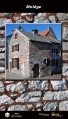

Exploring local heritage around the Olne town hall

Olne, one of the most beautiful villages in Wallonia, boasts an exceptional wealth of heritage.
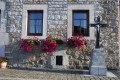
The centuries past have left numerous traces in Olne. Alongside the architectural heritage with its grand buildings, the ‘small heritage’ (inscriptions, wayside shrines, crosses, water sources, gateways, etc.) is another valuable record of village life. Our walk helps you discover these reminders of the past, which are sometimes somewhat neglected and often go unnoticed on more conventional walks.

Details

n°934580
Creation:
Last update:
Last review:
  • Walking
    Activity: Walking
  • ↔
    Distance: 1.50 mi
  • ◔
    Average duration: 0h 45 
  • ▲
    Difficulty: Easy

  • ⚐
    Back to start: Yes
  • ↗
    Ascent: + 62 ft
  • ↘
    Descent: - 62 ft

  • ▲
    Highest point: 801 ft
  • ▼
    Lowest point: 738 ft

Photos

Description of the walk

(S/E) We set off from the Hall Omnisport, passing the school and the school car park on our way to Rue Bouteille. From there, we head downhill to the left towards the centre of the village of Olne until we reach the junction with the Route du Château, which links Soumagne to Olne.

(1) We continue to the left towards the village centre. On the right is the former Montagnards’ hall with its beautiful Art Deco stained-glass windows. A little further on, on the building that currently houses the police station, the inscription ‘école communale’ (for girls) can still be seen.
As we continue towards the village, we see the first houses dating from 1600–1750 and the Church of Saint Sebastian,
Let’s enter through the church gate, visit the old cemetery and take a look at the crosses that are set into the wall of the enclosure.

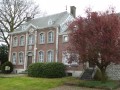
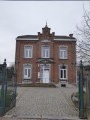
(2) Let’s leave the church grounds through the gate with its wrought-iron grilles dating from 1774. Let’s follow Rue Village to the town hall, a typical 18th-century building which was originally a bourgeois house.
There are other 18th-century houses a little further along on either side of Rue Village.
Let’s continue to the junction with Rue des Combattants and take a look at the inscriptions on the door lintels.

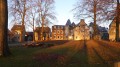
(3) Let’s turn left into Rue des Combattants. Two remarkable buildings stand on the right-hand side of this street: Château Chrouet (also known as Château de Terwangne) and Maison Kaivers.
Let’s carry on to the Post Office building, which was originally the Municipal Boys’ School (see inscriptions).
We arrive at the junction with Rue du Presbytère, with Maison Warnier on our right.
Opposite this house, we turn left towards the church to reach the crossroads.
We turn right at the end of the street and take a path on the right, between some old houses, to return to the Hall Omnisport (S/E).

Waypoints

  1. S/E : mi 0 - alt. 801 ft - Car park at the sports hall
  2. 1 : mi 0.2 - alt. 778 ft - Château d'Olne
  3. 2 : mi 0.31 - alt. 768 ft - Eglise Saint Sébastien et ancien cimetière
  4. 3 : mi 0.47 - alt. 738 ft - Château Chrouet
  5. S/E : mi 1.5 - alt. 801 ft - Omnisport Hall car park

Notes

The walk is very short. You should therefore take the time to look not only around you, but also up and down to discover the local heritage features. Do not hesitate to stray from the route to explore a narrow alleyway, go behind the town hall, or walk round the church (the old cemetery).

If you’re interested in a detailed description of Olne’s local heritage, the website http://olne.petit-patrimoine.be/ features a comprehensive inventory of these heritage features, complete with numerous photos, maps, descriptions and anecdotes about the various heritage objects.

A booklet entitled “Olne: Local Heritage, Inscriptions, Crosses, Wayside Shrines, Fountains and Wells”, by Henri Limet, with photographs by Freddy Creuen, is on sale at the town hall (which is on your route).

Worth a visit

During the walk

(1) On our right, heading towards Soumagne, we can see the monumental entrance gate to the “Château d’Olne”, built in 1703 by the lords of Olne. The main building was destroyed after the First World War.

(2) Olne was part of the “United Provinces” (now the Netherlands) between 1648 and 1785 and thus formed a Protestant enclave within a Catholic region. From both a religious and administrative perspective, this situation gave rise to numerous problems. The “Simultaneum” was one such issue: Protestant and Catholic services were held in the same church.
From the wall surrounding Olne Church, there is a lovely view of the village street, its old houses and their doorposts, which are often dated.
The façades of some very old houses (1660–1760) were modernised around 1920 when a local builder from Olne had the ‘good’ or ‘bad’ idea of cementing over these façades.
Numerous gateways topped with ‘teutés’ (the Walloon name for shelters) conceal the inner courtyards in the centre of the village.

(3) The inscription above the door at No. 3 indicates a renovation in 1788.
Gerardvs Chaineux / Scabinvs Vlensis / Me Renovabat MDCCLXVVVVVIII.
Opposite stands Château Chrouet, austere from the street but very beautiful from the (private) grounds. The oldest part of Château Chrouet was built around 1710 by Warnier Chrouet, a famous doctor (specialising in the waters of Spa, Chaudfontaine and Aachen).
The white paintwork of the Kaivers House lends a sense of unity to this 18th-century complex comprising three sections. The Regnier family (aldermen, mayors, notaries) lived there for nearly 200 years.
Note the ‘rust-coloured’ joints between the rubble stones of some of the houses in the middle of Rue des Combattants. These joints, known as ‘molèye’, were reinforced with iron filings from the many nail-making workshops in Olne.

(3) The Maison Warnier is a fine example of 17th-century Meuse architecture with its horizontal bands of limestone.

Nearby

- Numerous walking routes are signposted from the Hall Omnisport.
- For lovers of local heritage: see the website
- Wallonia’s Most Beautiful Villages: there are two other villages in the vicinity that have been designated as such: Soiron (4 km) and Thimister-Clermont (10 km).
- Wégimont (3 km): imposing castle, lake, playgrounds, mini-golf, open-air swimming pool.
- Further afield: Liège, Maastricht, Verviers, Eupen, the Hautes Fagnes, Monschau and Aachen.

Reviews and comments

4.3 / 5
Based on 1 review

Reliability of the description
4 / 5
Ease of following the route
5 / 5
Route interest
4 / 5
cbdp
cbdp

Overall rating : 4.3 / 5

Date of your route : May 17, 2020
Reliability of the description : ★★★★☆ Good
Ease of following the route : ★★★★★ Very good
Route interest : ★★★★☆ Good
Very busy route : No

a short but interesting heritage route

Machine-translated

Other walks in the area

For more walks, use our search engine .

The GPS track and description are the property of this route's author. Please do not copy them without permission.