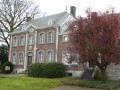
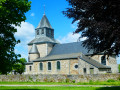
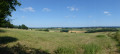
With its centuries-old buildings in the centre of Olne and the Fief de Saint-Hadelin, Olne has been designated as one of the ‘Most Beautiful Villages of Wallonia’. Our walk showcases this architectural heritage, the old roads and the historic mills, and offers magnificent views.
If you’d like to find out more, please feel free to visit the website for the Most Beautiful Villages of Wallonia, the Olne local authority website and Wikipedia.
Those interested in local heritage can visit the website, which provides an explanation of each feature (waymarkers, crosses, drinking troughs, gates with guardian figures, remarkable trees, etc.) and locates these features on a map.
At the start of the walk, the route takes us through the old centre of Olne:
Streets and village
- Admire St Sebastian’s Church, its wrought-iron gate dating from 1774 and its old enclosed cemetery. On the church tower is the inscription ‘1584’. Try to find the gravestone of Jacques the mason, dated 1639
- The town hall, dating from 1746, was originally a typical 18th-century town house. Inside, in the wedding hall, there is beautiful panelling and Louis XV fireplaces.
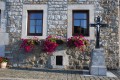
.- The 17th- and 18th-century houses are built of rubble stone quarried from nearby quarries. Some houses are built of red brick with bands of cut limestone.
- Numerous gateways topped with ‘teutés’ (the Walloon name for shelters) conceal the inner courtyards in the centre of the village.
Rue des Combattants:
- The white paintwork on the Kaivers house lends a sense of unity to this 18th-century complex comprising three sections. The Regnier family (aldermen, mayors, notaries) lived there for nearly 200 years.
- Note the ‘rust-coloured’ joints between the rubble stones of some houses in the middle of Rue des Combattants. The mortar used for the joints (‘molèye’) was reinforced with iron filings from the many nail-making workshops in Olne.
- The inscription above the door at No. 3 indicates a renovation in 1788.
Gerardvs Chaineux / Scabinvs Vlensis / Me Renovabat MDCCLXVVVVVIII.
- Opposite stands Château Chrouet, austere on the street side, rustic on the park side (private). The oldest part of Château Chrouet was built around 1710 by Warnier Chrouet, a famous doctor (specialising in the mineral waters of Spa, Chaudfontaine and Aachen).
As the walk continues, we discover the leats of the old mills of Vaux-sous-Olne and the hamlet of Froidbermont:
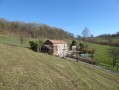
- In Vaux-sous-Olne stood the two communal mills of Olne. The leats of these mills were fed by the ‘Ri de Rode’ stream (which springs in Olne and resurfaces in Vaux) and the Hazienne. Other mills were situated along these streams and along the Vesdre valley. After serving as flour mills, they were successively converted into fulling mills, cannon factories and power stations.
- The seigneurial farm of Froidbermont was built on the foundations of the first castle of Olne. The Lord of Olne had his new castle built near the present-day road between Soumagne and Olne. Of this castle, completed around 1700, only the towers surrounding the enormous entrance gate remain.
Nearby
- There are numerous signposted walks starting from the Hall Omnisport.
- For lovers of local heritage:
- Wallonia’s Most Beautiful Villages: near Olne there are two other villages listed among Wallonia’s Most Beautiful Villages: Soiron (4 km) and Thimister-Clermont (10 km).
- Wégimont (3 km): an imposing castle, a lake, play areas, mini-golf and an open-air swimming pool.
- Further afield: Liège, Maastricht, Verviers, Eupen, the Hautes Fagnes, Monschau and Aachen.



 Country:
 City:
City:






 Visorando Member
 Easy
Easy 
 Local authority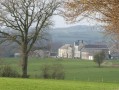
 Difficult