Country:
 City:
City:


Start from the Pont-Aven harbour car park.
(S/E) From the car park, head south to reach the end of the road and the unsightly sewage treatment plant located there.
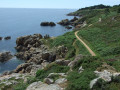
(1) When you reach the building, take the path on the left that climbs the embankment, then heads downstream, following the shore as closely as possible. You will quickly notice the extraordinary gnarled trees, remnants of hundreds of years of harvesting the branches of these venerable plants that line the shore just above the waves. They are particularly impressive in the first cove, which you will enter to go around it. Follow the path to the bottom of the submersible valley .
(2) At the highest water level, the path crosses to the other bank and returns to the karstic cave, which is particularly winding here and enclosed between the two wooded banks.
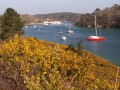
(3) Once you have passed Anse de Kergourlet, on the opposite bank, where you may wonder where the river flows, the horizon soon clears, and a little further on, above the shore, you can see the austere façade of the Château du Hénan.
Continue along the coastal path, skirting the hill topped by the Château du Tal Mor. On leaving the woods surrounding the building, you move away from the course of the karstic cave once more, skirting another cove, then passing below the hamlet of Kerscaff Izella.
(4) At the crossroads, turn left to climb towards Kerscaff Huella via a beautiful path lined with stone embankments. At the entrance to the property, turn right to reach the road that leads to the mill and Château du Hénan.
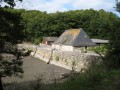
Cross this road and take the path on the left that runs parallel to the road, on the other side of the embankment. You will soon see the squat silhouette of the tide mill, standing in the middle of the dyke that holds back the Étang du Hénan.
(5) Cross this dyke, taking care to look both outside and inside the mill, which appears to be in working order. Pass the miller's house, a solid granite building on the opposite side of the hill, then turn left to follow the coastal path again.
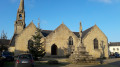
At this point, it skirts around the departmental arboretum that has been planted there, and you can happily leave the path to wander among the various more or less exotic species that have been planted there. Just keep your eyes on the chapel, which you will need to pass to continue the walk.
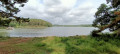
(6) From the chapel, walk back up towards the road, passing by the tall sequoias that dominate the arboretum. Walk past the imposing gate of the castle and continue straight ahead, descending slightly to the left to reach the three fountains where local weavers used to wash their products. Head back up to the left towards the car park but turn right to pass underneath it, then continue straight on through the woods until you reach the edge. Then follow the edge to reach the end of the Étang du Hénan. A magnificent refuge for many birds that frequent these areas, the basin is subject to the tides, so its water level varies depending on the time of day. You may therefore find it empty, but rarely without birds.
(7) Follow the edge of the pond on the right, go around a bend at the end of which are the remains of a wash house, then return to the road just as it is about to cross the mill dam.
Turn left to return to the other bank, then take the same path back to the bottom of Kerscarff Izella.
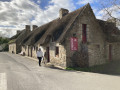
(4) Leave the coastal path and take the path that leads up to the top of the village. Pass a curious building with ogival openings before reaching the access to the highest dwellings. If the gate is open, take a look at the magnificent standing stone wall (men zao, in the local language) of the first building on the right.
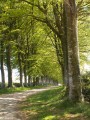
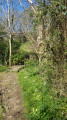
Leave the village by turning left, then immediately right at the next crossroads. At the highest point, leave the main path and take the sunken path that leads down to the left, between two embankments planted with tall trees. You will soon reach the bottom of the first cove.
(2) Cross over to the other side and return to the starting point by taking the same path in the opposite direction. And don't forget to take a last look at the expressive tree trunks(S/E).


 Visorando Member
 Moderate