Pié Foulard Convent (Pied Foulard)
The community
Stemming from a reform of the Royal Abbey of Fontevrault (in southern Anjou), we were founded on 25 October 1617 in Poitiers by Madame Antoinette d’Orléans-Longueville (1572–1618). The nascent congregation (Benedictines of Our Lady of Calvary) was characterised by a spirit of simplicity and poverty of life. The superior was no longer an abbess but an elected prioress. The communities were united by close bonds of charity.
Our community lived in Poitiers until 1962, when we moved to Saint-Julien-l'Ars (Vienne). In October 1999, we moved from the Vienne department to the southern part of the Deux-Sèvres department. We are based in Prailles, in a former Huguenot dwelling, in the Pays Mellois, a region marked by the Wars of Religion. In 2002, sisters from the community of Kerbénéat (Finistère) joined us.
As a community of around fifteen sisters, we live out the Gospel, day by day, in the manner of Saint Benedict. Our monastic presence—discreet, simple and welcoming to all—is intended to be a sign of reconciliation and peace. Listening to the Word of God brings us together several times a day in communal and personal prayer. It builds us up as a community and nourishes our fraternal life, our work and our hospitality, shaping our daily lives. Bonds of prayer and friendship are forged with our Protestant brothers and sisters in the region. We gather around the Word of God on the night of 31 December to welcome in the New Year, and in the early hours of Easter morning to celebrate the Lord’s Resurrection.
A printing press specialising in birth announcements is our main source of income. Orders come from all over France and even from abroad.
History of the site
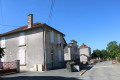
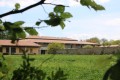
The hamlet of Pied Foulard and a dairy farm of the same name appear in historical records in the mid-16th century. The farmhouse is shown on the old land register; it is said to have been built for Anne Chalmot, a member of a Protestant family of aldermen from Niort, the lords of Pied Foulard. She married Josias d’Auzy in 1676. In the first quarter of the 18th century, their children lived there. The estate remained in the d’Auzy family’s possession until the early 19th century. Around 1818, at the time the old cadastral map was drawn up, the name Dauzy was struck out and replaced by that of Louis Mougon, residing at La Bessière in Vitré. At that time, the house was taxed on ten windows. The private cemetery shown on the old cadastral map is probably that of the d'Auzy family. The descendants of Louis Mougon lived there throughout the 19th century. Several members of this family are buried in another private cemetery, situated further to the east. In 1996, a community of Benedictine nuns, founded in Poitiers in 1617 and based in Saint-Julien-l’Ars (Vienne) since 1962, acquired the property. Following restoration, adaptation and construction work based on a design by the architect Denis Thoumin, the nuns moved in in 1999.
Bessière Castle
The manor house is built on a hill. Below the southern slope lies a pond. Two branches of a stream to the west and woods to the east mark the boundaries of the estate.
The Château de Bessière first appears in the tributes of Alphonse de France, Count of Poitiers, in the 13th century; Hugues de la Touche was then its lord. It subsequently passed to the family of Saint Gelais Lusignan. In 1432, Tranchant de Saint-Gelais, a knight and lord of La Bessière, having no children, bequeathed it to his nephews; through a division of the estate, it fell to Jean de Saint-Gelais. The property subsequently passed to various families: the Chabanais, the Brémond d’Ars, the Payen, and the Gourjault. The château was built in the 15th century and extensively restored and extended around 1880.
The various wings are arranged around a trapezoidal courtyard, with the main residence occupying the southern part. This consists of a rectangular building flanked by a pavilion to the west and extended by two bays to the east; the whole is covered in slate. A secondary wooden staircase has been installed in the eastern extension of the main residence. The dormer windows feature a trefoil decoration set within a triangular pediment. The smithy is covered in interlocking tiles, the south tower in zinc, and the west and east towers in flat tiles and slate. All other buildings are covered in hollow tiles, except for the shed adjoining the barn and the outbuilding to the east of the smithy, which have corrugated iron roofs.
Château de la Lussaudière
History
The first known lords of the Lussaudière manor were the Pandins. Around 1750–1760, the main house belonged to the d’Auzy family and later became the property of General Poinsignon. The central section of the main house may date back to the 17th century, whilst the two wings date from the 19th century.
Description
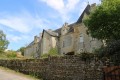
The Lussaudière residence features a central building flanked by two taller wings. The central building has a three-bay façade with a central door, one storey and an attic. The wings are two-storeyed with an attic lit by a dormer window with a triangular pediment.
Documentation
The locality known as Lussaudière appears in historical records before the end of the 15th century: Lourssaudère (1470), Louxaudière (1537).
Josué Pandin, the second son of Jean and Marie Barbade, is the progenitor of the Pandin branch of Lussaudière, who lived in the house bearing this name between 1636 and the Revolution.
The first synod of the Poitou Desert is said to have been held in 1744 in this house.
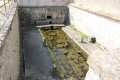
In 1818, at the time the old cadastral map was drawn up, (Gaspard-Jacques?) Pandin, mayor of Prailles, was the owner of this estate. Among the plots that formed part of the estate, we note the farmyard (C292), the grove (C297), the field of La Fuie (C298), the wash house (C303), the reservoir (C318), and the warren (C319).
In the second quarter of the 19th century, the Lussaudière estate passed into the Poinsignon family through the marriage in 1834 of Charlotte-Louise-Germaine Pandin de Lussaudière, born in 1801, daughter of Gaspard-Jacques, eldest son of Josué III, to Jean-Nicolas Poinsignon, born in 1790 in Montigny-lès-Metz, the future brigadier general. At least two generations of the Poinsignon family would live there.
Their son Dominique-Jean-Théophile-Auguste, known as Auguste, born in Prailles in 1835, married in 1862 Jeanne-Marguerite-Laure Taillefer, aged 16, daughter of Pierre-François-Alcide, justice of the peace for the canton of Celles, and Pauline-Virginie-Thomas Belleroche, who had had the Fontiville house built around 1845 in the neighbouring commune of Vitré. In 1866, Anne-Fanny Taillefert, Laure’s sister, married Alfred Guille-Desbuttes, and the couple moved into the nearby Fontiville house. The relationship between the two sisters appears to have been close.
Auguste Poinsignon, Knight of the Legion of Honour, who died in August 1915, was buried in the municipal cemetery of Vitré, as was his wife, who died in July 1937.
At the very end of the 18th century, on 18 Floréal Year VI (7 May 1798), Josué-Louis Pandin, the second son of Josué III, is said to have been living in Prailles, and most likely in his ancestors’ residence. Through the marriage of his niece, Charlotte-Louise-Germaine Pandin, the Lussaudière estate passed into the Poinsignon family.
Certain names of the plots on the old cadastral map provide us with further information about this manor: the orchard situated to the south of the buildings had already disappeared; to the south-east, a clearly demarcated plot named ‘bosquet’ suggests the existence of a formal garden, a hypothesis supported by the straight boundary—an old path (perhaps a bridleway?)—between the plot known as ‘le bosquet’ (C297) and the ‘fuie’ field (C298); Furthermore, there were likely to have been hydraulic works, as suggested by the presence of a reservoir, a wash house and a pond. (Source: Inventory of the heritage of the Poitou-Charentes region).



 Country:
 City:
City:







 Visorando Member


 Easy
Easy