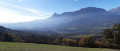
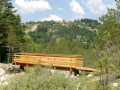
Col de Chétives and Cabane des Pierres from the Chapelle Saint-Étienne

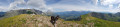
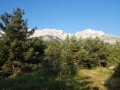
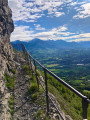
This route takes you from vegetation (the first part is through a beautiful coniferous forest) to rock (the final ascent is over scree). At the pass, you look out over the Cirque de Chaudun (south side) where the Petit Buëch river has its source, but although you can see Ceuze, the view is mainly towards the Écrins peaks.

Details

82038482
Creation:
Last update:
Last review:
  • Walking
    Activity: Walking
  • ↔
    Distance: 7.78 km
  • ◔
    Average duration: 4h 20 
  • ▲
    Difficulty: Moderate

  • ⚐
    Back to start: Yes
  • ↗
    Ascent: + 727 m
  • ↘
    Descent: - 723 m

  • ▲
    Highest point: 1,850 m
  • ▼
    Lowest point: 1,132 m

Description of the walk

From the RN85 road between Gap and Grenoble, take the D17 through the village of Poligny, then the D817 west towards Le Noyer. Pass the hamlet of Les Forestons to reach the Chapelle Saint-Étienne (3 km). Park in the chapel car park (Route de Saint-Esteve).

(S/E) Take the forest track south, following the yellow markings towards Col de Chétive.

(1) Stay on the left track, heading south-west-west, until you pass a house in the woods.

(2) Continue slightly to the right and keep following the yellow markings.

(3) Turn left at the junction towards Rageoux - Cabane des Pierres and continue for 80 metres.

(4) Turn right onto the path that climbs uphill and continue ascending until you reach the junction with the GR®93.

(5) Turn left towards Cabane des Pierres - Col de Chétive and follow the GR® for at least 1 km. Cross the Torrent du Rageoux stream over the rocks, then leave the woods to reach Les Pierres.

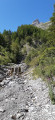
(6) Turn right towards Col de Chétive, climbing up the scree slopes, still following the GR®. The climb becomes steep and rocky. Continue until you come to another path on the hillside, next to a large rock.

(7) Turn right to continue climbing towards Col de Chétive. Be careful on the tricky section at an altitude of around 1,730 metres, near a small waterfall. Reach the pass by finishing the climb on a windy ridge.
(Note that from the pass, you can climb left to the Sommet du Chamois and back, or descend towards Chaudun.)

(8) At the pass, turn back and follow the same route you took on the way up.

(7) Turn left at the large rock, still following the route you took on the way up.

(6) Continue to the right towards the Cabane des Pierres.

(9) Descend the track to the left, heading north-west, to reach Cabane des Pierres in its meadow.

(10) Pass to the left of the hut and continue along the path, which veers slightly to the left and descends, heading due north. The path joins others on the right; continue heading due north until you reach a sharp left turn.

(11) Take the path that descends into the forest, still heading north, and continues almost in a straight line. You will come back to the intersection you passed at the start of the hike (house in the woods).

(2) Retrace your steps along the route you took on the way up to return to the car park (S/E).

Waypoints

  1. S/E : km 0 - alt. 1,132 m - Chapelle Saint-Étienne (Poligny)
  2. 1 : km 0.19 - alt. 1,140 m - Crossing the Naïs ravine
  3. 2 : km 0.33 - alt. 1,152 m - Crossroads - House no. 19
  4. 3 : km 1.25 - alt. 1,245 m - Les Chaups crossroads
  5. 4 : km 1.35 - alt. 1,249 m - Crossroads
  6. 5 : km 1.95 - alt. 1,295 m - Rageoux crossroads
  7. 6 : km 2.96 - alt. 1,436 m - Les Pierres crossroads
  8. 7 : km 3.55 - alt. 1,643 m - Large rock
  9. 8 : km 4.33 - alt. 1,850 m - Col de Chétive (1852m)
  10. 9 : km 5.81 - alt. 1,416 m - Crossroads towards Pré la Chaup
  11. 10 : km 5.93 - alt. 1,396 m - Cabane des Pierres
  12. 11 : km 6.7 - alt. 1,262 m - Hairpin bend
  13. S/E : km 7.78 - alt. 1,132 m - Chapelle Saint-Étienne (Poligny)

Notes

Picnic tables and fire pits are provided in the clearing at the start (Clots des Moures). The water from the fountain is not tested and there are nowater sources along the route.

The Cabane des Pierres offers shelter (not locked), with a wood stove and a table.

The wooded section is pleasant in the heat of summer, but late summer is the ideal time to walk along the scree and ridge (very exposed to the sun).

Shorter alternative: at the edge of the forest (6), continue straight ahead to reach the Cabane des Pierres rather than climbing up to the pass (scree). This allows you to make a pleasant loop in the woods (300 m elevation gain, total time 2h30).

Longer option: from the Col de Chétive (8), you can reach the Sommet du Chamois via a steep but clear path (920 m elevation gain, total time 5 hours). The view from the top is magnificent.

Worth a visit

The village of Poligny is known for its imposing, dark forest, where conifers grow alongside deciduous trees. Criss-crossed by an extensive network of paths, it is ideal for mushroom picking.

Le Veyre de Saint-Étienne has three monuments: the Chapel of Saint-Étienne or Saint Estève (Occitan), the Oratory of Sainte-Geneviève de Brabant and a fountain. Located on the edge of the Poligny forest, this clearing is surrounded by a mountain cirque offering views of the Col du Noyer and the entire Champsaur valley. Very pleasant in summer, it is a picnic area equipped with tables and barbecue facilities.

The Chapel of Saint Etienne has been a sacred place since the 6th century AD. The first and only church on the Poligny and Noyer plateau, dedicated to Saint Etienne, was built on the edge of the Roman road. Built in the Romanesque style with a "cul de four" choir, the building is topped by a bell tower, known as a "panelle" in Champsaur, which houses a bell.

In 1930, a beautiful fountain with a circular basin was erected, topped by a group of cherubs holding a vase.

And in 1936, Antoine Taix completed the site with an oratory in honour of Geneviève de Brabant. This Romanesque-style stone building is topped by a statue of the Saint holding her son (Drogan) close to her. The benefactor, born in 1852 in La Fare, emigrated to California and made his fortune there.

This large space is called the "Clots des Moures" (land of the dead) because, according to the "legend of the meadow", a labourer who tried to plough this land a long time ago was splattered with blood. Legend has it that this is where "stillborn" children, the unbaptised, or those born to unknown parents, a few lawless vagrants, atheists and all those who rejected religion were buried. It was said that this was why nothing could grow in this place and that the land should not be touched.

 Always be cautious and plan ahead when you're outdoors. Visorando and the author of this route cannot be held responsible for any accidents occurring on this route.

The GR® and PR® markings are the intellectual property of the Fédération Française de Randonnée Pédestre.

Other walks in the area

For more walks, use our search engine .

The GPS track and description are the property of this route's author. Please do not copy them without permission.