Route discovery of the town of Wissembourg and its vineyards

This walk along the ramparts, through the vineyards and around the neighbourhoods of Wissembourg will take you past more than 70 houses built before 1700 and the imposing St. Peter and St. Paul Church.
The town's origins date back to themid-7thcentury when Benedictine monks founded an abbey, St-Pierre-et-Paul, on an island in the Lauter. The town has miraculously emerged unscathed from a history punctuated by sieges, disasters and acts of war, with a battle in 1870 bearing its name.

Details

3996882
Creation:
Last update:
Last review:
  • Walking
    Activity: Walking
  • ↔
    Distance: 9.50 km
  • ◔
    Average duration: 3h 05 
  • ▲
    Difficulty: Moderate

  • ⚐
    Back to start: Yes
  • ↗
    Ascent: + 123 m
  • ↘
    Descent: - 120 m

  • ▲
    Highest point: 279 m
  • ▼
    Lowest point: 157 m
  • ⚐ Country: France
  • ⚐
  • ⚐ City: Wissembourg (67160)
  • ⚑
    Start/End: N 49.037753° / E 7.948842°
  • Accessible from the train station Gare de Wissembourg.
  • ❏
    IGN map(s): Ref. 3814ET, 3914OT
  • Hour-by-hour weather

Photos

Description of the walk

Parking at the fairground in Wissembourg (free in 2020).
Most of the route is marked with red rings.

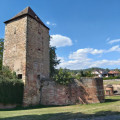
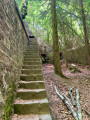
(S/E) Take Rue de la Poudrière heading north. After about 150 metres, pass the junction with Rue des Jardins to see the remains of the ramparts and the Tour de la Poudrière tower on your left. Retrace your steps, turn right at the junction onto Rue des Paysans and immediately turn right up the stairs leading to the Tour de la Poudrière tower and the top of the ramparts.
Stay on the path at the top, keeping the town on your left. When you reach the bend to the right, you will see the Lauter river and a lock below. Continue to the right (do not go down the steps on the left towards the lock) and after about ten metres on your left, you will find a gate leading out of the ramparts and into the moat.

(1) Take the path on the right, cross the lawn, leaving the path that leads to the moat on your right, and climb up Rue des Ormes opposite. When you reach Rue des Acacias, turn left until you reach the roundabout (which is oval).

Climb up opposite via Rue du Pflaenzer (marked with a red ring) and take the second street on the right, Rue Robert Schumann. It leads to the vineyards and the village of Schweigen in Germany.
When you reach the village, continue straight on along Hauptsraße until you reach the church on your right, then turn left onto Paulinerstraße. Start climbing to reach the top of the vineyards. Stay on this path until you cross the border.

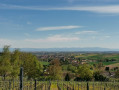
(2) Shortly after the border, go up the path on the right, then turn into thefirst path on the left. Follow the Red Ring markings to the end of the tarmac road, admiring the view of the Black Forest.

(3) Take the dirt track that climbs to the right and goes around the vineyards on the left. At the end of the vineyards, take the path on the left that descends slightly into the forest (a shortcut) and then reach the Les 3 Marronniers crossroads. There, turn right (the current path no longer follows the IGN map, marked Anneau Rouge).

(4) The path opens out and runs alongside the entrance to a private property. When you reach Route de Weiler, turn left and cross the road to take thefirst street on the right. This leads to the river, the Lauter. Just before the bridge, turn left, with the Lauter on your right, and continue between the ponds and the river. Part of the road is closed to traffic and has picnic areas.
After the hotel and then the Moulin de la Walk, continue along Rue de la Walk until you reach the D334. Cross the road and continue straight ahead to reach the Faubourg de Bitche. On your right, you will see the fortifications of the city's suburbs. Continue straight ahead through the Quartier du Bruch, a neighbourhood that was established in the9th century, and you will arrive at the Maison de l'Ami Fritz (1550) on your left, just before the crossroads with Rue du Rempart.

(5) Cross the bridge on your right, then the road on your left. Cross asecond bridge with a small lock on your left and immediately turn right onto the cycle/footpath. It runs between the city centre ramparts and the stream. The path leads to Rue Stanislas, with the14th-century Schartenturm tower on your left, which was part of the monastery's surrounding wall.
Cross the street, take the path opposite and go through the Porte des Remparts gate. Shortly afterwards, cross the bridge on the right and continue left along the Lauter river on your left until you reach the large roundabout.
Leave the roundabout on your right and continue along the cycle/footpath on the other side of the road, staying alongside the Lauter until you reach the next bridge on your left.

(6) Cross the bridge, turn left along another branch of the river and pass back through the ramparts. When you reach Rue du Tribunal, cross over to the Tribunal car park. Turn into thefirst lane on the left. At the end, take Impasse des Capucins, which leads to Rue du Général Leclerc, and follow it to the right.
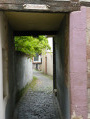
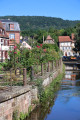
When you reach Place du Marché aux Choux, keep right on Rue de la République, cross the bridge that marks the beginning of Petite Venise. About 50 metres further on, take thefirst left onto Rue de la Passerelle, cross the small footbridge over the Lauter river in the middle of Petite Venise to reach a passageway under a house. This leads to Rue de l'Ordre Teutonique. Turn right, then take thesecond street on the left, Rue Stanislas.

(7) Pass the Palais Stanislas on your left, then turn right at thefirst street, Rue du Chapitre. When you reach the church, you will see the former sub-prefecture on your left. Visit the Church of Saint-Pierre-et-Saint-Paul with its 11-metre-high fresco.

(8) Retrace your steps and continue right on Rue du Chapitre. At the end of the street, turn right and cross the bridge on the left to walk along Quai Anselmann, where you can admire the Vogelsberger and Schaaf houses on your left.
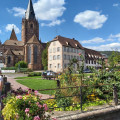
Opposite you is the Maison du Sel (Salt House), next to it is the beginning of Little Venice, and on your right is the Church of St. Peter and St. Paul, with the Grange aux Dîmes (Tithing Barn) between them.

(9) Take the street on the left, Rue du Marché aux Poissons, to reach Place de la République, with the Town Hall on your left.
With your back to the Town Hall, cross the square and head towards Rue de la République. Take thefirst left onto Rue des Maréchaux, then turn right onto Rue des Carmes to reach Rue de l'Ange.
Turn left onto Place des Carmes, go straight ahead, then left onto Rue des Écoles. About 70 metres on your right, La Nef, a former13th-century Dominican church (listed as a historic monument since 1982), has been converted into a cultural centre. Leave the square and continue along Rue des Écoles to reach Rue Nationale.

(10) Opposite, admire the Maison Holzapfel, a beautiful Gothic house with corner turrets and, above the doorway, a Hercules (or a savage) holding the coat of arms of the House of Austria and the city.
Turn left and take thefirst street on the right, Rue de la Laine, with several beautiful houses along the way, then take thefirst right into Rue de la Chaîne to reach the fairground car park (S/E).

Waypoints

  1. S/E : km 0 - alt. 159 m - Fairground car park
  2. 1 : km 0.83 - alt. 163 m - Ramparts, access to the moat
  3. 2 : km 3.12 - alt. 254 m - Intersection after the border
  4. 3 : km 4.6 - alt. 250 m - End of the tarmac road
  5. 4 : km 5.24 - alt. 186 m - Walk along the access road to a private property.
  6. 5 : km 6.45 - alt. 160 m - House of Fritz the Friend
  7. 6 : km 7.43 - alt. 159 m - Bridge over the - Lauter (rivière)
  8. 7 : km 8.07 - alt. 159 m - Palais Stanislas
  9. 8 : km 8.2 - alt. 159 m - Abbatiale Saint-Pierre et Saint-Paul (Wissembourg)
  10. 9 : km 8.56 - alt. 158 m - Maison du Sel
  11. 10 : km 9.16 - alt. 157 m - Holzapfel House
  12. S/E : km 9.5 - alt. 159 m - Fairground car park

Notes

Between points (3) and (4), the path or dirt track, the rest of the walk is on asphalt, so good trainers are sufficient.

Worth a visit

160m from the start :: The Powder Tower was part of the first city walls of Wissembourg, built in 1746. The walk above the old ramparts of Wissembourg allows you to discover the weathered roofs of the old quarter, the majestic towers of the Church of Saint Peter and Saint Paul and, in the distance, the rolling hills of the Vosges.

(5) The Bruch district, which was established in the9th century, was home to winegrowers, whose emblem can still be seen on the lintels of the doors.
Maison de l'Ami Fritz: this house, whose cross-section is adorned with a loggia or oriel (1550), was used as the setting for the filming of the film L'Ami Fritz in 1933.

(7) Palais Stanislas This was the residence of King Stanislas Leszczyński, then in exile, from 1719 to 1725, whose daughter Marie married Louis XV in 1725. It became a college (1869), a hospital (1875-1973), and then a retirement home. A little further on from the Stanislas House stands the Schartenturm, a remnant of the old monastery walls.

(8) Former Sub-Prefecture Opposite the church, this elegant late-Enlightenment pavilion occupies the former deanery of the collegiate church.

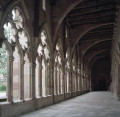
(8) The Gothic-style Church of Saint Peter and Saint Paul was built in sandstone between the end of the 13th and 14th centuries on the site of a Romanesque church, of which the square bell tower remains. Inside, in the south transept, note the 15th-century fresco of Saint Christopher carrying Christ, the largest painted figure known in France (11 metres high), and some13th-century stained glass windows. You can also admire a sumptuous Gothic cloister, left unfinished, on the north side of the church.

Quai Anselmann
The Vogelsberger House, built in 1540, has a rich Renaissance portal and a painted coat of arms. One of its owners, Sébastien Vogelsberger, a schoolmaster who became a mercenary leader, was beheaded in 1548 on the orders of Charles V for attending the coronation of Henry II.
Schaaf House This very old patrician house (1491) served as an inn until 1603, then belonged to the Bartholdi family at the end of the18thcentury before Auguste Schaaf, a local history enthusiast, acquired it in the20thcentury.

(9) The Salt House, recognisable by its large sloping roof with dormer windows, which was used as a hop dryer, was first a hospital (1448), then a slaughterhouse and later a salt warehouse.

The tithe barn of the former abbey adjoins the house of the Teutonic Knights, dating from 1606. The Teutonic Order, founded in the Holy Land in the12thcentury, disappeared during the Revolution.

Wissembourg Town Hall was built between 1741 and 1752 in pink sandstone, with a pediment, small tower and clock, according to plans by Massol. It replaces the old Rathaus, which was destroyed in the town fire on 25 January 1677.

Holzapfel House This beautiful Gothic house, known as Holzapfel, with corner turrets, was the meeting place for guilds, then a post house from 1793 to 1854; Napoleon is said to have stopped there in 1806. Above the doorway, a Hercules (or a savage) holds the coat of arms of the House of Austria and the town.

Reviews and comments

4.4 / 5
Based on 10 reviews

Reliability of the description
4.5 / 5
Ease of following the route
4.1 / 5
Route interest
4.5 / 5
mach
mach

Overall rating : 4.7 / 5

Date of your route : Oct 14, 2024
Reliability of the description : ★★★★★ Very good
Ease of following the route : ★★★★★ Very good
Route interest : ★★★★☆ Good
Very busy route : No

Lovely walk through the town and vineyards.

Machine-translated

Jeffharley
Jeffharley

Overall rating : 5 / 5

Date of your route : Nov 18, 2024
Reliability of the description : ★★★★★ Very good
Ease of following the route : ★★★★★ Very good
Route interest : ★★★★★ Very good
Very busy route : Yes

It was a lovely walk through the vineyards, with a visit to Schweigen and its many winegrowers and restaurants, as there was a slight variation to the route for the lunch break. And last but not least, the ramparts and old town of Wissembourg, which are really worth a visit.

Machine-translated

Giteannyetjeanyves
Giteannyetjeanyves

Overall rating : 5 / 5

Date of your route : Nov 04, 2024
Reliability of the description : ★★★★★ Very good
Ease of following the route : ★★★★★ Very good
Route interest : ★★★★★ Very good
Very busy route : Yes

A big thank you to the person who made this tour available. We had a lovely walk on a sunny autumn day in Wissembourg and in the vineyards overlooking the town, with a brief foray into Germany. Magnificent views over the vineyards and the plain.

Machine-translated

helenek
helenek
• Edited:

Overall rating : 4.3 / 5

Date of your route : May 01, 2024
Reliability of the description : ★★★★★ Very good
Ease of following the route : ★★★★☆ Good
Route interest : ★★★★☆ Good
Very busy route : Yes

A lovely walk to explore the centre of Wissembourg and the surrounding area.
At point 3, the crossroads is that of the 3 Marronniers (not the 3 Chênes).

Machine-translated

giorgo
giorgo

Overall rating : 4 / 5

Date of your route : Mar 03, 2024
Reliability of the description : ★★★★☆ Good
Ease of following the route : ★★★★☆ Good
Route interest : ★★★★☆ Good
Very busy route : No

A beautiful circuit on the heights of Wissembourg, the diversions via the "Weintor" is well worth it.
Fortunately I had downloaded the route on my laptop, especially on the German side.

Machine-translated

mimichele
mimichele

Overall rating : 4 / 5

Date of your route : Jan 29, 2024
Reliability of the description : ★★★★☆ Good
Ease of following the route : ★★★★☆ Good
Route interest : ★★★★☆ Good
Very busy route : Yes

An open-air route to enjoy a sunny day in winter, and the wonderful colours of the vines in autumn!

Machine-translated

marcounet
marcounet

Overall rating : 4 / 5

Date of your route : Oct 23, 2023
Reliability of the description : ★★★★☆ Good
Ease of following the route : ★★★★☆ Good
Route interest : ★★★★☆ Good
Very busy route : No

We took advantage of a sunny autumn day to explore Wissembourg and the surrounding area. The route was easy and pleasant, and the vines are bursting with colour at this time of year.

Machine-translated

tchequemat
tchequemat

Overall rating : 5 / 5

Date of your route : Aug 27, 2023
Reliability of the description : ★★★★★ Very good
Ease of following the route : ★★★★★ Very good
Route interest : ★★★★★ Very good
Very busy route : No

Hello,

I already knew Wissembourg, with its centre and vineyards.
But I discovered parts of the route that I didn't know at all. Especially on the other side of the border.
A route to recommend, especially for wine lovers.

Well done for the route!

Machine-translated

randoBM
randoBM

Overall rating : 4.7 / 5

Date of your route : Jun 10, 2023
Reliability of the description : ★★★★★ Very good
Ease of following the route : ★★★★☆ Good
Route interest : ★★★★★ Very good
Very busy route : No

A lovely walk through vineyards, forests and the pretty little town of Wissembourg, which we already knew but always enjoy revisiting.
One minor difficulty on the route was finding the rue des acacias ...

Machine-translated

Zielinsky
Zielinsky

Thank you above all, sylviadaniel, Grandin and Fanfan, for your kind understanding and cooperation. Writing a route (= Guiding with words, = anticipating obstacles, misunderstandings and ambiguities) is obviously very tricky, I'm perfectly aware of that: many experiences other than Visorando have often proved that to me.
Wissembourg has charmed my wife and me. I'd like to say it again: in the end, your itinerary, despite a few wanderings, fully achieved its goal! In short, all I wanted to do in writing to you was to encourage its use. I'm probably a little mischievous in that I only hike 'à-la-carte', without a telephone or GPS, but preferably with a compass; and precisely for the pleasure of words, writing and... flair'. No doubt that day, a little preoccupied by the curfew, we had to get back to our home a hundred kilometres away - and that doesn't help.
So... It's all very well to note the inconsistencies between Internet resources (I've described this); it's all very well to regret the difficulty of accessing detailed city maps, and also to regret the lack of street signs; it's all very well to criticise... you have to suggest solutions!
So I 'stuck to it', in a purely cooperative spirit, as I'm sure you can understand. With Google maps on the left and Word on the right of the screen, point by point, I examined all the hesitations we encountered, leaving nothing to chance, often reformulating or adding some detail or landmark according to our experience, or sometimes according to the compass - immutable and indispensable in hiking, but insufficiently used.
I therefore submit this text to you, sylviadaniel, and to you alone via Visorando. I've left two passages in bold: one whose wording needs to be checked in the field (the "Rue des Ormes" gave us a hard time and we wandered for a long time on the Boulevard de l'Europe looking for the Rue des Acacias). The other is a detour to the interesting Château Saint-Paul.
You be the judge, of course, and in any case, I won't be publishing any more on this subject.
Incidentally, while I was waiting for the best season, this writing exercise enabled me to revisit the site: after all, wasn't that its greatest interest?...

Machine-translated

sylviadaniel
sylviadaniel

Thank you for your suggestion👍, when I do the route again I'll look to see if I can find this type of info.
Good hiking to all

Machine-translated

fanfan
fanfan
• Edited:

Hello everyone,
I'm here to add my two cents, but if we work together we might find some solutions.
I've already been to Wissembourg but I didn't follow this route.

My grain of salt: perhaps we could use directional signs for motorists at certain crossroads (see the signs in the highway code to help with identification, for example: take the one-way street;; see also the signs indicating shops or services), in short anything that helps you understand a direction.

Personally, I've already used it to find a tourist office.

It's just an idea, to be tested in the field.

Best regards
Fanfan

Machine-translated

grandin
grandin ★

sylviadaniel

If the street signs are missing, I think you just need to specify in the description that the street names are given for information only, to at least make a connection between the description and the map. There's not much else to do, it's just that hikers need to pay close attention to the map at every intersection if they're not using a GPS.

Machine-translated

sylviadaniel
sylviadaniel

Thank you for your feedback,
Thank you for your feedback, personally I use my phone during my visiorando... the ign map locates me and I follow the route using the gps... understand that writing is not an easy exercise, especially in an urban environment 🥵
So I'm asking you and the visorando moderator, what more can you add to the left, right,...? Indicate house colours knowing that over time they may change? Describing the houses in detail, wouldn't that make the description indigestible?

Machine-translated

Zielinsky
Zielinsky
• Edited:

Overall rating : 3 / 5

Date of your route : Feb 04, 2021
Reliability of the description : ★★★☆☆ Average
Ease of following the route : ★☆☆☆☆ Very disappointing
Route interest : ★★★★★ Very good
Very busy route : No

There's nothing wrong with the abundant documentation. But more meticulous guidance would go a long way to helping you enjoy this beautiful route.
Generally, the Visorando maps are sufficient and satisfactory. But here, in an urban environment, the Visorando description alone and its OpenStreetMaps mini-plan are no match for a good, serious, detailed city map. The IGN map is of no help (a GPS perhaps?). As a last resort: a compass and... flair".
Admittedly, the author of this description does quote street names: good. I went over the route again in the evening when I got home, using Google Maps. There, you can see these names in white, clearly written on the pavement. Did the author use Google Maps? But what's the point if you don't have your laptop with you? Because on the spot - oh Mr Mayor! - street signs are sometimes missing in neighbourhoods, both old and new, just where they are mentioned as landmarks.
So, if you don't have a GPS or a compass, before you set off on your hike, we strongly advise you to find out where you are on the web.
Point S/E: You instinctively follow a certain "Rue des Paysans", unless I'm mistaken, without any street signs, either at the foot of la Poudrière or further on. In the evening, you use Google Maps to find that this long street that starts at the foot of La Poudrière is actually called "Rue des Paysans". Now go to ViaMichelin and you'll see that this same road has 3 names (R de la Laine - R du Musée - R. Saint-Jean) before becoming, far from it, a humble and brief "R des Paysans". A mess!
Point 1): we've never seen "Rue des Ormes" written down, either on site or even on Google Maps in the evening. Well, a little flair and we ended up finding "Pflaenzer" and "Schumann".
Point 2): One comment: It's a shame not to find a word about the slight diversions to the Château (Saint-Paul?) or any mention on the map other than a vague silhouette in black.
Point 9): Rue de l'Ange! Clearly visible in the evening on Google Maps; but on the walls of this large square... wow! So some good locals, who don't even know we're here, point out the "Passage de l'Ange" at the other end, and off you go again... Then it's back to Rue des Ecoles (except that there's no doubt about it: 4am... crowds of children... the Nave not far away...).
But I swear we'll be back in this charming town. And if possible on sunny days and without a curfew!

Machine-translated

Other walks in the area

For more walks, use our search engine .

The GPS track and description are the property of this route's author. Please do not copy them without permission.