

 Country:
 City:


Park in the small car park on the corner of Avenue Jean-Paul II and the Bourbince.
(S/E) Head towards the Basilica of the Sacred Heart, an architectural masterpiece of the Romanesque style.
(1) To the right of the basilica lies the cloister. Dating from the 17th–18th centuries, it was home to Cluniac monks until the Revolution. In the centre, the medieval-inspired garden offers a space imbued with serenity. Joël Barguil’s artwork transforms the side courtyard into an amphitheatre of vertical lines of shadow and flashes of light.
Head towards Avenue Jean-Paul II and follow it to the right, running alongside the Bourbince, before turning right into the Jardin Saint-Hugues to admire the Tour du Rempart, dating from the 10th to the 15th centuries. Partially preserved, it reinforced a weak point in the town’s fortified walls, near the river.
Head to the right, then turn left onto Rue de la Visitation to reach the junction with Rue de la Paix. Turn right to reach the Musée du Hiéron.
(2) In this municipal Museum of Fine Arts, discover the National Treasure by Joseph Chaumet, jeweller to high society in Paris – a precious piece of goldsmith’s work measuring three metres by three metres depicting scenes from the life of Christ. Also on display are the Romanesque portal of Anzy-le-Duc, Italian paintings from the 17th and 18th centuries, and a collection of modern and contemporary art.
Cross the road to visit the Chapelle de la Colombière. Inspired by Byzantine architecture, its interior is adorned with mosaics and stained-glass windows by the Mauméjean brothers. It was built to mark the beatification of Claude La Colombière, the spiritual director of Saint Margaret Mary.
Head back towards the Musée du Hiéron and take Rue de la Paix to reach the Tour Saint-Nicolas.
(3) Formerly a parish church, it was reduced to its current size in the 19th century when the apse and side chapels were removed. To prevent its demolition, the installation of the clock led to it being declared a building of public utility. It has served various purposes, including as a prison, a guardhouse and a town hall. Today it hosts exhibitions.
Opposite the Saint-Nicolas Tower, admire the façade of the Town Hall. Formerly the private mansion of a wealthy merchant, Pierre Jayet, he had a Renaissance-style façade built between 1525 and 1528, superimposed onto older structures. You can see his portrait, as well as that of his wife, on carved medallions.
Follow Rue Dargaud to the right of the tower, turn right onto Rue Pasteur, then turn left onto Rue du 11 Novembre and continue to Notre-Dame Church. This site served as a stone quarry during the construction of the basilica.
(4) Head back towards Rue Pasteur, follow it to the right, then turn left to return to the Saint-Nicolas Tower. Leave it on your left as you cross the square, then take Rue Victor Hugo and carry straight on to cross the Bourbince via Rue des Deux Ponts. Take the second right onto Avenue Charles de Gaulle, where mosaic tiles are set into the pavement.
As you pass by, admire the Théâtre Sauvageot, built thanks to a donation from Mlle Sauvageot, whose bust is carved above the door. The various ornaments on the façade are reminiscent of the Burgundian Renaissance style.
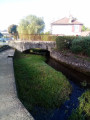
Continue along Avenue Charles de Gaulle to the Canal du Centre. Stretching 112 km and featuring 61 locks, it links the Loire to the Saône. Once used to transport goods, it is now mainly used by pleasure boaters.
Cross the canal, then turn right onto Quai de l’Industrie and walk to the Maison de la Mosaïque Contemporaine, which explains the origins of mosaics and showcases the tools, materials and techniques used. Do also take a stroll through the mosaic garden.
(5) Head back towards the bridge, then take the first street on the right (Rue Paul Charnoz), which leads to the Paul Charnoz Museum of Art and Industry, which traces the various stages in the history of this ceramics factory.
Opposite the museum, discover the Chapelle Saint-Roch, built in 1835. Continue to the right, cross the footbridge over the railway lines, then carry on straight ahead along Rue de Bellevue until you reach the École de Bellevue and the Église Sainte-Marguerite-Marie, which has an inlaid tiled floor.
Walk back to the Museum of Art and Industry, then follow Avenue de la Gare opposite to return to the Canal du Centre. Cross the canal, then turn diagonally right onto Avenue Charles de Gaulle. Join Rue des Deux Ponts and follow it to the left.
(6) Cross the Bourbince, then turn right onto Avenue Jean-Paul II to return to the car park (S/E).
 Visorando Member


 Difficult
 Very difficult
 Tourist office