Country:

 City:
City:


The starting point is in the Latse neighbourhood, at the Abillaitz farmhouse by the GI 3410 (see Google Maps link); there are a few parking spaces near a small green rubbish bin (it is best not to come with more than two cars and, if necessary, to ask the owners of the house for permission).
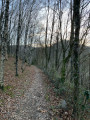
(S/E) This is where a concrete track begins, leading to Caserío Txabolategi. At the bend in the access road, we take the track on the right, which takes us into the woodland. Continuing along the main route, the climb takes us to the Azeri pass (410 m),
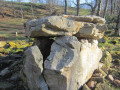
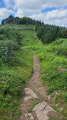
(1) This marks the start of a pleasant ridge walk to the summit of Urdaburu. The pass separates two of the three twin peaks that flank Urdaburu to the west, Agiña and Erkaitz (marked by a cairn), both of which are easily accessible. You’ll need to take a short detour to climb Erkaitz (437 m), which lies to the left of the main path.
(2) From the pass, we head straight ahead, following the ridge line until we reach the summit rocks. We then veer slightly to the left to join the eastern ridge and reach the Elorrieta Pass (395 m), recognisable by its Canadian-style gate. A wide track then appears; we follow it to the left towards Pagoetako gaina (436 m), the third peak in this trio. The summit, situated on the left, is marked by a boundary stone and a wooden post.
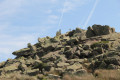
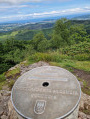
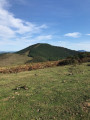
(3) We then descend towards the vast Lizarregi Pass (365 m), which offers superb panoramic views, both to the north and to the south. Its strategic position is evidenced by the numerous signposted paths that intersect there. Facing us, Urdaburu reveals itself in full, with its impressive western rocky ridge, which appears impassable. We leave the track at a signpost to take a path that climbs to the left, which we follow to the summit. It leads to the foot of the cliff face, which it skirts to the right as it winds its way up between the rocks. Once on the upper plateau, the path winds its way through pine trees and boulders to the summit ridge, where the triangulation point and the post box (buzon) are located. Here we are at the top of Udaburu (599m), which rises majestically to an altitude of 600 metres between the right bank of the River Urumea and the Añarbe reservoir. The view alone makes the climb worthwhile: on a clear day, La Concha Bay and the entire coast of Gipuzkoa are clearly visible, despite the twelve kilometres separating us from them.
(4) For the return journey, we retrace our steps to avoid descending via the eastern slope, which is very steep and potentially vertiginous. We go round Urdaburu Txiki to the north and follow the path that takes us through Pagosarde (413m), signposted.
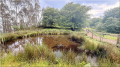
(5) Nearby, we notice a small pond with a remarkable ecosystem. From here, it is possible to shorten the walk and head back down to (9) by turning left, where the path joins the Usoko stream. We continue along the planned route heading north-east and arrive at Zuarkazu (465m).
(6). At the foot of Malbazarko Gaina (416 m, information sign), we take a narrow path, pass another pond and climb this hill (443 m)
(7). The summit of Malbazar (or Malbazarko Gaina) is a well-known stopover for migratory birds. We then descend to the nearby pass of the same name (406m).
(8) We return via the GR®121 just below to get back to Pagosarde
(5) We then circle round Urdaburu Txiki once more, this time along its northern slope. We complete our route by reaching the Usoko stream, which flows into the Urumea at Latse.
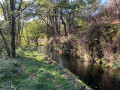
(9) A junction on the right takes us down towards the Usoko stream valley. The track, initially stony then tarmac, follows the stream; we cross a bridge.
(10) We then make our way back at a leisurely pace to Latse. We follow the road for about a hundred metres to the hamlet of Abillaitz, where we’d parked the cars (S/E).
(Walk completed on 1 May 2026)


 Association / Club / Walk leader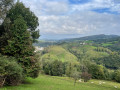
 Easy
Easy 
 Visorando Member