Saint-Péreuse
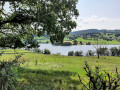
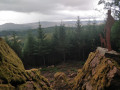
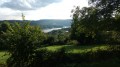
Saint-Péreuse overlooks the Veynon valley and lies on the border between the Morvan and Bazois massifs. In 1860, it covered an area of 1,607 hectares, 500 of which were woodland. At that time, the vineyards here were of fairly good quality. The highest point is at Toureau de Remondot, at 432 metres.
History
The commune of Saint-Péreuse is said to have been founded in the 5th century by a monk, Saint Pétrusii, who came to spread Christianity. The name Solières – ‘Solis lucus’ – tells us that this place was a wood dedicated to the sun. Some discontented locals, seeing him destroy their idols and convert people, put him to death. His remains were then buried at the site of his execution, and his tomb soon became a place of pilgrimage. An oratory was built there, which soon became an abbey that Charles the Bald granted to the Church of Nevers in the 9th century, a grant confirmed by Charles III the Fat on the 15th day before the calends of January 888. This monastery subsequently became a chapter of canons. It is believed that the abbot’s residence was situated near the church, to the south.
In 1161, the Bishop of Nevers, Bernard de Saint-Saulge, acknowledged in his letters to Abbot Bernard II that the church was indeed the property of the Abbey of Saint-Martin d’Autun, and this donation was also confirmed by a papal bull from Pope Alexander III, who had taken refuge in France in 1164: “In Nivernensi episcopatu ecclesiam de S. Petrusio”.
The land of Saint-Péreuse held the title of barony and was part of the county of Château-Chinon and part of the duchy of Nevers. It enjoyed high, middle and low justice and all the feudal rights of the time. Étienne and Jacques de Beaumont, knights, were its lords in 1285.
The village suffered several fires, including one in 1847 which consumed a large part of it; ten years later, another fire destroyed the rest of the village. By 1865, it had been fairly well rebuilt.
Seigneury of Solière
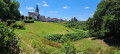
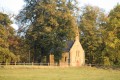
Situated on another plateau to the south, it boasts a beautiful castle built in 1786. Next to it stands a Romanesque-style chapel built to the plans of Messrs Pierre-Félix Delarue and Andoche Parthiot, architects. It measures 12 metres long by 5 metres wide and was consecrated on 18 July 1859 by Monsignor Dominique-Augustin Dufêtre.
Places and monuments
Civil
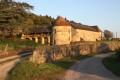
Château de Saint-Péreuse: all that remains are two thick, solid sections of wall near the new cemetery. This fortress was besieged in July 1474 by the troops of Louis XI, and its decline certainly dates from this period. It lay completely in ruins by 1555. Indeed, in that year, Anne de La Tornelle, wife of Jean de Saint-Père, Baron of Chandiou, wishing to pay homage to her suzerain for her vineyard at A La Taulpine, presented herself on 4 October before the gate of her castle—now in ruins and decay—knelt down and kissed the threshold of the gate.
The 15th-centuryChâteau de Besne, remodelled in the 19th century, with its moats filled in.
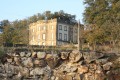
18th-centuryChâteau de Saulières.
Section of the ancient road:
Gallo-Roman remains were found at Saint-Péreuse and Villars; this section of the road is situated on the western edge of the commune and connected Moulins-Engilbert to Blismes. It certainly played an important role in the Middle Ages as it linked Vézelay with the southernmost regions, intersecting the major communication routes. Its route crosses the seigneury of Chandioux.
Remains of the Gibet, consisting of four posts, each set in a sort of stone cube, joined at the top by a wooden frame and held in place by struts; this symbol of the high, middle and low justice held by the seigneury of Saint-Péreuse stood in the 15th century at the highest point of the seigneury, at the Toureau de Remondot. In the 1940s, three of the stones making up this structure could still be seen; today, only one remains.
Schools
The first state school for boys dates from 1865. Girls attended a convent school in the hamlet of Le Chemin, three kilometres from the village. It closed in 1892 following the opening of the girls’ school in the village in 1885, in a rented house. As the town hall and boys’ school building was in a state of serious disrepair and in danger of collapsing, the council decided in 1897 to build a school complex for both boys and girls.
Religion
Saint-Péreuse Church
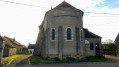
The old church was a 12th-century Romanesque building with a shallow apse and a barrel-vaulted chancel, topped by an unsightly tower. The nave, with a heavy wooden gallery, was rather characterless, except for a trefoil-arched side door dating from the 14th century, though this had been bricked up. Dedicated to the patron saint of the region, whose feast day is 12 November, the new church stands at the western tip of the plateau alongside the presbytery. Rebuilt in 1864 to plans by Andoche Parthiot, an architect from Château-Chinon, it is in the Neo-Romanesque style, shaped like a Latin cross, and built of granite. It comprises an apse choir, a transept and a nave, preceded by a bell tower and an octagonal spire. It is 34 metres and 40 centimetres long, with a width of 16 metres at the cross and 8 metres in the nave. It cost 40,000 francs, of which 10,000 francs were provided by the houses of Saint-Maur and Saint-Péreuse, which, in return, were granted the side chapels, dedicated to the Blessed Virgin and Saint Péreuse, though they were required to pay an annual rent of 25 francs to the parish council for this concession.
Presbytery: Dating from the early 19th century. It was used for services in the period prior to the reconstruction of the new church, which explains the presence of the holy water font, which comes from the old building. This room was used to house horses and also as a woodshed. Restored after lying derelict, it was subsequently used for religious instruction.
Natural heritage
A pedunculate oak, listed in the Morvan’s inventory of remarkable trees. It is located at a place called La Pommeraie. It is 14.5 metres tall and has a circumference of 5.25 metres. This tree is hollow and allows one to enter inside.
(Extract from Wikipedia)



 Country:

 City:
City:





 Visorando Member
 Moderate