Bois d'Enfiré and Fontaine de la Belle

A pleasant hike leading to the Métairie aux Moines, the Bois d'Enfiré, the hamlet of La Carte and the Fontaine de la Belle. Discover a beautiful fountain nestled in the valley after the hamlet of La Carte. The hike is mostly shaded and, in the second half, runs along the La Belle river for a while.

Details

1117323
Creation:
Last update:
Last review:
  • Walking
    Activity: Walking
  • ↔
    Distance: 5.70 km
  • ◔
    Average duration: 1h 45 
  • ▲
    Difficulty: Easy

  • ⚐
    Back to start: Yes
  • ↗
    Ascent: + 33 m
  • ↘
    Descent: - 39 m

  • ▲
    Highest point: 157 m
  • ▼
    Lowest point: 117 m

Photos

Description of the walk

Parking behind the dairy farm.

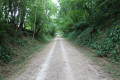
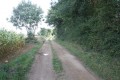
(S/E) Take the path to the left of the fire hydrant (as you look at it). This path winds between a hedge of trees on the right and fields on the left, then fields line the path on both sides. Continue straight ahead until you reach the junction with the "Ruban Vert" on your right (an old railway line converted into a footpath and cycle path).

(1) Cross the "Ruban Vert" and continue straight ahead. The path turns to the left before climbing to the right towards a road. As you pass, admire the beautiful, well-restored property on the left. When you reach the road, cross it carefully and continue straight ahead on a narrower path that climbs slightly.
The path winds its way up the hillside through the woods and emerges below some houses on the right-hand side, leading to a small road at a right-angle bend. Continue straight ahead with caution, as this small road joins a busier one. Continue straight ahead towards the north-west.

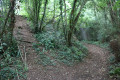
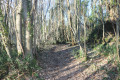
(2) At the right-hand bend in the road, continue straight ahead along a shaded path that enters the woods on the hillside. After passing a few "gardens", the path widens as it enters the Bois d'Enfiré. Shortly afterwards, it emerges from the woods and joins a road (elevation 145). Turn left and carefully follow this slightly downhill road to the hamlet of La Carte. The road comes to a T-junction: turn left and carefully follow this new road for about 150 metres.

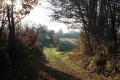
(3) Before the last house on the right-hand side of the road, turn right into a cul-de-sac that descends towards the Belle valley and continues along a path. The path turns to the left and shortly afterwards arrives at the ruins of a house. At this point, admire the beautiful fountain on the left-hand side, which emerges from the hillside with a small basin. Continue along the path that runs along one side of the valley where the Belle flows. The path even follows the La Belle river for a while, which allows the animals in the pastures to drink. The path eventually arrives at some houses with the locality of La Thomazière on the left.

(4) Continue until you reach a small road that makes a hairpin bend. At this point, take the path on the right that runs along the Belle (on your left). A little further on, the path runs alongside a pond near the Métairie de la Carte. Further on, the path widens and makes a large bend to the right to join a path passing under the "Ruban Vert". The "Ruban Vert" is an old railway line, the route of which can be seen above you. You will need to "climb" either before or after the bridge to reach the "Ruban Vert". When you arrive, turn south-southeast and follow the "Ruban Vert" down a very slight slope.

(5) Just before crossing a bridge over a road that leads to a place called La Maison Neuve, take the stairs on the right to descend to the road. When you reach the road, turn left, go under the tunnel and shortly afterwards turn right.

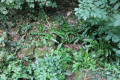
(6) About four hundred metres further on, in a right-hand bend in the road, you will see a sign on a tree announcing the Belle springs on the right-hand side of the road. A spring gushes out a few metres below some stones that form a small structure. Retrace your steps until you reach the "Ruban Vert" again.

When you reach the top of the stairs, turn left and follow the "Ruban Vert".

(1) Continue along the Ruban Vert. When you reach the fire cistern at La Métairie aux Moines, you will arrive at the car park (S/E).

Waypoints

  1. S/E : km 0 - alt. 150 m - Parking behind the dairy farm
  2. 1 : km 0.75 - alt. 142 m - Crossroads between farm track and Ruban Vert
  3. 2 : km 1.45 - alt. 154 m - Road-path junction
  4. 3 : km 2.83 - alt. 129 m - Road junction - path towards the valley of the - Belle (rivière) - Affluent de la Boutonne
  5. 4 : km 3.29 - alt. 119 m - La Thomazière locality on the left
  6. 5 : km 3.78 - alt. 132 m - Ruban Vert-route junction (at the top of the stairs)
  7. 6 : km 4.04 - alt. 125 m - Fontaine de la Belle
  8. S/E : km 5.7 - alt. 150 m - Parking behind the dairy farm

Notes

The parking area is located behind the dairy farm aux Moines at the intersection between the road and the green ribbon (former railway line): park on the grass verge.

This hike covers varied terrain and requires sturdy footwear.

This unmarked route does not present any real difficulties. It follows marked sections. It is therefore advisable to follow the directions in this description and on the map, while also taking note of the landscapes you pass through. Distance indications from the starting point, or even the GPS coordinates of the waypoints (including the starting point), can also help hikers find their way.

Hike completed by the author on 10 August 2018.

Worth a visit

The old railway line from Niort to Ruffec

The 19th century saw the birth and development of the railway. Until the eve of the First World War, France was adorned with a dense network of railways (400 km of track in 1840, 19,600 km in 1875 and 39,400 km in 1913).

In 1853, the rail network needed to be expanded with cross-country lines, in particular to connect Nantes to Limoges via Niort. Several routes were under consideration to the south-east of Niort. Finally, in 1879, it was decided to build a line connecting Niort to Ruffec via Melle. The line was inaugurated on 1 March 1885. In addition to freight trains, three passenger trains ran on this line every day, which were packed during the fairs in Niort and Melle and the pilgrimage to the Virgin Mary in Celles-sur-Belle.
In 1940, the train enabled refugees from the Ardennes to find asylum in Melle.
However, the rapid development of road traffic sounded the death knell for this line. The last section still in operation for freight traffic between Niort and Melle was closed in January 1991. Fortunately, the 15 km stretch between Tauché and Melle was bought by the local authorities and converted into a rural hiking trail: the Ruban Vert, inaugurated on 18 September 1999.

Melle station was once a hub of economic activity. In addition to being on the Niort-Ruffec SNCF line, it was also the starting point of the TDS (Tramway des Deux-Sèvres) line connecting Melle to Parthenay via Lezay, La Mothe-Saint-Héray and Saint-Maixent-l'Ecole. Most of this secondary railway network disappeared in the 1930s. However, a 3 km section of the former TDS line remained in operation until 1975 between the station and the factories in Melle, supplying them with goods.
The station had a large hall for unloading wagons under cover, eight sorting tracks... and a water tank (pumped from the Béronne river below) to supply the locomotives in the days of steam.
Source: hiking guide for the Melle area published by the Deux-Sèvres Departmental Hiking Committee
of Deux-Sèvres"

Carte wash house

This wash house was once covered.
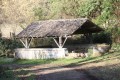
The wash house is located on the edge of the rural path that leads from local road no. 2 south of the village of La Carte towards the Belle river. A few steps lead down to it. The wash house, which is not covered, is sheltered on two sides by a restored rubble stone wall. The basin is fed by a masonry spring. A pump, with a copper body and cast iron rocker arm, completes the ensemble.
Source: "Les lavoirs des Deux-Sèvres" (The Wash Houses of Deux-Sèvres) published by the Deux-Sèvres General Council

La Dairy Farm aux Moines

Periods of construction: Four different eras mark the history of the site.
18th century
19th century
Third quarter of the 19th century
Fourth quarter of the 19th century
Source: Monuments de France and Wikipedia (excerpts)

Melle

Saint-Hilaire Church: Catholic church. It has also been listed as a UNESCO World Heritage Site since 1998, as a stop on the Way of St James in France. Note in particular the chevet, characterised by the staggered roofs of the apses, then the ambulatory, and finally the choir, which is surmounted by the bell tower. It is a model of balance. The south face: above the portal runs a cornice with historiated modillions (symbols of the Evangelists) between which are carved the signs of the zodiac. The north side wall: notable for its sculptures. The high-relief horseman in a niche, symbolising Constantine I's victory over the pagans, surmounts the representation of the battle between vices and virtues on the outer roll of the arch. The current sculpture dates mainly from a restoration in 1872, with only the central part being authentic.

There are two other Romanesque churches in the town: Saint-Savinien and Saint-Pierre. The Hôtel du Ménoc (former courthouse) is also worth a visit.

In addition to its Romanesque churches, Melle has a number of other remarkable monuments and sites:
- The Hôtel de Menoc, a composite building with stair towers in the flamboyant Gothic style.
- The Art Deco bandstand
- The metal-framed market halls
- The hospital, a former Capuchin convent
- The Protestant temple and cemeteries, signs of the strong influence of the Reformation
- The Discovery Trail
- The Green Ribbon
- The forest arboretum
- The Loubeau quarries
Source: Wikipedia (excerpts)

Reviews and comments

4.5 / 5
Based on 6 reviews

Reliability of the description
4.2 / 5
Ease of following the route
4.8 / 5
Route interest
4.5 / 5
Stef du Pwatoo
Stef du Pwatoo

Overall rating : 4.7 / 5

Date of your route : May 10, 2021
Reliability of the description : ★★★★☆ Good
Ease of following the route : ★★★★★ Very good
Route interest : ★★★★★ Very good
Very busy route : No

A lovely walk, not too long to warm up your legs.
The route is quiet and very pleasant, mainly following paths.
I can confirm the error in the route details at point 6: when you reach the top of the stairs, turn right, not left, and follow the "green ribbon".
Thank you for introducing us to these pleasant routes.

Machine-translated

Luzi
Luzi

Overall rating : 4.7 / 5

Date of your route : Feb 15, 2021
Reliability of the description : ★★★★★ Very good
Ease of following the route : ★★★★★ Very good
Route interest : ★★★★☆ Good
Very busy route : No

Very good route, I extended it by continuing along the path to Les Chaumes Rondes (before Checkpoint 3) then returning from La Source de la Belle to the original path before turning onto the greenway. 6.36 km in total
Thank you for these routes!

Machine-translated

pgetrochon
pgetrochon

Good evening,

Actually, the description is correct. It was the waypoint (5) that was incorrectly positioned. By mistake, it ended up at the bottom of the stairs instead of at the top on the green ribbon path. I have just corrected this slight discrepancy on the map attached to the description. I apologise for any inconvenience this may have caused you. The landmark at this location is also the fact that you have to pass under the Green Ribbon before turning right towards the Belle spring.
I invite you to try again when you have the opportunity.
Happy hiking.

Machine-translated

brizim
brizim

Overall rating : 4 / 5

Date of your route : Feb 14, 2021
Reliability of the description : ★★★☆☆ Average
Ease of following the route : Not used / Not applicable
Route interest : ★★★★★ Very good
Very busy route : No

Hello,
There were three of us on this very pretty and varied route. The only problem, which has already been pointed out, is that you have to turn RIGHT and not left at point 5, at the top of the stairs, as indicated in the description. We ended up at the wrong end of the greenway and, due to the 6 p.m. curfew, we had to run back the 3.8 km in the opposite direction. Please amend the description and it will be perfect!

Machine-translated

Elo79
Elo79

Overall rating : 4.3 / 5

Date of your route : May 25, 2020
Reliability of the description : ★★★★☆ Good
Ease of following the route : ★★★★★ Very good
Route interest : ★★★★☆ Good
Very busy route : No

A lovely, very peaceful walk. However, vegetation encroaches on the path in places (particularly between points 3 and 4) and two people in our group were bitten by ticks.
At point 5, at the top of the stairs, turn right and not left as indicated.
The cultural information provided in the hiking guide is really very interesting.

Machine-translated

pgetrochon
pgetrochon

Thank you for your comment.

For paths that are rarely or poorly cleared, it's true that it's a lot of work for local authorities and farmers, and we don't fully appreciate how much time they spend on it. Otherwise, we would need more hikers on these paths... but there are so many of them in our area, and it's so nice to have so many. Sometimes a stick can be used to flatten the nettles. Personally, I always carry pruning shears with me to cut back brambles that can quickly grow across a path and make it impassable.
Happy hiking.

Machine-translated

jcmc79
jcmc79

Overall rating : 4.3 / 5

Date of your route : Jun 03, 2019
Reliability of the description : ★★★★☆ Good
Ease of following the route : ★★★★☆ Good
Route interest : ★★★★★ Very good

A pleasant hike, even though one section was not well maintained, forcing us to weave our way through brambles and nettles. The shaded paths were very pleasant in the hot weather. Thank you.

Machine-translated

pgetrochon
pgetrochon

Thank you for your comment and for the cultural insights it provides.
Happy hiking!

Machine-translated

Gâtino-rando
Gâtino-rando

Overall rating : 4.7 / 5

Date of your route : Feb 23, 2019
Reliability of the description : ★★★★★ Very good
Ease of following the route : ★★★★★ Very good
Route interest : ★★★★☆ Good

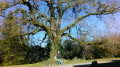
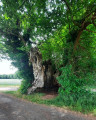
A very pleasant short route, especially along the stretch that runs alongside the Belle. With the glorious February sunshine, it was divine! The added bonus of this fairly short distance is that you have time to stroll around the surrounding villages: La Carte, Villermat and Clopegenet, with the latter being my favourite. There are some beautiful old houses there. Perhaps the highlight, in terms of nature, is the sight of the majestic centuries-old lime tree located just before Eclopegenet (before 2) on the small road that runs alongside the "houses on the right", overlooking the path. These houses are in fact a superb, large property, and the lime tree stands opposite its entrance gate on the right-hand side of the road. At its foot, an environmental association has installed a plaque inscribed with these lines by the Poitevin poet Maurice Fombeure (born and died in the 20th century): "I am light to the tips of my branches, unevenly shaped from the chest up and heavy from the trunk down. But birds populate my Sundays, and the winds turn their squadrons there"... That says it all! Thank you for this beautiful walk.

Machine-translated

Other walks in the area

For more walks, use our search engine .

The GPS track and description are the property of this route's author. Please do not copy them without permission.