Prahecq
Prahecq is a town with a population of over 2,000. It is situated 15 km from Niort.
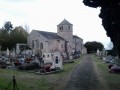
The town of Prahecq has a church dedicated to Saint Maixent; the church has a fascinating history. Inside, you’ll find faces carved into the columns, including the fairy Mélusine, and there are also two tombs beneath the church. This church is said to be connected to the Château de la Voûte and leads to the fort via underground passages, which are now unusable as they have collapsed.
Places and monuments
Fosse de Paix (artesian well)
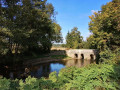
The monks of Artois had nothing to do with it; Prahecq has inherited its history – a geological one at that – from an artesian well known as the Fosse de Paix, at the western entrance to the village. Every wet winter, water gushes up from the water table through a fissure and bubbles up into a vast basin, at the bottom of which the villagers have dug a well.
Château de la Voûte
Set amidst extensive grounds, a local lord named Baudouin had a castle built for himself in the early16th century in the purest early Renaissance style, modelled on Azay-le-Rideau, though with somewhat more modest financial means... Nevertheless, the carved decorations on the exterior, on the east and west façades, are so heavily inspired by Greco-Roman motifs that the lord of the castle had himself depicted on numerous occasions fighting a lion… His family is also finely carved, particularly his wife, in whom one need not strain too much to see a resemblance to the Mona Lisa… During the war, Château de la Voûte lost its wing, which is now only visible on old postcards. The war had nothing to do with it. The cause was a chimney fire in 1943. The château was purchased by the local council some thirty years ago. The ground floor hosts weddings and ceremonies, whilst the adjacent former farmhouse is currently being converted into a community, cultural and leisure centre.
Fiée des Lois (a natural spring, from which the town takes its name, Prahecq meaning ‘wet meadow’): thanks to geological surveys, a deep aquifer was discovered at a depth of around one hundred metres. Of high quality and in ample supply, it is bottled in the plant built above it, under the local name ‘Fiée des Lois’ – now abbreviated to ‘FDL’ for international recognition – and distributed by the Intermarché group. The plant was able to be built on this site as the land had previously been used to store materials for the construction of the motorway.
Butte du Peu, the highest point in the commune at 78 m; according to legend, it was created from Gargantua’s excrement.
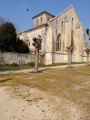
The Church of Saint-Maixent.
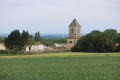
The church, for its part, continues to stand proudly at the centre of the village. Named Saint-Maixent, after the Bishop of Agde who came to Poitou in the5th century, it has retained features from its12th-century Romanesque origins
The Church of Saint-Maixent in Prahecq features numerous sculptures. Outside, first of all, between heaven and earth, several modillions remain, through which unknown artists gave free rein to their creative imagination whilst conveying a message to the faithful approaching the church: that the path leading to heaven is paved with many evil temptations. Inside, a few capitals depict, notably, a pair of tempting mermaids or Samson fighting a lion with his bare hands. However, as indicated by an inscription carved into the south-east interior wall of the church, the so-called ‘Wars of Religion’ swept through the area in 1568 and the church was set alight. Many stained-glass windows were bricked up, and over the course of two centuries, depending on the local church council’s finances, repairs were carried out which provided the church with a number of stained-glass windows in the Rayonnant Gothic style. A monumental altar stone, probably dating fromthe 15th century, depicts the Entombment and Resurrection of Jesus Christ in six carved scenes.
Some notable figures
Madame Ernest Pérochon was much more than simply the wife of the Goncourt Prize-winning author from Deux-Sèvres. Born in Prahecq as Wanda Houmeau, she became a primary school teacher and taught in Vouillé alongside her husband, who had taken up writing. And it was she who convinced him to invest their meagre household savings in publishing *Nêne*, which earned its author the 1920 Prix Goncourt. It was also she who persuaded him to leave teaching and move to Avenue de Limoges in Niort to devote himself to writing.
André Nocquet(1914–1999), the founder of aikido in France, was born there, and his house stands on the village square.
Dr Gazeau had come to practise medicine in Prahecq before 1939. As a member of the ‘Triangle 16’ network, he used his position as a doctor to hide fugitives in local farms, sign false medical certificates and pass on intelligence. He died on 2 July 1944 in Triou de Mougon, mistakenly strafed by Canadian aircraft which had caught his car in their line of fire. The collaborationist press seized the opportunity to denounce the British for murdering brave French citizens. Dr Gazeau’s wife moved to Niort and joined the Lycée Fontanes after the war.
Source: Wikipedia (excerpts) and an article by AMOPA79, ‘Prahecq, between past and future. The town where history flows naturally’, by Gilles Brangier (excerpts)



 Country:
 City:
City:



 Visorando Member

 Moderate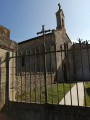
 Association / Club / Walk leader