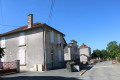
On either side of the Lambon, passing through Pied l'Ouaille

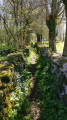
A pleasant hike on either side of the Lambon at the gateway to Niort in a little-known, peaceful countryside with varied landscapes. This route also allows you to discover a high-quality ancient built heritage with beautiful properties, a dovecote, etc.

Details

1069804
Creation:
Last update:
Last review:
  • Walking
    Activity: Walking
  • ↔
    Distance: 10.00 km
  • ◔
    Average duration: 3h 05 
  • ▲
    Difficulty: Moderate

  • ⚐
    Back to start: Yes
  • ↗
    Ascent: + 87 m
  • ↘
    Descent: - 94 m

  • ▲
    Highest point: 114 m
  • ▼
    Lowest point: 60 m
  • ⚐ Country: France
  • ⚐ District: Fressines (79370)
  • ⚑
    Start/End: N 46.320062° / W 0.291059°
  • ❏
    IGN map(s): Ref. 1628SB
  • Hour-by-hour weather

Photos

Description of the walk

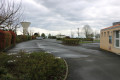
Park in the car park of the Fressines village hall.

(S/E) Join the Mougon road. Head north-west and follow the road carefully until you reach Rue de la Thibaudière on your right.

(1) Turn onto Rue de la Thibaudière, then right a few metres further on.
The street soon gives way to a path, the Venelle de la Garenne, which quickly descends to a crossroads.
Turn right onto an almost level path that heads east.
Further on, the path turns right at almost a right angle. After about 100 metres, turn left (about 30 metres before the road). The path then descends quite steeply to a flat farm track.

(2) At the crossroads, turn left and follow the farm track, which soon runs alongside the Lambon river.
Continue straight ahead until you reach a road, Rue de Rochetan.

(3) Turn right and carefully follow Rue de Rochetan northwards: it passes over the Lambon. Continue to the crossroads of two roads and a path shortly afterwards.
Take the farm track on the left. This climbs up a small valley a little further on towards Moulay Bas.
The track reaches a small road that leads to Moulay Bas. Cross it carefully and continue straight ahead on a farm track. Continue straight ahead until the farm track turns to the right.

(4) At the bend, take the path opposite that heads north.
Follow it until you reach a road near Les Chaumettes.
At the crossroads, take the left-hand road, which quickly turns into a farm track and heads west.
The track winds its way until it joins an east-west road at a T-junction.
Turn left and follow the path along the edge of the woods.
Further on, the path turns almost at a right angle to the left. Continue to the next T-junction.

(5) Turn right and then left at the next crossroads.
Continue straight ahead until you reach the street of a sort of housing estate. The junction is at a right-angle bend. Go straight ahead and shortly afterwards take Rue du Pigeonnier, which branches off to the right, leaving the path straight ahead.
At the next crossroads, continue straight ahead westwards along Rue du Pigeonnier and join the D7 road which crosses Bougouin. Admire the17th-century dovecote, which is part of the Château de Bougouin, located in the commune of La Crèche, in another canton.
Turn left and carefully follow the D7 road for about 20 metres before crossing it.

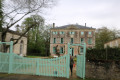
(6) Turn right onto Route de Vaumoreau and go around a beautiful residence.
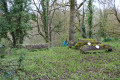
Once you are behind the property, turn right onto the road that soon leaves Bougouin and winds through the fields, passing a family cemetery on your left.
Continue to the second right-angle bend after the family cemetery.

(7) At the bend, continue straight ahead along the farm track. This track, which is flat at first, eventually descends towards the Lambon. It leads to a road near a pumping station and a crossroads.
When you reach the road, turn left and take the road towards Pied l'Ouaille.
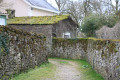
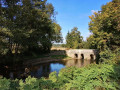
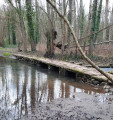
Cross the locality and turn left onto the farm track along a stream (take the path on a low stone wall). The path immediately turns right and crosses the Lambon river over an old stone bridge.
Continue to the junction with the Chemin de la Guiberte.

(8) Turn left and take the Chemin de la Guiberte towards the east. This path climbs towards some houses.
At the first crossroads, turn left and at the next one, turn left again into Rue du Lambon, which descends below the houses.
At the next crossroads, turn right onto Rue du Quartier Latine and climb up to the crossroads with Rue de Tibu.
Turn left and follow this street slightly downhill. At the end, the route arrives at a T-junction.
Turn left onto the downhill path that leads almost to the Lambon.

(9) Just before the Lambon, turn right onto a path that runs alongside the Lambon.
Follow the Lambon to the farm track that runs from La Plinière to Bougouin.
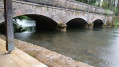
At the crossroads, admire the bridge over the Lambon before turning right onto the path towards La Plinière (south). Follow the path for about seventy metres before turning left onto a path that heads east into a wooded area.
Continue along the hillside until you reach the path that runs from La Billaudière to Bougouin.
Turn right onto the path towards La Billaudière. Admire the very typical family cemetery opposite the crossroads.
Climb up to La Billaudière. When you arrive, the path joins Rue de la Billaudière.

(10) Take Rue de la Billaudière on the left, along the hillside.
Continue to La Remondière.
When you reach the crossroads of four streets, cross carefully and continue straight ahead along Rue du Lison.
Go to Rue de la Fontaine on the left.
Turn left and follow this street until you can take the Mi-Voie alleyway that runs behind the Pierre Moinot School.
At the end of the alley on Place des Charmilles, you will see a well by the side of the road.
Continue straight ahead into Rue du Vieux Puits.
At the end, return to the D7 road and continue on the right. Follow this road with great caution until you reach the Salle des Fêtes.
Enter the car park and drive to the parking spot (S/E).


Waypoints

  1. S/E : km 0 - alt. 110 m - Car park at the village hall
  2. 1 : km 0.25 - alt. 108 m - Crossroads
  3. 2 : km 0.86 - alt. 80 m - Crossroads
  4. 3 : km 1.46 - alt. 72 m - Path-road junction. Bridge over the - Lambon (rivière) à finaliser
  5. 4 : km 2.62 - alt. 112 m - Crossroads
  6. 5 : km 3.54 - alt. 104 m - Crossroads
  7. 6 : km 4.5 - alt. 91 m - Crossroads
  8. 7 : km 5.34 - alt. 84 m - Road-path junction
  9. 8 : km 6.54 - alt. 61 m - Crossroads of farm tracks
  10. 9 : km 7.57 - alt. 65 m - Crossroads
  11. 10 : km 8.05 - alt. 68 m - Crossroads
  12. S/E : km 10 - alt. 110 m - Car park at the village hall

Notes

The car park is located next to the Salle des Fêtes de Fressines (route de Mougon, a short distance from the water tower).

This hike takes place on varied terrain with some descents on stony paths, so suitable footwear is required.

This path is not marked, even though it follows sections of various marked paths (of which there are many in this area). It is therefore advisable to follow the directions in the description and on the map, while also reading the landscape.

Hike completed on 11 April 2018.

Worth a visit

Fressines
Origins of Fressines:
The name Fressines is certainly related to the presence of numerous ash trees in the local landscape. Initially named "FRAZINA" (which first appeared in 1259), the commune became Saint-Martin de Fressines, then Fressines after the Revolution.
Fressines certainly owes its existence to the founding of the Picton cities in the 12th century.
A sad story
In 1898, Marie Simon, aged 83, living in the hamlet of La Billaudière, was murdered in her home. The octogenarian was strangled in her bed and her home was ransacked. The case caused a great deal of emotion in the Deux-Sèvres region, with newspapers expressing outrage at the violence of the crime and the lack of results from the investigators. For several weeks, the law enforcement officers searched and questioned people in the village. Henri Pommier, a 20-year-old farmhand, was suspected but could not be found. Despite dozens of reports throughout France, Henri Pommier was never caught. In 1904, the Deux-Sèvres Assize Court sentenced him to death for murder and theft.
Notablefigures
Pierre Cochon du Vivier was born in Fressines in 1731. He was chief surgeon at the port of Rochefort before being appointed director of the school of surgery in 1788. Dismissed during the Reign of Terror, he only resumed his duties after 9 Thermidor and was elected deputy in 1799.
Pierre Moinot (1920-2007), senior civil servant, writer and member of the Académie Française, was born in Fressines.
Source: Wikipedia (excerpts)

The Wars of Religion
The Dragonnades
The 16th century, a period of religious conflict, saw Protestantism, initiated by Jean Calvin, take root in the Poitou region.
The Edict of Nantes (1598), signed by Henri IV, then the new King of France, put an end to the conflicts between Catholics and Protestants. It allowed Protestantism to take root in Poitou, where strongholds and garrisons were established in Thouars, Saint-Maixent, Niort, and elsewhere.
At the beginning ofthe 17th century, Louis XIV, the "Sun King", decided to unify the kingdom in order to fight against invaders and forced Protestants to return to "the true religion". However, various measures, notably the surtaxes imposed on Protestant families by Colbert, were deemed insufficient. Marillac, Intendant of Poitou, invented a new method of oppression known as the "dragonnades".
The "dragons", as Louis XIV's soldiers were known, would then reside in Huguenot homes in order to obtain the Protestants' abjuration.
In central Poitou, an estimated 38,000 Protestants signed "the register" of new converts (the name of the document that the dragons made them sign).
Source: Protestant Museum website
Fressines, a predominantly Protestant community, experienced first-hand the famous dragonnades that took place in the region.
In 1681, under the persecution of the king's dragoons, 328 inhabitants of Fressines renounced their religion.

In the Desert
In 1685, Louis XIV, believing that there were no more Protestants, revoked his grandfather's edict at Fontainebleau.
The pastors were forced into exile, but this obligation did not apply to the faithful.
The exiles were welcomed in Germany, England and Holland.
Those who remained faithful to Protestantism went into hiding, a state of affairs known as "the desert".
Under this principle, Protestants would meet at night in woods, forests and fields.
"Desert" assemblies were held in Fressines, notably in 1746, at Bois-Martin and La Chesnaye.
Peasants, both men and women, as well as a few pastors who had returned from abroad under cover of a pseudonym, organised the preaching.
The dead were buried at night, quietly, on plots of land belonging to families.

The Marks of Protestantism
This is the origin of the small cemeteries found in the commune of Fressines, but more widely throughout the region.
Fromthe 16th tothe 17th century, the clergy refused to bury those who had not received the sacraments of the Catholic Church in "holy and blessed ground".
These cemeteries, whether communal or family-owned, are characterised by their low stone walls, bordered by box hedges, and where one or more cypress trees are usually planted. A few of them still remain, in varying states of repair, within the commune.
Another visible sign of the Protestant country is the presence of temples of various sizes found in the villages and hamlets of southern Deux-Sèvres. These public places allow people to listen to readings from the Bible and meditate on its teachings. Here, people address God directly, with no intermediary other than Christ. This explains the absence of statues representing the Virgin Mary or the saints.
The landscape is sometimes punctuated by the silhouette of a stone pine (or pine tree), which is unusual in our region.
These southern trees owe their presence, from the 16th century onwards, to peddlers who distributed Bibles and Protestant religious works that were then banned.
Buyers were given pine nuts and invited to sow them to mark their friendship with followers of Protestantism.
Houses marked by the presence of a stone pine offered a safe haven.
Places known as "le pin" or "le pinier", which usually mark an isolated farm or hamlet, owe their names to this practice.
Finally, walkers will notice villages without bell towers, statues of Christ or monuments to the glory of the Virgin and Child at crossroads.
Nor will they find stone crosses at the corners of fields.

Heritage
The Baths
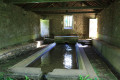
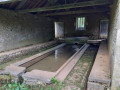
The public baths were built in 1953; since 1992, the small building has housed the town hall secretariat.

Le Lison
Farm with separate buildings. Five bays. Central door.
Components: shed; orangery; dovecote; outbuilding; park; driveway
According to the owners, work on the park began in 1845 and construction of the dwelling began in 1850.
The orangery, which is more recent, dates from 1920.
The dwelling has five bays and a moulded central door, preceded by a circular staircase.
The central bay, which protrudes slightly from the rest of the building, is crowned by a triangular pediment, inside which is a coat of arms bearing the inscription: Le Lison.
A string course, running just below the windows on the upper floor, divides the façade horizontally; a moulded cornice crowns the elevation and the roof is topped with a crest and metal finials.
To the south-west of the dwelling is an orangery and opposite it, to the south-east of the dwelling, are various outbuildings, including a shed and a dovecote.
Opposite and to the south of the dwelling, on the other side of the road, is a driveway marked by two pillars at its entrance, which leads to a place called La Badinière.

The Lambon (river)
The Lambon rises in Goux, in the commune of La Couarde, at an altitude of 156 metres.
It flows into the Sèvre Niortaise in Niort at 12 metres above sea level, near the source of the Vivier.
With a length of 37.85 km, it flows through the municipalities of La Couarde, Beaussais, Vitré, Thorigné, Prailles, Mougon, Aigonnay, Fressines, La Crèche, Vouillé and Niort, i.e. 11 municipalities.
It rises from a multitude of springs, which are unique in that they are located at an altitude of 155 metres above sea level.
From its source to Thorigné, it cuts through part of the Mellois plateau with its red soil covered in chestnut trees (clay and flint).
This part is a bocage region, with scattered farms and villages.
From its source to the entrance to the Lambon lake, the river already loses 50 metres in altitude.
From Fressines to Niort, the Lambon flows through the cereal-growing plains of the Niort region.
The geological structure is different, with groies soil covering the limestone rock, a gentle slope and a winding stream.
Source: municipal website

Reviews and comments

4.7 / 5
Based on 11 reviews

Reliability of the description
4.9 / 5
Ease of following the route
4.6 / 5
Route interest
4.6 / 5
Joel J.
Joel J.

Overall rating : 5 / 5

Date of your route : May 26, 2025
Reliability of the description : ★★★★★ Very good
Ease of following the route : ★★★★★ Very good
Route interest : ★★★★★ Very good
Very busy route : No

Very beautiful nature route.
Very interesting heritage.

Machine-translated

TINO1779
TINO1779

Overall rating : 4.5 / 5

Date of your route : Apr 17, 2025
Reliability of the description : Not used / Not applicable
Ease of following the route : ★★★★☆ Good
Route interest : ★★★★★ Very good
Very busy route : No

A very beautiful hike with few roads and well-maintained paths and trails.
At point 9, don't hesitate to go down to the bridge... At the pump, a small passageway leads to a wash house.
It's only a 200-metre round trip, but in my opinion it's well worth the detour.
I think this route can be done in the height of summer... The paths are very shaded.

Machine-translated

2MC
2MC

Overall rating : 4.7 / 5

Date of your route : Feb 28, 2025
Reliability of the description : ★★★★★ Very good
Ease of following the route : ★★★★☆ Good
Route interest : ★★★★★ Very good
Very busy route : No

The route is very well described, so be sure to follow the information and the map.
There is a lot of water at this time of year, which means you need to wear suitable footwear.
The gurgling of the Lambon and the birdsong accompanied us throughout this beautiful hike.
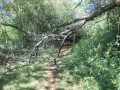
PLEASE NOTE: during our hike, we encountered some difficulties between points 9 and 10, with large trees fallen across the path (which we were able to cross, however!) and a backwater of the Lambon (about 50 cm deep) cutting across the path for a width of 2-3 m, making it impassable. Turn right onto a "meadow" where there is a barbed wire gate and follow the faint footprints for 150 m to find another gate leading back to the trail. Do not forget to close these gates behind you.

Machine-translated

kgyorffy
kgyorffy

Overall rating : 4.3 / 5

Date of your route : Nov 17, 2024
Reliability of the description : ★★★★★ Very good
Ease of following the route : ★★★★★ Very good
Route interest : ★★★☆☆ Average
Very busy route : No

Nice ride.
Personally, I found it not "wild" enough, a bit too much tarmac.
It's perfect for a walk. Thank you for this route.

Machine-translated

Motives
Motives

Overall rating : 4.3 / 5

Date of your route : May 13, 2024
Reliability of the description : ★★★★★ Very good
Ease of following the route : ★★★★☆ Good
Route interest : ★★★★☆ Good
Very busy route : Yes

Lovely walk

Machine-translated

Hortial
Hortial

Overall rating : 5 / 5

Date of your route : Feb 05, 2023
Reliability of the description : ★★★★★ Very good
Ease of following the route : ★★★★★ Very good
Route interest : ★★★★★ Very good
Very busy route : Yes

A superb walk, mostly shaded, which takes you upstream along the Lambon river and allows you to discover peaceful spots.
We have had the opportunity to walk it several times with friends. The multitude of paths in the area offers hikers the opportunity to personalise their routes.

Machine-translated

Nmf
Nmf
• Edited:

Overall rating : 5 / 5

Date of your route : Mar 05, 2021
Reliability of the description : ★★★★★ Very good
Ease of following the route : ★★★★★ Very good
Route interest : ★★★★★ Very good
Very busy route : No

A wonderful walk, winding along the Lambon, sunken paths and small stone bridges, beautiful countryside. One downside: avoid during periods of flooding.

Machine-translated

Jonaz
Jonaz

Overall rating : 4 / 5

Date of your route : Aug 30, 2020
Reliability of the description : Not used / Not applicable
Ease of following the route : ★★★★☆ Good
Route interest : ★★★★☆ Good
Very busy route : Yes

Pleasant despite a little rain!

Machine-translated

pgetrochon
pgetrochon

Thank you for your message.
Happy hiking!

Machine-translated

Sneg
Sneg

Overall rating : 4.3 / 5

Date of your route : Jul 09, 2020
Reliability of the description : ★★★★☆ Good
Ease of following the route : ★★★★☆ Good
Route interest : ★★★★★ Very good
Very busy route : No

A lovely walk that I highly recommend. As mentioned, you really need to wear suitable footwear (stony paths)!

Machine-translated

pgetrochon
pgetrochon

Thank you for your comment. Enjoy your group outing, and I hope that the other hikers will enjoy this hike as much as I did.

Machine-translated

jlfaure
jlfaure

Overall rating : 5 / 5

Date of your route : Aug 13, 2019
Reliability of the description : ★★★★★ Very good
Ease of following the route : ★★★★★ Very good
Route interest : ★★★★★ Very good

I did this route on my own before suggesting it to my club, which I will definitely do because I was not disappointed.
Quite the contrary.

Machine-translated

pgetrochon
pgetrochon

Thank you for your comment.
Happy hiking!

Machine-translated

Cmarsil
Cmarsil

Overall rating : 4.7 / 5

Date of your route : Jun 14, 2019
Reliability of the description : ★★★★★ Very good
Ease of following the route : ★★★★★ Very good
Route interest : ★★★★☆ Good

Lovely walk
Worth repeating

Machine-translated

Other walks in the area

For more walks, use our search engine .

The GPS track and description are the property of this route's author. Please do not copy them without permission.