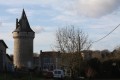
Around Sainte Blandine

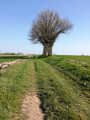
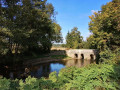
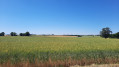
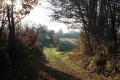
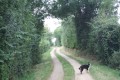
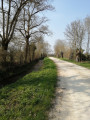
A walk with little elevation gain on the Mellois plateau in the Sainte-Blandine area. This route alternates between farm tracks and quiet country lanes used only by local residents.
This walk offers the chance to see Poitou donkeys when they are out in the pastures or grey mares (at several points along the route).

Details

486443
Creation:
Last update:
Last review:
  • Walking
    Activity: Walking
  • ↔
    Distance: 6.06 mi
  • ◔
    Average duration: 2h 55 
  • ▲
    Difficulty: Easy

  • ⚐
    Back to start: Yes
  • ↗
    Ascent: + 105 ft
  • ↘
    Descent: - 98 ft

  • ▲
    Highest point: 344 ft
  • ▼
    Lowest point: 230 ft

Photos

Description of the walk

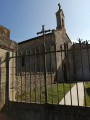
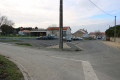
Park at the junction of Rue de l’Église and Chemin du Village.

(S/E) Leave the car park by taking Rue de l’Église, which runs alongside the cemetery. When you reach the junction with Rue de la Cure, turn left.
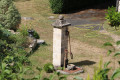
Pass a road on your right and immediately afterwards, turn left onto Chemin de la Dairy Farm. Walk past the farm and its model. Pass a dead-end path on your left.
Chemin de la Dairy Farm curves to the right just before joining a road at a T-junction. Turn left and continue to the junction with Chemin du Puits de la Vallée.

(1) Continue straight on, passing two roads on the right and one on the left. Follow this road until you reach a path on the right; take it.
You’ll reach a road with a T-junction. Turn left and continue along this road until the next T-junction.

(2) Turn 90° to the left. At the next junction, continue straight ahead. The road curves slightly to the left. Follow it to the crossroads at the hamlet of Pied de Lièvre.

(3) Turn right towards Bois Renoux. The road passes under the high-voltage power line. Ignore a road on the left leading to the houses in Bois Renoux. You will reach another junction with a path.

(4) Turn right onto this track. At the next crossroads, turn left. Further on, the track becomes a road near the hamlet of Le Genêt. Continue along the road, passing near Le Genêt, and go as far as the T-junction.

(5) Turn right onto the road heading towards the hamlets of Le Courteil and Saumon. Pass in front of Courteil Castle. At the next junction, ignore the two roads and continue left towards Saumon.
The road passes the old Courteil farm, which once belonged to the château.
Further on, ignore a farm track on the left just before a right-hand bend at the entrance to Saumon.
Cross Saumon via the Route des Talles, passing the Rue des Tisserands on the right and a track on the left. Continue straight on at the next crossroads.
A little further on, the road turns to the right. Pass a road – the Chemin du Puits – on the right and a farm track on the left leading to houses. Continue straight on to the T-junction with the Route de la Croix du Chêne.
Turn left and head towards a four-way junction.

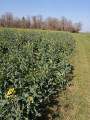
(6) Turn left onto the farm track. This track, which starts on the edge of the woods, then passes through the middle of the fields before returning to the edge of the woods and continuing between two fields. The track leads to a bend in the road where a second farm track joins it.

(7) Turn right onto the second farm track, leaving the road on your left. Further on, pass a farm track on your left.
You’ll reach the Route du Grand Lac. Turn left onto it for about 50 metres until you reach another forest track.

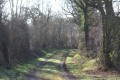
(8) Turn left onto it and follow it until you reach a road just before a junction.

(9) First turn right then left, pass under the high-voltage power line and continue straight ahead at the next junction onto Chemin des Trois Bois. Return to Sainte-Blandine and Chemin du Village.

(10) Turn left to quickly reach the car park (S/E).

Waypoints

  1. S/E : mi 0 - alt. 272 ft - Crossroads Rue de l'Église - Chemin du Village
  2. 1 : mi 0.47 - alt. 262 ft - Crossroads – go straight on
  3. 2 : mi 1.12 - alt. 246 ft - T-junction – turn left
  4. 3 : mi 1.79 - alt. 272 ft - Crossroads at Pied de Lièvre – turn right
  5. 4 : mi 2.02 - alt. 302 ft - Road-path junction at Bois Renoux – turn right
  6. 5 : mi 2.48 - alt. 315 ft - T-junction – turn right
  7. 6 : mi 3.35 - alt. 331 ft - Crossroads – road and path – turn left
  8. 7 : mi 3.94 - alt. 338 ft - Crossroads – 2 paths
  9. 8 : mi 4.55 - alt. 335 ft - Crossroads – farm track – left
  10. 9 : mi 5.36 - alt. 282 ft - First turn right then left
  11. 10 : mi 5.95 - alt. 266 ft - Crossroads – turn left
  12. S/E : mi 6.06 - alt. 272 ft - Crossroads Rue de l'Église - Chemin du Village

Notes

Parking is available in an open space near a junction close to the church and the cemetery: at the corner of Rue de l’Église and Chemin du Village.

This route alternates between farm tracks and quiet country lanes. Nevertheless, it is advisable to wear suitable footwear.

Worth a visit

Sainte Blandine
History

The connection between the name of the village (the well-known saint) and its translation into the local dialect is problematic. Indeed, the oldest residents, or those originally from the area, do not say Sainte-Blandine, as one might expect, but “Sé-Piazine”. Who knows this saint, absent from the dictionary of saints and blessed? However, on a map from the late 16th century, at the exact location now occupied by Sainte-Blandine, between Celles and “Prahec”, we read: S Placine, which is very close to the dialectal form (Pla? Pia).
In 175 AD, Saint Blandine, known as the Saint of Lyon, is said to have come to this region of Gaul to preach the holy word, and is said to have left in the church of Sainte-Blandine extracts from holy writings, penned by Saint John (according to legend); these writings are now archived at Notre-Dame Cathedral in Paris. It was not until 1789 that the village was renamed Sainte-Blandine, that is to say, after the discovery of the sacred writings in the church. Before that, the illustrious village was known as Le Fief Cellois, as it still belonged to the canton of Celles-Belle.
Since that time, various legends have emerged regarding Saint Blandine’s visit to the village. According to accounts from long-established families of Sainte-Blandine, the saint was lost when she arrived in the “fief cellois”. She went to preach the holy word using water from the well and found the divine voice that guided her back to her home. From that day on, Saint Blandine is said to have been the village’s spiritual guide. But this is merely a legend.
Another legend says that she was abducted by the Count of the Fief Cellois, who was an extraordinary courtier, and that he kept her captive for seven days. On the seventh day, she finally broke free. A maid recounted that she had managed to escape thanks to the divine voice of the saint, which is said to have opened the gates of light leading her home. The baron, who had fallen madly in love with the young girl, let himself die of despair. Thus the count’s Chatelet was destroyed and the village square was built on the site, where today stands the holy well that brings light to dark thoughts.

Notable figures associated with the commune
Jacques Bujault, MP for Deux-Sèvres from 1815 to 1822. Author of various works popularising agricultural progress. His bust stands in front of the village school in Tauché, the largest village in the commune.

Introduction to the commune

Documentary file compiled from the 1999 inventory survey. Poitou-Charentes region
Jacques Bujault (1771–1842), a printer and author of agricultural almanacs, acquired a large farm in Challoue where he settled, as well as farms in La Forêt and the neighbouring village of Saint-Médard. In 1878, the town hall and school were built with the money he had bequeathed for this purpose. To commemorate his memory, a monument was erected in front of the town hall and school in 1880.
History
Under the Ancien Régime, the parish of Sainte-Blandine was situated in the district of Saint-Maixent and fell partly under the jurisdiction of the provostship of Melle and, in spiritual matters, the archpriesthood of Exoudun. The main road known as the “Rochelais” ran along part of the southern boundary of the village before reaching Saumon. Two hoards of French and Spanish gold coins from the 16th century and the first half of the 17th century, found near the field known as the “Champ doré”, confirm the existence of a trade route, likely linked to the mule trade. During the Reformation, a large number of its inhabitants converted to Calvinism, and even today, around a hundred private Protestant cemeteries are scattered throughout the village. A headstone, erected on private land, bears the inscription:
FROM 1572 TO 1789 / DUE TO THE MISFORTUNES OF THE TIMES / THE BODIES OF POOR PROTESTANTS / REFUSED ENTRY TO THE COMMUNAL CEMETERY / OF ST BLANDINE / WERE BURIED IN THIS CORNER OF LAND / BY THE MORILLON FAMILY / PASSERS-BY, RESPECT THEIR MISERY!
From the creation of the Deux-Sèvres department, Sainte-Blandine has been part of the canton of Celles-sur-Belle. In the 19th century, the Protestant community (along with those of Celles and Verrines) formed part of the second section of the consistorial church of Melle and was served by a dedicated pastor residing in Celles. The Protestant inhabitants of Sainte-Blandine contributed financially to the construction of the church in Celles-sur-Belle. Before 1916, a small chapel (now demolished) was built in Tauché. In addition to this large hamlet, there is the village of Sainte-Blandine, where the church and the old cemetery are located, and Saumon, a few hamlets (Bois-Renoux, Challoue, Fief-Briant, La Forêt, Le Magnou, La Pièce), a few isolated farms (Belle-Plaine, Le Genet), the Château du Courteil and the farm attached to it. In the past, many plots were enclosed by dry stone walls; where these remain, there are fine country lanes. In the early 20th century, the northern part of the commune was crossed by the Niort to Ruffec railway line, to the west of the Chaloue farm. A new municipal cemetery, situated between the villages of Sainte-Blandine and Tauché, was opened in 1968 at a place known as Le Magnou. With the exception of the quarries known as the Saintonge quarries, the village has never had any activities other than agriculture.

Reviews and comments

4.6 / 5
Based on 4 reviews

Reliability of the description
4.5 / 5
Ease of following the route
4.7 / 5
Route interest
4.5 / 5
Mathé Thierry
Mathé Thierry

Overall rating : 5 / 5

Date of your route : Jun 15, 2026
Reliability of the description : ★★★★★ Very good
Ease of following the route : ★★★★★ Very good
Route interest : ★★★★★ Very good
Very busy route : No

A perfect hike – lovely route, thank you

Machine-translated

philouis
philouis

Overall rating : 4 / 5

Date of your route : Apr 08, 2023
Reliability of the description : ★★★★☆ Good
Ease of following the route : ★★★★☆ Good
Route interest : ★★★★☆ Good
Very busy route : No

A lovely, very easy walk. We saw the Poitou donkeys (3)

Machine-translated

Sneg
Sneg

Overall rating : 5 / 5

Date of your route : Mar 06, 2021
Reliability of the description : ★★★★★ Very good
Ease of following the route : Not used / Not applicable
Route interest : ★★★★★ Very good
Very busy route : No

A very pleasant walk. There are parking issues near the church, but you can find spaces if you go a little further (between S/E and point 1). You’d probably want to avoid this route if it’s sweltering, but in March it was brilliant!

Machine-translated

pgetrochon
pgetrochon

Hello,

Thank you for your comment and, above all, for pointing out this error in the directions, which I will correct immediately. When writing descriptions on a computer, it’s easy to get confused between left and right, and once the mistake has been made, it can sometimes be hard to spot.

Enjoy your upcoming hike

Machine-translated

Stef du Pwatoo
Stef du Pwatoo

Overall rating : 4.3 / 5

Date of your route : Jul 24, 2018
Reliability of the description : ★★★★☆ Good
Ease of following the route : ★★★★★ Very good
Route interest : ★★★★☆ Good

An easy walk done in the evening to avoid the heat.
Although there are a few roads to cross, the area is very quiet.

Small error in the route description:
(1) Continue straight on, passing two roads on the right and one on the left. Follow this road until you reach a path on the left, then take it.
You need to turn right, not left, to take the path, which is well worth a detour, by the way!!

Machine-translated

Other walks in the area

For more walks, use our search engine .

The GPS track and description are the property of this route's author. Please do not copy them without permission.