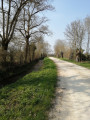
From Marigny to the Chizé Forest

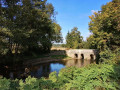
A very natural route crossing the northern tip of the Chizé Forest in the first part and the countryside west of Marigny in the second part. This route with its varied and relaxing landscapes offers a peaceful moment. You may see deer and birds in this area. Marigny was the home of a great Poitevin bard: Yves Rabaut.

Details

3245517
Creation:
Last update:
Last review:
  • Walking
    Activity: Walking
  • ↔
    Distance: 10.82 km
  • ◔
    Average duration: 3h 15 
  • ▲
    Difficulty: Moderate

  • ⚐
    Back to start: Yes
  • ↗
    Ascent: + 53 m
  • ↘
    Descent: - 58 m

  • ▲
    Highest point: 90 m
  • ▼
    Lowest point: 46 m

Photos

Description of the walk

Starting point: Place du Centre car park in Marigny.

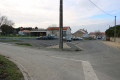
(S/E) Leave the car park and head towards the south-west, towards the back of Place du Centre, where the car park is located. Continue along Chemin de Saint-Sévenin.
You will see a well in front of a house on the right-hand side.

Go straight ahead at the junction with Rue de la Morinne, heading towards the campsite.
You will seea beautiful farm with livestock buildings on your right.
Further on, turn right off the road leading to the campsite. Beautiful views to the north over the surrounding countryside.

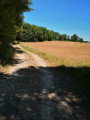
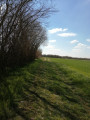
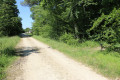
Continue straight ahead until you reach the first wood. Go through it and continue to a small road. Cross it carefully and continue opposite into the Chizé Forest. The path runs along the edge of the wood on the right-hand side, with large fields beyond.

When the path reaches a large clearing of cultivated fields, follow the forest path that turns sharply to the left. Shortly afterwards, the path turns right at a right angle. Pass through a barrier restricting motor vehicle traffic and continue along a beautiful forest lane.
A little further on, the forest lane turns to the right and comes to a junction with a forest track on the right.

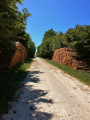
(1) Continue straight ahead along the beautiful forest lane - Forest Road No. 11 - which heads straight south-west and climbs gently up a small hill. At the top of the hill, the forest lane levels out. Continue for about 100 to 150 metres until you reach a barrier restricting motor vehicle traffic at a forest path on the right.

(2) Turn right and follow the forest path that runs alongside the D1 departmental road inside the woods. Further on, pass a crossroads and almost immediately the path turns left and winds its way closer to the D1 road. The road eventually leads to a small road from Rimbault to a place called Sèche-Bec. Turn left to go around the Plan de Rimbault Forest House opposite the end of the road.

(3) At the junction with the D1 road, in front of the Maison Forestière du Plan de Rimbault, take the Allée Verte (GR®36) on the right. A little further on, pass a barrier restricting motor vehicle traffic and continue to the junction with the first path on the right shortly afterwards.

(4) Turn right onto the forest path, which runs alongside the small road leading from Rimbault to Sèche-Bec.
Further on, you will see a small pond in the woods on the right-hand side of the path. It is visible a few metres from the path and is perfectly circular.
At the end of the straight line described by the path, leave the path on the right and continue along the path that turns left and winds a few metres into the woods with a large field on the right. The path, now narrower, eventually leads to a good farm track (GR®36).

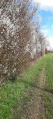
(5) Turn right onto the path that crosses the area known as La Vallée. Shortly afterwards, the path is lined with two beautiful shrub hedges and offers beautiful views of the surrounding fields. Continue to the road leading to Sèche-Bec, which is nearby on the left-hand side. Cross the road carefully and continue opposite on a path through open terrain. Continue to the junction with a path on the left.

(6) Turn left onto the slightly uphill path lined with a hedge on the right-hand side. Continue to the crossroads between the D101 road leading from Beauvoir-sur-Niort to Marigny and the road leading to a place called Le Grand Mauduit.

(7) Carefully take the D101 road to the right for about 50 metres. Turn left onto a path at the corner of a small wood. Follow this path, which crosses a large open field in a place called Chiron de l'Ipaisse. Continue until you reach a small road at a right-angle bend.

(8) Turn right onto the path between two hedges, which heads north. Shortly afterwards, the path descends towards the railway line, which it overlooks. Follow the railway line for a short while. The path - Pln de Beauregard - is then tarmac and leaves the railway line to climb up the hillside. A little further on, small plots of vines are visible, particularly on the right. The path heads east. In front of a small wood, turn left and descend towards the railway line at a place called Les Vignes Franches.

(9) Just before the railway line, turn right onto the path that runs alongside it on the left, known as Chemin de Beauregard. Arrive at the modest Marigny station and continue to the junction with the D102 road, Rue de la Gare.

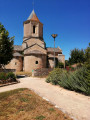
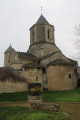
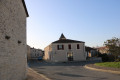
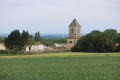
(10) Turn right onto a narrow path that runs alongside the D102 road (separated from it by a barrier). Follow it towards Marigny. Enter the village and continue to Impasse de l'Église on the right-hand side. Turn into this cul-de-sac and, before the gate of the very austere Saint-Jean-l'Évangéliste church, take the alleyway that runs alongside the church and leads to the chevet, where you will find a sign and a beautiful view of the church. Reach Rue de Beauvoir and head east towards the Town Hall to arrive immediately at Place du Centre (S/E).

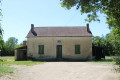
Before reaching the car park that marks the end of this route, take a look at the beautiful house where Yves Rabault, the Poitevin bard and singer-songwriter, lived.

Waypoints

  1. S/E : km 0 - alt. 52 m - Car park at Place du Centre.
  2. 1 : km 2.32 - alt. 74 m - Crossroads between forest road No. 11 and the path on the right.
  3. 2 : km 3.53 - alt. 86 m - Crossroads between forest road No. 11 and the path on the right.
  4. 3 : km 4.49 - alt. 89 m - Crossroads of the D1 road and Allée Verte
  5. 4 : km 4.67 - alt. 81 m - Allée Verte crossroads - path on the right
  6. 5 : km 5.41 - alt. 63 m - Crossroads at the edge of the woods.
  7. 6 : km 6.59 - alt. 72 m - T-junction after Sèche-Bec
  8. 7 : km 7.1 - alt. 81 m - Crossroads of the D101 road and the path.
  9. 8 : km 7.94 - alt. 74 m - Crossroads of two paths in a bend in the road.
  10. 9 : km 9.04 - alt. 57 m - Crossroads near the railway line.
  11. 10 : km 9.93 - alt. 52 m - Crossroads with Rue de la Gare (near the railway line)
  12. S/E : km 10.82 - alt. 52 m - Car park at Place du Centre.

Notes

The car park is located on Place du Centre in Marigny. At the back of the car park on the right, at the end of a small grassy area, there are toilets. There are other parking spaces in the village (opposite the cemetery, next to it, near the village hall). For those arriving from the west via the D102 road, it is possible to park at Marigny station (just before the (10) on the route) and then walk to the start of the route.

This hike covers varied terrain and requires suitable footwear.

This route is partially marked as it follows sections ofthe GR®36andGR®36diverticule, marked in red and white. It follows the GR®36 almost from the start to (1), from (3) to (4), and from (5) to the road near Séche-Bec. Nevertheless, it is advisable to follow the directions in this description and on the map, while also taking in the landscapes you pass through. The distance indications from the starting point, and even the GPS coordinates of the waypoints (including the starting point), can also help hikers find their way.

Alternative: For those who would like a shorter route, it is possible to continue straight on at (6) to reach (1) in about 400 metres. The end of the route is then the same as on the way out to (1). In this case , the route is 9.3 km long .

Hike completed by the author on 13 December 2020.

Worth a visit

Marigny
In the 12th century, vineyards expanded at the expense of wheat fields. Food shortages occurred at the slightest sign of bad weather.
From the 15th to the 16th century. It is said that FrançoisI, who owned a kennel in Rimbault for hunting in the Chizé Forest, enjoyed local wines such as those from Marigny. He appreciated grape varieties such as Folle Blanche for white wine and Balzac for red wine.
In the 18th century, the intensification of crops and cereals allowed for the planting of vineyards.
During the Empire, vineyards, which occupied only 12% of arable land, provided the main source of income for the commune. Some names of fiefdoms evoke the presence of vineyards, such as Le Plantis, Les Vignes Franches, Le Vigneau, Les Vieilles Vignes, Le Fief de Beauregard, Le Fief des Dames, etc. The vineyard area increased from 360 hectares to 700 hectares in 1875 (over a period of fifty years).
In 1881, the vines were infected and died, leading to the disappearance of almost all the vineyards. This was accompanied by a significant exodus of the population.
In 1889, the first dairy in Deux-Sèvres was founded in Beauvoir. This led all the farmers to build up their herds. In 1896, new families settled on the vacated land. They came from Gâtine and Vendée.

The Church of Saint John the Baptist
The site has been inhabited for a long time, as evidenced by the megaliths and nine Merovingian tombs found in 1883. In 936-954, Marigny (Marniacus) was the capital of a Carolingian district, a viguerie. The church must have been built by the monks of the Abbey of Saint-Jean-de Montierneuf in Poitiers at the end of the 11th century. It has the same patron saint as the abbey, John the Evangelist.
It was confirmed as belonging to the abbey by Pope Adrian IV in 1157. The priory church remained under the authority of Montierneuf until the Revolution. The priory buildings adjoined the church. Damaged during the Wars of Religion, the church underwent major restoration work in 1715.
During the Revolution, it was put up for sale as national property and acquired in 1793 by Jacques-Claude
Jard-Panvilliers. It was used as a saltpetre store. When the purchaser offered to sell it back to the municipality for 1,600 francs, the municipality refused. He then had the paving removed and the vaults and south and west walls destroyed in 1801.
In 1813, a new municipal council was elected and decided to rebuild the church. Mr. de La Rochebrochard donated stones from the old Fors castle for this purpose.
Source: official municipal website

The enhancement of the surroundings allows visitors to admire the beauty of the straight bay and the semi-circular apse flanked by the semi-circular apsidioles of the transept with their slate roofs. The ensemble is dominated by the
massive bell tower. The bell tower, above the square transept, dates back only to 1854. Due to its imposing octagonal base, it is likely that the original bell tower was more slender. A cut stone glacis compensates for the square with four bays that illuminate the bell chamber.
The spiral staircase leading to the bell tower is located at the junction of the nave and the right arm of the transept. The bell tower covers the square of the transept with an octagonal dome on squinches. The four arches of the transept square are basket-handle arches. The pillars are decorated with large capitals, each of which is worth admiring individually. A semi-circular apse opens onto each arm of the barrel-vaulted transept.
The choir has a straight barrel-vaulted bay and a semi-circular apse lit by
an oculus. This part of the church was listed as a historic monument on 8 April 1909.

The Forest of Chizé
The Chizé State Forest
A remnant of a prehistoric forest, it covers approximately 3,435 hectares and is part of a larger area, the Aulnay-Chizé massif.

An open forest
Crossed by theGR®36andGR® de Pays de la Sylve d'Argenson hiking trails, the Forest of Chizé welcomes many visitors, including hikers, cyclists, schoolchildren and scientists.

Remarkable wildlife
Identified as a Natura 2000 site, the forest is home to 31 species of mammals, 6 species of reptiles, 8 species of amphibians, 78 species of birds and more than 530 species of butterflies!

Dominant deciduous trees
The Chizé Forest is unique in that it is mainly composed of beech trees. Affected by the storm of 1999, it is now the subject of extensive observation and study on the resistance of trees in the context of climate change.
There are also many oaks, including the Emperor Oak, which is around 250 years old and 27 metres tall, and the Papinot Oak, which will provide shade for your picnic break.

A forest, a legend: the seven oaks of Chizé
It is said that Mélusine, the fairy of Poitou, flying over the Forest of Chizé, had to find a water source to bathe her serpent's tail. She made seven acorns sprout into a seven-trunked oak tree, in the centre of which a natural basin filled with water. Today, it is called Mélusine's Bath.

Professionals present at the Chizé site:
The CNRS laboratory (on the site of a former military camp that housed 4,000 American soldiers and French civilians from 1952 to 1967);
Ifrée (on the CNRS site), which aims to promote greater citizen involvement through environmental education;
Zoodyssée (established in 2009, an ATMO Poitou-Charentes air quality monitoring station provides a better understanding of the links between air quality and forest ecology).
Source: website

Yves Rabault, the bard and singer-songwriter from Poitou (1910-1990)
The genesis of "Quand tu m'fais d'la sauce aux lumas"
Yves Rabault was born at 12 Chemin de Saint-Séverin, in Marigny, a small rural commune on the edge of the Chizé Forest. Born into a family of farmers, he was nicknamed the bard of Poitou in the 1930s. His "Histouères et chantuseries", published in 1982 with a preface by Léon Zitrone, is a collection of all his work, including the famous "Sauce aux Lumas", written in 1940 to the tune of "Quand on s'aime bien tous les deux" by Vincent Scotto, an idea that came to him in 1934 while performing in Paris at the Caveau de la République, the Lapin Agile, the Théâtre des Deux Ânes, the Coucou and La Lune Rousse; a song that would become famous throughout France!
He remarried in 1965 to Simone Suzange, a pianist-accompanist and star of Parisian cabarets who created a dance and music school in Marigny. He then took over the management of Productions Paris Variétés, created by his wife, and in 1973 received the Georges Chepfer prize for the best poet-songwriter in the local dialect of the year. After a lively career, he now rests in the Marigny cemetery.

What is a "luma" in Poitou?
Called "luma" (*) in Poitou and Aunis, "bavou" in Deux-Sèvres and "cagouille " (**) in Charentes, it is a small grey snail, 30 to 40 mm long and weighing 6 to 18 g. The French strongholds of snail farming are Cavaillon, in Vaucluse, and Charente-Maritime; Poitou-Charentes remains the leading producer, even though the gastropod is not well suited to farming, which is therefore marginal.
(*) From the Latin "limax", meaning slug or snail.
(**) From the Latin "cuculle", meaning hood or cap.
To find out more
Source (excerpts)

Always be cautious and plan ahead when you're outdoors. Visorando and the author of this route cannot be held responsible for any accidents occurring on this route.

The GR® and PR® markings are the intellectual property of the Fédération Française de Randonnée Pédestre.

Reviews and comments

4.5 / 5
Based on 7 reviews

Reliability of the description
4.6 / 5
Ease of following the route
4.4 / 5
Route interest
4.6 / 5
User 1828875

Overall rating : 4 / 5

Date of your route : Dec 16, 2025
Reliability of the description : ★★★★☆ Good
Ease of following the route : ★★★★☆ Good
Route interest : ★★★★☆ Good
Very busy route : No

Route between the plains and forest, passing through the village of Marigny

Machine-translated

claudius1954
claudius1954

Overall rating : 5 / 5

Date of your route : Jan 27, 2025
Reliability of the description : ★★★★★ Very good
Ease of following the route : ★★★★★ Very good
Route interest : ★★★★★ Very good
Very busy route : No

Recommended itinerary. For large groups (30 people or more), depart from the village hall.

Machine-translated

Jacques gomes
Jacques gomes

Overall rating : 4 / 5

Date of your route : Jun 26, 2024
Reliability of the description : ★★★★☆ Good
Ease of following the route : ★★★★☆ Good
Route interest : ★★★★☆ Good
Very busy route : No

Pleasant forest and countryside route

Machine-translated

pgetrochon
pgetrochon

Thank you for your encouragement.
Happy hiking.

Machine-translated

jlfaure
jlfaure

Overall rating : 4.7 / 5

Date of your route : Sep 27, 2022
Reliability of the description : ★★★★★ Very good
Ease of following the route : ★★★★★ Very good
Route interest : ★★★★☆ Good
Very busy route : No

A beautiful, enjoyable route despite the headwind that blows through the paths crossing the fields without protective hedges. This varied and uncrowded route allows you to learn a lot, as it is very well documented, as always, by this author, whom I thank and recommend. We will do it again this coming Friday.

Machine-translated

Sneg
Sneg

Overall rating : 5 / 5

Date of your route : May 29, 2022
Reliability of the description : ★★★★★ Very good
Ease of following the route : ★★★★★ Very good
Route interest : ★★★★★ Very good
Very busy route : No

On the way to Marigny, we crossed over the very congested motorway, but during this long route we only encountered three people!
Thank you for this pleasant route, which features long stretches and the beautiful monotony characteristic of our landscapes.
Beautiful church in Marigny!

Machine-translated

LoJP
LoJP

Overall rating : 4.7 / 5

Date of your route : Sep 05, 2021
Reliability of the description : ★★★★☆ Good
Ease of following the route : ★★★★★ Very good
Route interest : ★★★★★ Very good
Very busy route : No

A very beautiful walk, done with a small group of friends.
We also hesitated between points 1 and 2 to find the path that branches off to the right. One seemed too far away (about 200 m) and the other too close to the barrier (about 50 m), so we opted for the second one, which turned out to be the right choice.
Otherwise, everyone was delighted: it was warm and most of the route was under the trees
Thank you for this lovely walk.

Machine-translated

solignat
solignat

Thank you for your reply; that's exactly what happened, but after a few moments of hesitation, I found the right route!
It was a very pleasant hike!
Kind regards.

Machine-translated

pgetrochon
pgetrochon

Thank you for your message.
Between point (1) and point (2), the description can only be brief, as the forest path goes straight south-west. What may have confused you is the fact that the path on the right in the forest is BEFORE the barrier restricting motor vehicle traffic, whereas the road is more easily visible after the barrier. The transition from a beautiful forest lane to a simple narrow forest path may indeed be surprising, but it avoids having to follow the road.
Happy hiking!

Machine-translated

solignat
solignat

Overall rating : 4.3 / 5

Date of your route : Mar 29, 2021
Reliability of the description : ★★★★★ Very good
Ease of following the route : ★★★☆☆ Average
Route interest : ★★★★★ Very good
Very busy route : No

Lack of precision between 1 and 2... I must have made a mistake because afterwards I got a bit lost...

Machine-translated

Other walks in the area

For more walks, use our search engine .

The GPS track and description are the property of this route's author. Please do not copy them without permission.