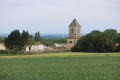
La Pétousse via Léther

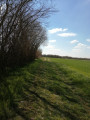
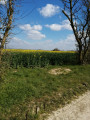
A pleasant walk north-east of Fors in countryside alternating between hedgerows and open fields. The very natural route also allows you to explore the built heritage, ancient witnesses to the past.

Details

3177045
Creation:
Last update:
Last review:
  • Walking
    Activity: Walking
  • ↔
    Distance: 9.50 km
  • ◔
    Average duration: 2h 45 
  • ▲
    Difficulty: Moderate

  • ⚐
    Back to start: Yes
  • ↗
    Ascent: + 22 m
  • ↘
    Descent: - 22 m

  • ▲
    Highest point: 64 m
  • ▼
    Lowest point: 33 m
  • ⚐ Country: France
  • ⚐ District: Fors (79230)
  • ⚑
    Start/End: N 46.232948° / W 0.40897°
  • Hour-by-hour weather

Photos

Description of the walk

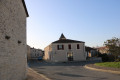
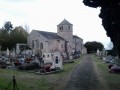
(S/E) Head towards Notre-Dame Church and take Rue de l'Église on the left (north). Pass the cemetery on the right and, further on, the Town Hall on the left. Continue to the crossroads with Rue de la Mairie.

(1) Follow it, turning right until you reach Impasse de la Venelle on the left. Just before the alley, you will see an exhibition hall for vintage cars on the left.

Turn left into the cul-de-sac and continue to the end of the alleyway. The path winds between houses and arrives at Rue de la Poste alongside a long building on the left. Turn left into this street, then right into Rue de la Douve.

(2) Turn right to cross the railway line (level crossing) and after about 20 metres on Rue des Ors, turn left onto a path between two rows of trees that heads north.

It eventually leads to the Route de Bel-Air. Turn right and follow it carefully for about 20 metres before turning left onto a path that goes around some farm buildings. Continue north-east until you reach the Route de Niort (D106).

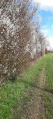
(3) At this point, follow the path to the left of the hedge on the field side, which avoids walking on the road (markings on wooden posts). At the end, cross the road carefully and take a farm track between two hedgerows on the right-hand side of the road. Continue straight on until you reach a triangular crossroads between three small roads at a place called Les Brousses de Goursay (Gourçay).

(4) Take the small road on the right towards the east, which is not very busy (grass in the middle of the road). Continue to a crossroads with a small road at a place called Léther just before a high-voltage power line. At the crossroads on the right-hand side is a triangular pond.
Turn right towards the south-west. The road runs alongside Pié Baudin, climbing slightly.

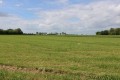
(5) At the top of the small hill, at a Y-junction with two roads, turn left onto a path that runs alongside a hedge of trees on the left-hand side. Several gaps in the hedge offer beautiful views of the plain towards Léther. The path runs along the right-hand side of a large cultivated plot in the area known as Les Caillettes. Continue to a junction with a grassy path on the right that leads to a hedge separating Les Caillettes from the Fontanelles area.

Turn right onto this path, which quickly joins the hedge and runs along it on the left-hand side, heading towards a wooded area. The path runs alongside the hedge and turns left at a small intermittent stream. Continue to a crossroads about 50 metres further on.

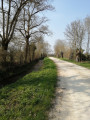
(6) Turn right onto a path between two hedgerows. The path runs alongside meadows on the right at a place called La Pétousse and a large field on the left. Shortly after this large field, take a grassy path on the right that heads north. About two hundred metres further on, turn left at a right angle onto a wide grassy path just after crossing an intermittent stream.

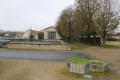
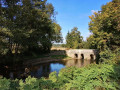
Follow the stream until you reach a building that houses a pumping station. Here you will find a clearing with a well, a pond and picnic tables. Return to the path you left earlier, follow it again to the right, and continue until it meets the D106 road, the Niort road.

(7) Cross carefully and turn right, following the road with caution until you reach the Route des Ors on the left. When you get there, turn left and return to the level crossing you crossed on the way out.

(2) Cross the railway line and continue straight ahead for about 20 metres before turning left into Rue de la Douve. Follow this road until you reach the junction with Rue de la Poste. Turn left onto Rue de la Poste and continue until you reach a crossroads near the railway line. Turn right and you will immediately come to a roundabout.

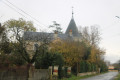
(8) Head straight ahead into Rue de la Gare, which runs alongside the railway line on the left and passes between the two buildings of the Rabault SARL garage. Further on, you will see a calvary on the left-hand side of the street, then a house with a beautiful tower.

(9) At the calvary, turn right, pass between two pillars that simulate a property entrance and leave the property by taking the path on the right after an open passage in the fence. The path continues between two properties towards the cemetery. At the end of this path, go through an old gate, of which only the stone frame remains, to take a passage along the church.

When you reach Rue de l'Église, cross carefully and return to the car park, which marks the end of this walk (S/E).


Waypoints

  1. S/E : km 0 - alt. 55 m - School and - Église Notre-Dame (Fors)
  2. 1 : km 0.28 - alt. 53 m - Rue de la Mairie
  3. 2 : km 0.95 - alt. 50 m - Level crossing
  4. 3 : km 1.83 - alt. 42 m - Route D106
  5. 4 : km 2.9 - alt. 34 m - Triangular crossroads
  6. 5 : km 4.97 - alt. 56 m - Y-shaped crossroads
  7. 6 : km 6.58 - alt. 54 m - T-junction
  8. 7 : km 7.91 - alt. 51 m - Route D106
  9. 8 : km 9.06 - alt. 53 m - Rond-Point
  10. 9 : km 9.27 - alt. 55 m - Calvaire
  11. S/E : km 9.5 - alt. 55 m - School and - Église Notre-Dame (Fors)

Notes

The parking area is located in a small car park near the church, at the crossroads of Rue de l'Église and Rue de l'École (there is parking on both sides of Rue de l'École - road D306). Alternatively, there is a parking area on Rue de l'Église after the cemetery.

This hike covers varied terrain and requires sturdy footwear.

This route is marked in green. In addition, it is advisable to follow the directions in this description and on the map, while also taking in the landscapes you pass through. The distance indications from the starting point, and even the GPS coordinates of the waypoints (including the starting point), can also help hikers find their way.

Hike completed by the author on 3 December 2020.

Worth a visit

Fors

The village has had the same name since 1243, and its origins are thought to be Gallo-Roman (ex-foris: "outside" the city). At that time, there were 11 dairy farms forming small neighbourhoods (La Nouzière, La Chamerie). There has been a fortress since 1099.

There were three main families who ruled Fors:
The Vivonne family: until 1494.
The Poussards: 1494-1663.
Anne Poussard was the first mistress of François I. He built a magnificent castle for her on the site of the fortress. The castle measured 30 metres long by 30 metres wide, with a 10-metre-high façade. (About half the size of a small football pitch). Upon his death, his son Jean became Lord of Fors. Charles, the grandson of François I, became Vice-Admiral of the Normandy coast (he died at the age of 80 in 1584).
Between 1663 and 1686, there was a legal proceeding to determine the right of blood over the castle.
The Mabouls: (1686-1776)
The first members of the family to rule over Fors were Anne Catheu (who died at the age of 91) and Louis Maboul II. Jacques Maboul, Louis's brother, was appointed Bishop of Arles in 1708 and gave the funeral oration for Louis XIV in 1715. Louis François Maboul, son of Anne Catheu, became Master of Requests in 1728 at Versailles, at the king's court. At that time, there were 37 dairy farms in Fors. So, in 1686, Louis II inherited the château and carried out work on it until 1716. He preserved the main architecture and added slate roofs (mansard roofs), a large 1 km long avenue and two courtyards. He bought around thirty villas around the château, which he had demolished to make way for avenues of chestnut trees. The perimeter of the château extended to the current church. Louis died in 1721.
In 1725, Anne Marie Louise Maboul, Louis's daughter, married Jean Emmanuel de Crussol. After the death of the last Crussol in the early 18th century, the château was divided between two families. It passed to Philippe Xavier de la Rochebrochard. In 1815, the Bourbons returned to power after the fall of Napoleon I. Fearing that he would have to return the château, he chose to destroy it. The ruins were purchased by Mr. Arnault, who sold them to Mr. Robelin in 1884. Mr. Robelin used the ruins to build his house (opposite the current town hall). In fact, several houses were built with stones from the castle at this location. The rest was looted (e.g., the house in Prahecq with the castle's salamander).

Places and monuments
The fairground: it has existed since Saint Louis in the 13th century. It hosted at least two fairs a year until the early 20th century.

The town hall: in 1855, a house was purchased to serve as a school and town hall (opposite the tobacconist's). In 1923, the town hall purchased the house opposite Robelin's, which became the current town hall and still serves as a school.

Former bar, house with earthen floor, former post office and presbytery.

The presbytery: built in 1860, it served as accommodation and administrative office for the parish priest.

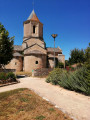
Notre-Dame Church dates from the 12th century and was under the authority of the abbot of BourgDieu de Bourges. It was destroyed during the Wars of Religion (late 16th century).
The frescoes inside the church were discovered in 1923.

The bell: this old bell was cast on 23 May 1881 in Le Mans and weighed 206 kilos. The godparents, whose names are engraved on the metal, are usually the donors of the bells. On this bell, the founder Bollée inscribed the following words in the metal: I was blessed in 1881, when Mr Morisset was parish priest of Fors. My name is Adeline, my godfather was Mr Charles Arnaud, owner of La Chauvinière, and my godmother was Adeline Arnaud, née Brault.
This bell was recast in 2011 with the aim of preserving its heritage and therefore making it as close as possible to the 1881 bell. The total cost was €11,299.12 including VAT. The same inscriptions appear on it, with the simple addition of: Recast in 2011 by Bollée, bell founder in Orléans. The blessing of this new bell will take place in the Church of Notre Dame de Fors on 23 October 2011.
The frescoes inside the church were discovered in 1923.

The school: The first traces of a school date back to the end of the 18th century, when it was run by the castle's caretaker, Geoffroy, known as Le Boîteux-Grenotton.

Hétel cheese dairy: Created in 1947 on the site of the former distillery by Mr Lestel and Mrs Spangenberg.
During the heyday of the vineyards, and following the construction of the railway line in the heart of our village, large industrial buildings began to spring up.
The survey below by Pascale Moisdon-Pouvreau, carried out as part of the industrial heritage inventory, provides us with a wealth of details about this complex.
History: This distillery was founded in the 1890s by Georges Lefebvre, originally from Champagne, to diversify the family's wine-making activities. Its creation was linked to the installation of the railway line from Niort to Saintes. All the buildings (production workshop, wine storehouse, packaging workshop, accommodation) were built at the same time based on plans by architect Charles Charrier from Les Sables-d'Olonne (85). The owner's residence was called Villa Sainte-Marie and the distillery manager's residence was called Villa Sainte-Agnès. The initial project, which involved the production of cognac brandy, could not be completed as Fors was located outside the cognac appellation d'origine contrôlée (AOC) zone. Georges Lefebvre therefore had to fall back on producing a liqueur called La Cistercienne. In 1926, 20,000 hectolitres of wine could be distilled there in a year, producing around 2,000 hectolitres of liqueur. In the 1950s, the distillery ceased operations, the property was divided up and the industrial buildings were purchased by the Lestel cheese company for cheese maturing. The buildings were converted internally with the construction of large cold rooms and the installation of an electric winch; the cellars were used as a drying room. This company ceased operations in Fors around 1962-1965 and the buildings were bought by the Jean Reybier cheese factory, which used them as a warehouse for the south of France until the 1980s. New offices were fitted out. The industrial buildings have since been decommissioned, but the two dwellings are still inhabited by their owners. In 1926, 10 to 20 people were employed there.
Source: official website of the municipality and Wikipedia (excerpts)

Reviews and comments

4.7 / 5
Based on 6 reviews

Reliability of the description
5 / 5
Ease of following the route
4.7 / 5
Route interest
4.3 / 5
isabellebl
isabellebl

Overall rating : 4.5 / 5

Date of your route : Oct 15, 2025
Reliability of the description : Not used / Not applicable
Ease of following the route : ★★★★☆ Good
Route interest : ★★★★★ Very good
Very busy route : No

a beautiful, easy and pleasant hike. The route is slightly different after point (6). The path can be found a little further to the right. Thank you to the author for all the additional information.

Machine-translated

claudemoinet
claudemoinet

Overall rating : 5 / 5

Date of your route : Jan 20, 2025
Reliability of the description : ★★★★★ Very good
Ease of following the route : ★★★★★ Very good
Route interest : ★★★★★ Very good
Very busy route : No

Beautiful hike, well signposted

Machine-translated

jlfaure
jlfaure

Overall rating : 4.7 / 5

Date of your route : May 05, 2023
Reliability of the description : ★★★★★ Very good
Ease of following the route : ★★★★★ Very good
Route interest : ★★★★☆ Good
Very busy route : No

A route that suits the region well. A good hike to stretch your legs, with a bit of road but also paths lined with hedgerows and huge fields cultivated according to the seasons. (magnificent fields of flax)
At the moment, the bird scarers can also scare hikers, especially when they are placed just behind a hedge at the side of the path and go off just as you pass!
I followed this route using the Visorando app. Everything is perfect except after the point (6): the grassy path on the right that leads back to the pumping station is just a little further on. (dotted line on the IGN map)
Thank you for this route. Other routes suggested on the local council's website are worth checking out.

Machine-translated

JpLaf79
JpLaf79

Overall rating : 4.7 / 5

Date of your route : Nov 15, 2021
Reliability of the description : ★★★★★ Very good
Ease of following the route : ★★★★★ Very good
Route interest : ★★★★☆ Good
Very busy route : Yes

  • An easy, pleasant route; you often walk between two rows of trees, making it particularly suitable for summer hikes.
  • Very well signposted with green markings!
  • Note: the Town Hall has a leaflet with a few additional walks to do in Fors.

Machine-translated

philouis
philouis

Overall rating : 4.3 / 5

Date of your route : May 30, 2021
Reliability of the description : ★★★★★ Very good
Ease of following the route : ★★★★☆ Good
Route interest : ★★★★☆ Good
Very busy route : No

Being somewhat sceptical about the appeal of the landscape we were about to discover, we were pleasantly surprised by the shady, green paths.
What we liked first was the village of Fors with its beautiful buildings, green spaces and narrow streets.
It's a shame that it's only 9.5 km long.

Machine-translated

Sneg
Sneg

Overall rating : 4.7 / 5

Date of your route : Mar 20, 2021
Reliability of the description : ★★★★★ Very good
Ease of following the route : ★★★★★ Very good
Route interest : ★★★★☆ Good
Very busy route : No

A peaceful and pleasant route. Very precise description, supplemented by green markings.

Machine-translated

Other walks in the area

For more walks, use our search engine .

The GPS track and description are the property of this route's author. Please do not copy them without permission.