Through the narrow streets and memories of Pierrefeu-du-Var

Nestled against a rocky peak, Pierrefeu-du-Var reveals itself as a Provençal gem at the gateway to the Massif des Maures. This picturesque village invites you to stroll through its narrow streets, where every stone seems to whisper history. The route naturally leads to the site of Sainte-Croix, the spiritual and historical cradle of the commune.

Details

84948828
Creation:
Last update:
Last review:
  • Walking
    Activity: Walking
  • ↔
    Distance: 2.80 km
  • ◔
    Average duration: 1h 00 
  • ▲
    Difficulty: Easy

  • ⚐
    Back to start: Yes
  • ↗
    Ascent: + 71 m
  • ↘
    Descent: - 75 m

  • ▲
    Highest point: 151 m
  • ▼
    Lowest point: 81 m

Photos

Description of the walk

To reach the starting point, head towards Pierrefeu-du-Var (83390). Parking is available on Chemin du Petit Pass du Bon Puits, just opposite the tourist office on Place Jean Jaurès.

(S/E) From the car park, start the route by heading west. Go straight across the roundabout. When you see the sign for "Le Bon Puits", go down a few steps on the right and follow the path to Bon-Puits.

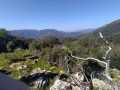
(1) Follow the path, then at the first intersection, turn left, and left again onto Impasse des Roucas to reach Chemin du Small Pass du Bon Puits at a hairpin bend. Continue to the right uphill, then turn right onto Chemin du Barry. At the first intersection, turn left towards the chapel. Go up the narrow road to the Sainte-Croix Chapel, where you can enjoy the view and a map of the area.

(2) From the chapel, go to the end of the cul-de-sac, then go down the stairs that extend Rue de l'Hermitage. At the bottom, turn right to continue on Rue de l'Église. Continue straight ahead to the Church of Saint-Jacques le Majeur.

(3) Continue opposite the church, then go up the stairs to the right of a "Voie sans issue" (dead end) sign. You will arrive at Rue de la Chapelle. Continue to the left (west), and after about a hundred metres, go down the stairs which, after crossing Rue de l'Asile, will take you to Rue du Moulin. Turn right (south) and continue straight ahead to the cemetery. Cross Avenue des Poilus carefully and, in front of the Bouchonnerie (former cork and cork product factory), continue left towards the Tourist Office. Pass in front of the École Anatole France and continue to the Fontaine Wilson.

(4) Turn right towards the Town Hall. Keep right at the fork and continue along Rue Général Sarrail. At the next fork, turn left onto Rue Dr Edmond Mercier. When you reach Place Gambetta, turn right. At the stop sign, turn left, follow Rue Jules Favre and you will arrive at Place Urbain Senes, just in front of the Town Hall.

(5) Cross Place Urbain Senes, pass in front of the town hall, then turn left in front of the stele. Continue on Rue Auguste Roux until you reach Fontaine Wilson.

(4) Turn right onto Boulevard Henri Guerrin. In front of the tourist office, cross carefully to reach the Monument to the Memory of the Dixmude Crew. Walk around the monument to find your vehicle in the car park (S/E) located at the rear.

Waypoints

  1. S/E : km 0 - alt. 98 m - Parking Place Jean Jaurès
  2. 1 : km 0.43 - alt. 97 m - Le Bon-Puits
  3. 2 : km 1.06 - alt. 148 m - Chapel of Sainte-Croix
  4. 3 : km 1.27 - alt. 111 m - Church of Saint James the Greater
  5. 4 : km 2.04 - alt. 99 m - Fountain
  6. 5 : km 2.46 - alt. 95 m - Town hall
  7. S/E : km 2.8 - alt. 98 m - Parking Place Jean Jaurès

Worth a visit

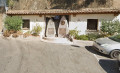
Le Bon-Puits. Old communal well restored in 2017. Testifies to the efforts of the people of Pierrefeuille to draw water from the hillside.

Chapelle Sainte-Croix. Perched on the heights, on the ruins of the original church destroyed during the Wars of Religion. Built in 1681, consecrated in 1682. A place of spiritual and historical remembrance, with panoramic views and an orientation table. Former site of the famous medieval Cours d'Amour.

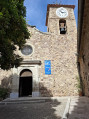
Saint-Jacques le Majeur Church. A two-nave building with stained glass windows from 1889 depicting religious figures. Bell tower dating from 1727, bell cast in Marseille in 1854. Organ restored in 2009, donated by the convent of Saint-Paul-de-Vence. Spiritual and architectural centre of the village.

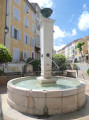
Wilson Fountain. First fountain supplied by the Redouron Canal (1567), built in 1860. Elegant stone basin, a place to cool off and meet people. Surrounded by narrow streets and shops, in the heart of the village.

Place Gambetta. Formerly "Place des Palmiers", renamed in 1920.

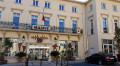
The Town Hall. Light-coloured façade with green shutters, central balcony and tricolour flags.

Steles on Place Urbain Sénès: double tribute:

  • On the left: "Tribute to our children who died in the war".

  • On the right: Memorial to Marshal Jean de Lattre de Tassigny, commander of the French Liberation Army. Bronze medallion, Cross of Lorraine, engraved inscriptions. A place of remembrance and transmission.

Dixmude Monument. A 14-metre-high stele made of imperial Corsican granite commemorates the disappearance of the Dixmude airship and its fifty crew members in 1923. Inaugurated in 1927 by Georges Leygues, Minister of the Navy.

Other walks in the area

For more walks, use our search engine .

The GPS track and description are the property of this route's author. Please do not copy them without permission.