The commune has one monument listed in the inventory of historic monuments (Mérimée database):
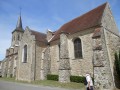
- Church of Saint-Pierre and Saint-Paul (12th–13th centuries, altered in the 16th century), listed as a historic monument, to which the following classified movable heritage should be added:
- 16th-century stone baptismal font;
- Altarpiece of the Chapel of the Virgin and panelling (South Chapel of the Virgin);
- Two bas-reliefs: the Baptism of Christ and the Resurrection (Baptismal Chapel);
- Stained-glass window: saint in armour (façade);
- Stained-glass window in the Chapel of the Virgin: scenes from the life of the Virgin (bay 0) (Chapel of the Virgin);
- Stained-glass window: scenes from the life of Joan of Arc (nave);
- Stained-glass windows in the chancel: scenes from the life of Christ, Saint Peter and Saint Paul (chancel);
- Stained-glass window in the Chapel of the Virgin: scenes from the life of the Virgin (pane 2) (Chapel of the Virgin);
- Monumental painting: scenes from the life and martyrdom of a saint.
(1) The village is unusual in that it has two schools: the École du Centre (primary school: in the centre of the village opposite the church), and the École du Champlat (nursery and primary school: at the junction of the hamlets of Champgoulin, Le Marais and Voigny). The reason for this is that, historically, until the reforms of the mid-1960s, the École du Champlat was the boys’ school, and the École du Centre was the girls’ school.
(2) Papeterie du Marais.
The Marais factory was at the heart of the secure paper industry in the Grand Morin valley during its heyday. On 21 September 1792, an agreement was signed for the production of paper to be used in the manufacture of assignats. On the opposite bank of the Grand Morin, the factory director lived at the Château de Chauffour.
(3) Marais Chapel.
The Chapelle du Marais dates from the 19th century and is situated in what was then an industrial area of Jouy-sur-Morin.
Eiffel Bridge at Crèvecœur.
This 19th-century structure, typical of Gustave Eiffel’s architecture, was no longer suited to the operations of the nearby Crèvecœur factory. The bridge was replaced, but the exceptional character of the Eiffel Bridge meant it was kept in place as a footbridge.
Before (6) Tunnel under the railway line.
The railway line cuts the town of Jouy-sur-Morin in two. There are several level crossings allowing people to cross it, but here there is a tunnel for pedestrians wishing to travel from ‘La Montagne’ to the town centre.
(6) The Sainte-Croix du Faubourg workshop.
More commonly known as the “Vieux Moulin”, this property, owned by the Saint-Vincent de Paul Foundation, has served as an industrial site (the Tannery Water Mill), a workshop, a care home and, more recently, a reception centre for asylum seekers until May 2025.
(7) The tannery.
The name of this place derives from the industrial activity that once took place on the small branch of the Grand-Morin river, in the village.



 Country:
 City:
City:


 Visorando Member




 Very difficult

 Moderate