Country:


Start and signposting: The starting point of the approximately 21-kilometre-long walking trail, marked with a red circle on a white background, is the car park at Perl Town Hall.
(S/E) Heading south-west through the town centre, past the Catholic Church of St Gervatius, the Palais von Nell and the Quirinius Chapel, you now follow the red dot downhill towards the Moselle Valley and on to the Maimühle. The path leads past the former Perl border crossing between Germany and France and then straight across the old Moselle bridge into the Luxembourgish wine-growing village of Schengen.
On 14 June 1985, the agreement between the Benelux states, France and Germany, which provided for the abolition of border controls, was concluded here. The treaty was signed on the Luxembourg state yacht “Princess Marie-Astrid”, which had moored here at the jetty in front of Schengen. A small bronze plaque and three steles on the banks of the Moselle commemorate the ceremony.
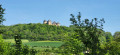
Once past the bridge, keep to the left and walk past the old cookhouse and the “Accord de Schengen” commemorative stone. Then the path begins to climb for the first time. Stunning views await walkers on the path over the Stromberg, all the way to the wooden cross high above Contz-les-Bains, which is now once again part of France. The path now leads below the old quarry and past the chapel into the village. In Rue de la Treille there is a wine museum and, very close by, the old washhouse.
The route now crosses the Moselle again and follows the “Chemin de la Moselle” cycle path to Sierck-les-Bains. The imposing fortifications serve as a reminder of the strategic importance of this small French town, just a few kilometres from the border. In the upper town stands the 11th-century fortress of the Kings of Lorraine. Vauban’s Sound Tower dominates the complex. Also of interest are the old gate “Le Vieux Port” and the clock tower “Tour de l’Horloge” on the market square. The castle is open to visitors from May to October.
At the end of Sierck-les-Bains, the path leads steeply uphill towards Rustroff, past the old monastery and the cemetery. Further up, you reach the heights between the Moselle and Saar valleys. Just past the village, turn right off the main road and head downhill towards Manderen. There, the path climbs steeply again until ‘Château Malbrouck’, with its imposing walls, lies before you. This formidable castle, too, belonged to the Kings of Lorraine and is open to visitors. It’s always worth a visit, not only because it hosts many exceptional exhibitions and cultural events throughout the year.
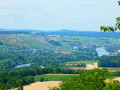
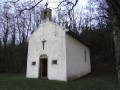
The route continues along shady forest paths to Merschweiler. Once again, the path leads uphill. The border is not far away now. Here, between the German village of Oberperl and the French village of Merschweiler – in no man’s land between Germany and France, so to speak – hikers can now rest in the shade of the Peace Chapel after the strenuous climbs, before tackling the rest of the route downhill back to Perl. The transmission mast on the Hammelsberg is already in sight. The mountain hut high above Perl invites you to take one last break, and the view of the Moselle Valley from here is truly impressive. You’re almost there now – Perl lies at your feet. (S/E)
 Visorando Member
 Average
 Easy
Easy