Country:


Starting point: “Centre Européen” European Information Centre
GPS: 49° 28’ 15’’ N 6° 21’ 59.5’’ E
32 U RW 3092214 HW 5483132
(S/E) Before we set off on the climb up to the Stromberg, we explore some historic ground right on the banks of the Moselle.
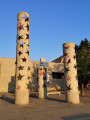
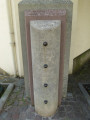
Just a few steps away from the European Information Centre ‘Centre Européen’, three steel stelae, each bearing a golden star, commemorate the signing of the Schengen Agreement over 25 years ago. On 14 June 1985, aboard the passenger vessel ‘Princesse Marie-Astrid’, representatives from Luxembourg, Belgium, the Netherlands, France and Germany signed the agreement, which was one of the most important steps towards European unification: the abolition of intra-European border controls on the movement of people and goods between the signatory states. Today, Schengen is regarded as synonymous with a borderless Europe: travelling easily from one country to another without border formalities, whether on foot, by bicycle or by car.
Back to the starting point: since 8 February 2010, a section of the former Berlin Wall has stood on the banks of the Moselle as a symbol of the opening of borders. To mark the 25th anniversary of the signing of the Schengen Agreement, the interactive ‘Musée Européen Schengen’ was established at the ‘Centre Européen’. The museum traces the development of Europe and provides a wealth of interesting facts and background information on the Schengen Agreement.
We start our walk in front of the “Centre Européen” and climb a few steps.
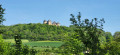
On the left is Schengen Castle with its striking round tower, first mentioned in records as early as 1350. For several years now, the castle has been home to a hotel. On the right, opposite the castle, a herb garden has been created as part of the cross-border project ‘Gardens Without Borders’. The beds of this 2,300-square-metre garden, filled with medicinal and aromatic plants, are reminiscent of the tradition of monastic gardening.
Passing through the gate of the castle garden, we reach the street ‘Beim Schlass’ (Rue du Château).
(1) At the end of the narrow lane, we reach Europaplatz, with a commemorative stone on the left bearing the inscription: 1990 Accord de Schengen, EUROPA OUNI GRENZEN, L’EUROPE SANS FRONTIERES, GRENZENLOSES EUROPA.
At Europaplatz, we keep to the left. At first, the path climbs gently uphill. As we pass the last houses of Schengen, the slope becomes steeper, but the views into the Moselle valley become all the more impressive.
We are walking through the Stromberg Nature Reserve above Schengen.
(2) A narrow path winds its way up to a viewing platform.
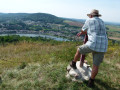
(3) From there, we enjoy a breathtaking view of the Moselle Valley.
On the opposite side, on the Saarland side, lies the 13.2-hectare Perler Hasenberg. It forms part of the ‘Southern Wine Mosel’ wine-growing region. The Perler Hasenberg, with its shell limestone soils, is one of the finest sites in the Upper Mosel. It is primarily home to Pinot Gris vines.
The view stretches further across the Moselle, beyond Remerschen in Luxembourg, with the houses of Perl – the Saarland’s only wine-growing municipality – opposite, and further to the right the cross-border Hammelsberg Nature Reserve, the French border village of Apach, and the villages of Belmach, Kitzing and Manderen.
We continue our walk through the Stromberg forest. In places, the route also follows the Strombierg Forest Discovery Trail and passes through the ‘Strombierg Nature Reserve’.
Until the 1950s, much of the vegetation on the Stromberg was destroyed by gypsum mining. Today, nature has reclaimed the terrain. The leathery, glossy fronds of the native fern species, the hart’s-tongue fern, are clearly visible on the forest floor.
Before we leave the forest, we pass an old boundary stone marking the border between Luxembourg and France.
At the Congress of Vienna (18 September 1814 – 9 June 1815), numerous borders were redrawn and Luxembourg was elevated to the status of a Grand Duchy. William I of Orange-Nassau was the first Grand Duke. Today, Luxembourg is the only Grand Duchy in the world.
(4) We walk along the edge of the woodland, through meadows and fields, across the French part of the Stromberg. Sweeping views open up across France and Luxembourg. In some places, the view stretches as far as Belgium.
(5) After crossing a tarmac-surfaced track on the Stromberg plateau, we descend along a narrow path through the forest.
(6) Once at the bottom, the woodland opens out to reveal an extraordinary view, as if through a window in the forest: before us lies Contz-les-Bains on Lorraine soil, the vineyards of the Moselle and the Cattenom nuclear power station.
The vineyards around Contz-les-Bains mainly grow Auxerrois, Rivaner, Pinot Blanc, Pinot Gris and Pinot Noir. On the Luxembourg side, the varieties include Pinot Blanc, Pinot Gris, Pinot Noir, Elbling, Riesling and Gewürztraminer. We continue our walk between meadows and woodland, keeping the Moselle in sight.
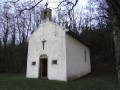
(7) Just before we reach the chapel above Contz-les-Bains, nestled in the heart of the forest, a narrow woodland path leads steeply upwards. The shaded area around the chapel is an ideal spot to rest on hot summer’s days.
(8) At the top of the Stromberg, there is a breathtaking view across the Moselle valley: below us lie the steeply sloping cliffs of a former quarry; the Moselle winds in a wide arc around the Stromberg; and the views stretch far across Germany, France and Luxembourg. The thick walls of the former fortress at Sierck-les-Bains are also clearly visible.
The current appearance of the complex above Sierck-les-Bains, situated on the banks of the Moselle, is characterised by the 17th-century extension and renovation work overseen by the renowned fortress architect Sébastien Le Prestre, Seigneur de Vauban (1633–1707). He constructed a massive fortification wall with bastion towers and redoubts around the ruins of the original castle, as well as a powder tower, a bakery and the stables. Numerous passageways run through the gun turrets, some of which are several storeys high.
We leave the Stromberg behind, winding our way down the serpentine path and walking past the mighty rocks of the former quarry, which rise almost vertically into the sky.
It is said that stone blocks from Contz-les-Bains were also used in the construction of the Porta Nigra, the best-preserved city gate from antiquity. A written source indicates that the originally light-grey sandstone came from quarries in the immediate vicinity of Trier, from the Biewer Valley and the Palatinate Forest.
Once we have passed the imposing rocks, the path leads downhill. A few remains of walls bear witness to former houses in the immediate vicinity of the quarry.
(9) Once at the bottom, we keep to the left. After a few minutes, our walking route branches off to the left once more. A longer uphill stretch lies ahead of us.
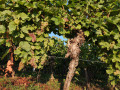
(10) Further up the slope, we leave the path to the right and walk through dense undergrowth interspersed with thick vines. We leave the forest at a vineyard slope that drops steeply downwards.
(11) Between the forest and the vineyard slopes, the path runs parallel to the Moselle valley towards Schengen.
At times we walk on soft meadow ground, at times on the hard surface of the farm tracks, and at times on forest floor. Time and again, the view opens up to the right into the Moselle valley. Shortly before Schengen, we have to climb one last time and turn left onto a path. It is particularly in this section of the forest that the aforementioned lush green ‘deer’s tongue’, a native species of fern, grows.
(12) During the final stretch through the woodland, we pass former tunnel entrances secured by wooden posts.
In 1932, the brothers Alfons and Karl Knauf secured the mining rights to a gypsum deposit on the Stromberg in the municipality of Schengen. A year later, the company’s first gypsum works was established in Perl. This laid the foundation for the Knauf company, which remains family-owned to this day. With 24,000 employees worldwide, the Knauf Group is one of Europe’s leading manufacturers of building materials and construction systems.
(2) We reach the point we passed earlier and turn right here.
(13) We leave the forest just above Schengen. The swing set up here allows us to linger one last time, enjoying a fantastic view of the Moselle valley, before we begin our descent to the banks of the Moselle.
(S/E) We return to our starting point via the familiar path.

 Visorando Member

 Tourism professional
 Difficult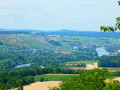
 Easy
Easy