A tour of Givet

This route allows you to discover the heritage of the town of Givet. From the Fort de Charlemont to Georges Simenon, via Méhul’s musical works and Givet’s pipe-making industry, you will learn about the key aspects of the heritage of the northernmost of the Ardennes towns.

Details

n°32098949
Creation:
Last update:
Last review:
  • Walking
    Activity: Walking
  • ↔
    Distance: 1.86 mi
  • ◔
    Average duration: 0h 50 
  • ▲
    Difficulty: Easy

  • ⚐
    Back to start: Yes
  • ↗
    Ascent: + 10 ft
  • ↘
    Descent: - 10 ft

  • ▲
    Highest point: 344 ft
  • ▼
    Lowest point: 331 ft
  • ⚐ Country: France
  • ⚐ City: Givet (08600)
  • ⚑
    Start/End: N 50.134965° / E 4.82115°
  • Accessible from the train station Gare de Givet.
  • ❏
    IGN map(s): Ref. 3008SB
  • Hour-by-hour weather

Description of the walk

Start and finish at the car park on Place Sourdille.

(S/E) At 11 Place Jacques Sourdille stands the monument to the148th Infantry Regiment, also known as the Régiment de la Tour d’Auvergne. This regiment guarded the Franco-Belgian border before the First World War. With this monument, the town of Givet commemorates its past as a military stronghold, of which the Manège and Fort de Charlemont are illustrious examples.

At 9 Place Jacques Sourdille stands the Manège, or, if you prefer, Givet’s cinema. This former military riding school was used right up until the aftermath of the Great War to train the cavalry stationed in Givet.

On the eastern tip of Givet, at 1 Route de Philippeville, the mist lifts to reveal a site steeped in history: Fort de Charlemont. It is one of our town’s most famous landmarks. It was built by Mary of Hungary, sister of Emperor Charles V, to protect the Spanish Netherlands from the Kingdom of France. This structure was redesigned by the famous architect Vauban in the17th century. Join our guide to discover this masterpiece of Renaissance defensive architecture, a symbol and source of pride in Givet’s history.

Further on, General Bourck put up a stubborn resistance against the Prussian soldiers in 1815, in the aftermath of the Battle of Waterloo. It is thanks to this general’s perseverance that the Pointe de Givet is now part of French territory.

With your back to the Meuse, walk up the Route de Philippeville, then turn right onto Avenue Victor Hugo. At the end of the avenue, on Place Méhul, stands a small obelisk symbolising Méhul’s musical genius. This musician rose to fame with *Le Chant du Départ*, the lyrics of which were written by Marie-Joseph Chenier.

(1) The house of Agit d’Étienne Nicolas Méhul is located at 13 Rue Méhul. This greatest composer of the revolutionary era was born in Givet; *Le Chant du Départ* made him famous. This French patriotic anthem is often described as the ‘little brother’ of *La Marseillaise*.

At 10 Place Carnot, Givet Town Hall resembles those found in northern France, built of brick and stone, complete with its belfry. Every hour, its bell tower plays an excerpt from Méhul’s *Le Chant du Départ*. The former town hall hosted the Tsar of Russia inthe 17thcentury. This speaks volumes about the grandeur of Givet’s history.

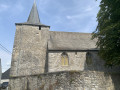
Walk round Place Carnot, then turn left onto Rue de la Halle. At number 3 on this street, the Church of Saint-Hilaire – the ‘blue pearl’ of Givet – gave its name to the ‘Grand Givet’, hence the name Givet Saint-Hilaire for the part of the town situated on the left bank of the Meuse. This building is a masterpiece of the Mosan Renaissance. Amongst its many treasures, you’ll discover numerous choir stalls, as well as paintings by artists from Liège.

(2) On the right, Rue de la Fausse Porte runs beneath the chancel of Saint-Hilaire. This church, the Rouget Barracks and Fort Charlemont are famous sites that Vauban built or restored in the 1680s following his visit to Givet with his good king, Louis XIV.

At the end, turn left onto Rue du Petit Port, then left again onto Quai des Remparts. Continue to Rue Flayelle.

At No. 1 Rue Flayelle, the red bricks and blue stone – two materials, two colours – give historic Givet its charm. The style of these façades, in the Meuse Renaissance style and unique in France, creates a genuine architectural unity stretching from Hierges to Givet and on to Maastricht in the Netherlands.

Cross the bridge over the Meuse.

The Pont de Meuse, or Pont des Américains, links the two parts of Givet into a single municipality. It offers a view of the Meuse’s waters, by turns calm and slightly choppy. Many bridges have been built in Givet; this one is among the most spectacular.

After the bridge, turn left at the corner by the post office onto Quai de Meuse. At the end, turn right onto Quai de la Houille.

The Quais de la Houille almost form a little ‘Venice’ of Givet. It was on the banks of this tributary of the Meuse that the Gilbert Pencil Factory was established. This company produced up to 30 million pencils a year. Using materials from the Americas and Europe, this pencil factory is now part of Givet’s flourishing industrial past.

Turn right onto Rue Jules Gilbert, cross Rue Oger at the pedestrian crossing and continue straight ahead.

(3) At 6–8 Rue Jules Gilbert stands the Gambier pipe factory, one of Givet’s finest industrial sites. With its kiln adorned with a head of Jacob, the Gambier pipe factory is an industrial treasure of international renown.

You’ll come out onto Rue André Bouzy.

Number 4 Rue André Bouzy lies at the foot of the lovely limestone massif on the right bank of the Meuse, the Mont d’Haurs, which is perfect for many a walk. The hill’s riches lie in its flora, fauna and splendid views.

Turn right, then right again onto Quai des Héros de la Résistance. Join Rue Oger, then turn left to cross the Pont des Américains once more. On the other side, turn left onto Quai des Remparts, which leads to the Tour Victoire, a lovely 14th- and 15th-century building. Under the summer sun.

Then head to the car park at Place Sourdille (S/E).

Waypoints

  1. S/E : mi 0 - alt. 335 ft - Place Sourdille car park - Meuse (fleuve)
  2. 1 : mi 0.57 - alt. 341 ft - Birthplace of the composer Méhul - Gare de Givet
  3. 2 : mi 0.72 - alt. 338 ft - The false door beneath St Hilaire’s Church
  4. 3 : mi 1.21 - alt. 331 ft - The Gambier Pipe - Tour Grégoire
  5. S/E : mi 1.86 - alt. 335 ft - Place Sourdille car park

Notes

(S/E) On the way back, you can extend your walk to reach 31 Quai du Fort de Rome, where you’ll find the Rouget Barracks, which was one of the longest barracks in France. It stands as a reminder of the long military presence in Givet. Built by Vauban at the foot of Fort de Charlemont, on the left bank of the Meuse, it could accommodate more than two thousand soldiers.

Reviews and comments

4 / 5
Based on 2 reviews

Reliability of the description
4 / 5
Ease of following the route
3.5 / 5
Route interest
4.5 / 5
promeneuse avertie
promeneuse avertie

Overall rating : 3.7 / 5

Date of your route : Nov 20, 2024
Reliability of the description : ★★★★☆ Good
Ease of following the route : ★★★☆☆ Average
Route interest : ★★★★☆ Good
Very busy route : Yes

I regret that there are two parts to the walking route description (draft, corrections). Just one would be nicer. For those of us who also read the information boards, we couldn’t manage this route in such a short time… we’re just out for a stroll…

Machine-translated

evd46
evd46

Good morning, Mr President,
These corrections are tedious, though undoubtedly useful, if not necessary.
I am happy to write everything as you wish, but please do send me the full text as you would prefer it to be published.
The current text is as follows. Please ensure that technical details, such as the instructions (1) and quotation marks, are adhered to.
Kind regards.
Erik van Dyck, former director of tourism marketing at Toerisme Vlaanderen

Start and finish at the Place Sourdille car park.

(S/E) At 11 Place Jacques Sourdille stands the monument to the148th Infantry Regiment, also known as the Régiment de la Tour d’Auvergne. This regiment defended the Franco-Belgian border prior to the First World War. With this monument, the town of Givet commemorates its past as a strategic stronghold, of which the Manège and the Fort de Charlemont are illustrious examples.

At 9 Place Sourdille stands the former military riding school of the Givet garrison. Built in 1826, it was abandoned by the Army in 1919. The Town of Givet purchased it and, in 1994, converted it into a performance venue for live theatre and cinema.

From the square, you can admire the eastern tip of Charlemont Fortress. This is one of the town’s most famous landmarks. It was built by Mary of Hungary, sister of Emperor Charles V, to protect the Spanish Netherlands from the Kingdom of France. The structure was extended by the famous architect Vauban inthe 17th century. Join our guide to discover this masterpiece of Renaissance defensive architecture, a symbol and source of pride in Givet’s history.

Further on, General Bourck put up a stubborn resistance against the Prussian soldiers in 1815, in the aftermath of the Battle of Waterloo. It is thanks to this general’s perseverance that the Pointe de Givet is now part of French territory.

With your back to the Meuse, walk up the Route de Philippeville, then turn right onto Avenue Victor Hugo. At the end of the avenue, on Place Méhul, a small obelisk has been erected to symbolise Méhul’s musical genius. This musician rose to fame with *Le Chant du Départ*, the lyrics of which were written by Marie-Joseph Chenier.

(1) The house of Agit d’Étienne Nicolas Méhul is located at 13 Rue Méhul. This greatest composer of the revolutionary era was born in Givet; *Le Chant du Départ* made him famous. This French patriotic anthem is said to be the ‘little brother’ of *La Marseillaise*.

At 10 Place Carnot, Givet Town Hall resembles those in northern France, built of brick and stone, with its belfry. Every hour, its bell tower plays an excerpt from Méhul’s *Le Chant du Départ*. The former town hall hosted the Tsar of Russia inthe 17thcentury. This speaks volumes about the grandeur of Givet’s history.

Walk round Place Carnot, then turn left onto Rue de la Halle. At number 3 on this street, the Church of Saint-Hilaire – the ‘blue pearl’ of Givet – gave its name to the ‘Grand Givet’, hence the name Givet Saint-Hilaire for the part of the town situated on the left bank of the Meuse. This building is a masterpiece of the Mosan Renaissance. Amongst its many treasures, you’ll discover numerous choir stalls, as well as paintings by artists from Liège.

(2) On the right, Rue de la Fausse Porte runs beneath the chancel of Saint-Hilaire. This church, the Rouget Barracks and Fort Charlemont are famous sites that Vauban built or restored in the 1680s following his visit to Givet with his good king, Louis XIV.

At the end, turn left onto Rue du Petit Port, then left again onto Quai des Remparts. Continue to Rue Flayelle.

At No. 1 Rue Flayelle, the red bricks and blue stone – two materials, two colours – give historic Givet its charm. The style of these façades, in the Meuse Renaissance style and unique in France, creates a genuine architectural unity stretching from Hierges to Givet and on to Maastricht in the Netherlands.

Cross the bridge over the Meuse.

The Pont de Meuse, or Pont des Américains, links the two parts of Givet into a single municipality. It offers a view of the Meuse’s waters, by turns calm and slightly choppy. Many bridges have been built in Givet; this one is among the most spectacular.

After the bridge, turn left at the corner by the post office onto Quai de Meuse. At the end, turn right onto Quai de la Houille.

The Quais de la Houille almost form a little ‘Venice’ of Givet. It was on the banks of this tributary of the Meuse that the Gilbert Pencil Factory was established. This company produced up to 30 million pencils a year. Using materials from the Americas and Europe, this pencil factory is now part of Givet’s flourishing industrial heritage.

Turn right onto Rue Jules Gilbert, cross Rue Oger at the pedestrian crossing and continue straight ahead.

(3) At 6–8 Rue Jules Gilbert stands the Gambier pipe factory, one of Givet’s finest industrial sites. With its kiln adorned with a Jacob’s head, the Gambier pipe factory is an industrial treasure of international renown.

You’ll emerge onto Rue André Bouzy.

Number 4 Rue André Bouzy lies at the foot of the lovely limestone massif on the right bank of the Meuse, the Mont d’Haurs, which is perfect for many a walk. The hill’s riches lie in its flora, fauna and splendid views.

Turn right, then right again onto Quai des Héros de la Résistance. Join Rue Oger, then turn left to cross the Pont des Américains once more. On the other side, turn left onto Quai des Remparts, which leads to the Tour Victoire, a lovely 14th- and 15th-century building. Under the summer sun.

Then head to the car park at Place Sourdille (S/E).

Machine-translated

SIG_08600
SIG_08600

Hello,

I am the chair of the Givet Tourist Information Office (a non-profit organisation under the 1901 Act) and we organise tours of our town. Following discussions amongst our members, we would first of all like to thank you for this initial contribution to the town of Givet, which is well worth a visit, and we would like to put forward a few suggestions for amendments to correct certain aspects and improve others.

Please do not hesitate to contact us if you have any comments or questions regarding these suggestions.

Yours sincerely,

The SIG


“S/E: it would be better to start from the OTC, Quai des Fours, 10. It’s right next to Place Sourdille, and all the information is available at point I

The paragraph on the Manege is fanciful. Here is what should be written:
“At 9, Place Sourdille, stands the former military riding school of the Givet garrison. Built in 1826, it was abandoned by the Army in 1919. The Town of Givet purchased it and converted it, in 1994, into a performance venue for live theatre and cinema.”

The third paragraph is even more fanciful. The “Eastern Tip of Givet” does not exist, nor does “1, Route de Philippeville”. There is rarely any mist in that area. This calls for a change to the route. The route leaves Place Sourdille, turns left towards the Route de Philippeville, and then passes through Rue Victor Hugo – a rather unremarkable street – to reach Place Mehul.

In fact, the guided walks organised by the Givet Tourist Office turn right onto Rue des Récollets. This takes you past the former Récollets convent and its chapel. Mehul gave his first organ recital there at the age of 10.
(It would be good to include a photo showing the amended route).
The sentence in question would then read:
“From the square, you can admire the eastern tip of Charlemont Fortress.” I would then replace ‘our’ with ‘the’. I would remove the ‘e’ from ‘Espagnoles’. I would write ‘was enlarged’ instead of ‘will be developed’, and ‘after Givet’s annexation to France in 1678’ immediately followed by ‘century’.
I’m not sure which ‘guide’ is being referred to next. I’d prefer ‘This masterpiece of military architecture is open to visitors from spring to autumn.’
Instead of ‘Further on’, I would write ‘Later’
The following paragraph should be deleted: ‘With your back to the Meuse’. For ‘Turn right into Rue des Récollets, passing in front of the façade of the chapel of the former Récollets convent (1684). Mehul, Givet’s famous son, gave his first organ recital there at the age of 10. This musician rose to fame with *Le Chant du Départ*, the lyrics of which were written by Marie-Joseph Chénier. Continue straight on to Place Mehul. There you will see the stone statue of Mehul, erected after the Second World War to replace the bronze one, which was stolen by the Nazis.
Turn right into Rue Mehul. The house where Mehul was born is at number 12 on this street.”
Note that the town hall was built in 1905 and that the previous one had burnt down.
Add a paragraph on St Hilaire’s Church: “On the square, St Hilaire’s Church was built to Vauban’s plans in 1702. Go inside. You will see five new, high-quality stained-glass windows which are gradually replacing the old, faded plastic ones. The church’s bell tower was described by Victor Hugo, who was passing through Givet in 1838: “The solemn architect took a square priest’s or lawyer’s cap. On top of this cap, he placed an upturned salad bowl. On top of this salad bowl, now serving as a platform, a sugar bowl; on the sugar bowl, a bottle; on the bottle, a sun with its lower vertical ray inserted into the neck; and on the sun, a rooster on a spit. Assuming it took him a day to come up with each of these ideas, he must have rested on the seventh day. This architect must have been Flemish.”
The paragraph beginning with “Go round” and ending with “Liège” is to be deleted: this church has nothing to do with the “Meuse Renaissance”!!
Instead, insert: “Turn left onto Rue de la Halle, then pass under the church choir to reach Rue du Petit Port on the left, leading to Quai des Remparts and the Meuse. Continue left until you reach the bridge.” Keep the paragraph “At No. 1, Rue Flayelle …”, but cross out the utterly absurd phrase “unique in France”!
There is no ‘s’ in ‘Givet’. The bridge is by no means ‘spectacular’.
Replace with: “This bridge was opened in 1970, replacing the one destroyed in 1940.”
There is no ‘Gambier pipe shop’ at 6.8 Rue J. Gilbert. One could write ‘the former Gambier pipe shop’.
We then return to the starting point.
Delete the paragraph encouraging visitors to go to 31 Quai du Fort de Rome to “find the Rouget barracks”. On the one hand, it was demolished ages ago, and, on the other hand, it involves walking along a narrow pavement beside a very busy road.

Machine-translated

Louise38
Louise38

Overall rating : 4.3 / 5

Date of your route : Apr 09, 2023
Reliability of the description : ★★★★☆ Good
Ease of following the route : ★★★★☆ Good
Route interest : ★★★★★ Very good
Very busy route : No

A lovely walk for anyone who loves the Ardennes, its forests and its villages, which have retained their character.

Machine-translated

Other walks in the area

For more walks, use our search engine .

The GPS track and description are the property of this route's author. Please do not copy them without permission.