Country:

 City:
City:


From Félins-Minervois, take the very narrow road that leads to the hamlet of Brama. At the end of the tarmac road, a gravel track allows you to get a little closer to the starting point. After the first DFCI water tank, continue along the track and park at the second water tank (elevation 315), taking care not to obstruct the manoeuvres of the emergency services' large trucks.
(S/E) Leave the track descending to the right of the cistern and take the one that climbs slightly to the left, towards the north-west. At the next intersection of tracks, leave the track opposite, which is the return route, and take the track on the left, towards the west, until you reach a fork.
Yellow markings
(1) Turn right onto the fairly steep path marked in yellow (PR®), which leads to the hamlet and marble quarry of Biot (mill). These buildings have been renovated by an association that has done a fine job.
No markings
(2) After the last house, leave the marked trail and turn left to reach a recently renovated canopy. It appears to contain an old well and an underground conduit that was used to supply water to the marble quarry for cutting marble blocks.
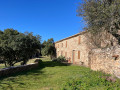
Return to the trail and continue west, then northwest. On the grassy track that follows, turn left to reach the hamlet of La Matte, with its magnificent farmhouses in perfect condition. Continue between the buildings to find a stony track (elevation 447). Turn right onto this track and follow it north for about 200 metres.
(3) Leave the next bend on your right and take the path that runs to the left, northwest. The path winds through the heath of low vegetation to a grassy track, which you should leave.
(4) Here, continue straight ahead, following a path that we have created, cleared and marked. The entire section that follows is marked with yellow paint circles. (We return regularly to maintain the trail and ensure that the markings are kept in place.) As I said in response to comments made by hikers, we prefer to walk on trails rather than tracks and, whenever possible, we open or reopen "forgotten" or neglected trails. This is the case between points (4) and (5). For this hike, which I published on 12 May 2025, I returned to improve the markings on 16 June and, after the summer, on 17 October. During these sessions, I cut back some brambles and added paint to the yellow circles that had been slightly faded by the sun.
(5) Turn left onto the path that descends for a few metres, then turn right. The path descends gently down the mountainside through the undergrowth to reach the bottom of the valley (Ruisseau du Cros à sec). Cross it and continue left on the other side. The path is becoming more and more marked on the ground due to regular use. We have alternated paint and cairns to make it easier to find.
(6) When you reach a wide path (our yellow markings end here), turn right, still in the undergrowth.
(7) Further on, at a sign engraved with "FERRUT", take the path that climbs to the right, leaving the path opposite that leads to the hamlet of Argentières. The well-marked path continues through the woods. A long flat section follows the somewhat steep climb. At the end of the flat section, turn left as the path descends slightly (cairn).
Yellow markings
(8) Find the PR® trail that takes you around the quarry known as "Font dal Rainard" and past an orientation table (beautiful view of the Montagne Noire and the hamlet of Argentières), then a cave (elevation 610) which marks the highest point of this hike. Continue along the path which leads to a large meadow and turn left, following the yellow markings (note: this is not easy in spring when the grass is high).
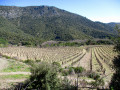
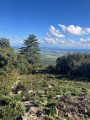
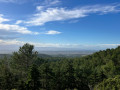
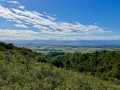
At the end of this meadow, you will be rewarded with a fantastic view of the Minervois plain and, beyond, the Corbières massif. On a clear day, you can see the Pyrenees mountain range, from the Albères in the east to the 3,000-metre peaks of the Ariège and even further west. Leave the path on the right (elevation 559) and continue east. The path veers east-northeast.
(9) At the first intersection, descend on a good path on the right, leaving the PR® for a moment. When you reach an intersection with a gravel track and the PR®, turn right. Walk along a very high, well-trimmed hedge, pass in front of a house with beautiful terraces (Bel Soleil), and note the sign for the Domaine viticole de Ventajou and a track below the property. Follow this track, ignoring all subsequent turnings on the left.
No markings
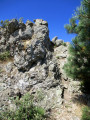
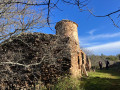
(10) Before reaching the hamlet of Ventajou (refuge open all year round), just after the antennas, turn right onto the path marked with a yellow cross that climbs a rocky mound (old castle ruins). The climb, which is a little steep, leads to a trail junction (signs for Argentières and La Planette). Head left.
(11) At the trail junction (elevation 539), turn left and pass by a dolmen whose horizontal slab is no longer there. The trail heads southwest, then west, to reach a gravel track. Turn left onto this track. On the right, you will see one of the last active marble quarries with its white "high flat walls". The track leads to a trail junction (elevation 469).
Yellow markings
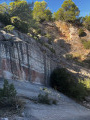
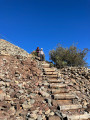
(12) Take the path on the right heading south-southwest to discover the Bessous quarry, a huge marble quarry that can be reached by descending steps secured by a handrail. At the bottom of the stairs, turn right for a round trip inside the marble block cutting area. A wagon and rails remain as vestiges of the titanic work of the labourers of a bygone era. Take the path downhill, which winds its way over a large cone of rubble formed by unusable waste from the quarry, to reach a wide stone track. Continue downhill to the left to return to the car park (elevation 315) (S/E).
 Visorando Member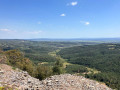

 Easy
Easy 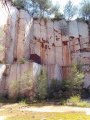
 Difficult