


 Country:

 City:
City:


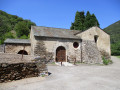
It is not easy to park in Citou, as the layout of the village is not particularly suitable and local residents occupy most of the parking spaces. That is why I recommend leaving your car at the Chapelle Saint-Jean, a very pleasant spot which also offers shade and a picnic table. Access is via a very narrow road that starts with a steep incline at the corner of the town hall (road signs). With a bit of luck, however, a few spaces may be available along the D620, which you’ll need to take at the start of the walk anyway.
(S/E) Head back towards the village. Join the D620 at the town hall, turn left and continue to the first junction after passing the wash house, the fountain, the church and the recycling bins.
Yellow PR® markings
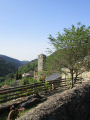
(1) Take the sharp right-hand bend onto a tarmac road which loses its surface after the last house and gives way to a wide stony track. You’ll reach a lovely viewpoint over Citou and the chapel below; take the opportunity to read the information provided. Continue to the third hairpin bend, where you’ll find a signpost indicating “Caunes-MinervoisPR®4”.
(2) Turn right onto a path that follows the contour lines almost exactly and eventually leads onto the Route Forestière de Rives.
(3) Turn right and begin the pleasant, gentle descent leading to a junction marked by another signpost bearing the same directions.
(4) Turn right, cross a junction and carry straight on. Continue to the next fork, located a good hundred metres further on and easy to miss if you’re not paying attention.
No signposting
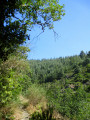
(5) Leave the wide path you have been following and turn left onto a more discreet path winding through dense undergrowth, where the trail on the ground is sometimes difficult to follow on the carpet of dead leaves.
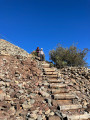
(6) Be very vigilant to spot the small fluorescent red mark on a slender tree on the right, which will serve as a landmark on the return journey, and continue to the foot of the Roc de Moussu, which you reach after climbing a short chimney, half earth and half rock, where you’ll need to use your hands.
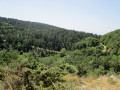
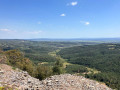
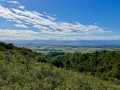
(7) Take in the exceptional 360° panorama: to the south, the Minervois, the Corbières and the Ariège Pyrenees; to the north, the Soulanes de Nore and the peak of the same name with its red and white antenna; to the east and west, the undulating, wooded landscape of the many small peaks of the Montagne Noire. Continue for about a hundred metres along the ridge to reach the secondary summit a little further west, then turn back. Please note that the descent down the chimney is trickier in this direction, although there is no objective danger.
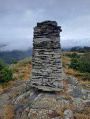
(6) When you reach the fluorescent red marker, leave the path and head left onto a faint track that is difficult to make out on the ground: to make this easier, look out for the next red marker on a tree about thirty metres further on, which indicates the direction to follow. Continue along this path, which is sometimes very overgrown but passable, until you reach the start of another path on the right: this junction is tricky and I have placed a cairn there (see photo).
(8) Turn right at the hairpin bend and continue the descent. You’ll come out onto another path coming from the left; continue straight on to begin a series of switchbacks leading back to the marked path you left earlier to reach the Roc de Moussu.
Yellow markings
(9) Turn left, pass a house on the right and the path leading to it, then head straight on following the markings. You will soon reach a junction marked by a signpost; turn right, following the sign for “Bibaud – Sentier du Facteur”. Join the D620 at the place known as Bibaud Ouest/Bibaud Est (signs).
(10) Cross with care as visibility is reduced due to the bend, then take the path opposite. Cross the bridge over the Argent Double, pass between the houses and continue to the next signpost.
(11) Go straight on following the sign for "Castanviels -PR®3", then take care not to miss the inconspicuous path climbing up to the right before reaching the houses in Ardenne. This very narrow but well-marked path makes the long climb up the valley housing the Ruisseau de Balbonne (dry in July 2023), which it crosses twice. You’ll emerge onto the road leading to the hamlet of Castanviels (D615).
(12) Turn left onto it, then leave it quickly to turn left onto the wide forest track that skirts the hamlet to the south. Pass the old wooden sign for “parking spéléo” and the sign for “Karstic Cave 50 m”, then continue along the track.
No signposting
Keep to the right in the hairpin bend, ignoring the markings: a large sign indicates the entrance to the Soulanes de Nore National Forest. Follow the track as it winds lazily through this beautiful wooded area and joins another track at a place called Peyre Male.
(13) Turn right, negotiate the hairpin bend at the weir on the Ruisseau de Peyre Male, then continue on level ground to the major junction with the Route Forestière de Patréou.
(14) Turn right. Ignore a turn-off on the right signposted as a private road and continue for a further 350 m or so.
(15) In a wide right-hand bend (about a hundred metres before the 644m mark), leave the forest road for the track on the left and descend through very dense woodland. The track becomes a narrow path, takes a sharp left-hand bend, briefly emerges from the cover, then turns right to re-enter the woodland. The route then requires great care as the track disappears for about a hundred metres before reappearing more clearly. You will need to ensure you keep heading east-southeast, and the GPX track will be very useful on this section. Join the D615.
(16) Turn left towards the hamlet of Rieussec. Cross two successive bridges and continue to the right, following the dry bed of a tributary of the Argent Double. Carry on to the first road junction where two signs on the left point to the Chapelle Saint-Jean and the cemetery.
(17) Turn left and follow the road to the car park at the chapel (S/E).

 Visorando Member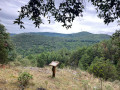
 Moderate
 Easy
Easy 
