Country:

 City:
City:



(S) The route starts just above the footbridge before the Pont des Fontaines.
The path leads into the woods; this is theGR®54Tour de l’Oisans, marked in red and white. Ignore the sign for the Cascade de la Pissotte on your left to quickly reach the Pont des Fontaines, which you do not cross.
(1) The path continues along the right bank of the Onde to the Pont des Places.
(2) The bridge is located near an annex of the municipal campsite.
Stay on the right bank so that you only rejoin the road later, at the Pra du Clot footbridge, and thus cover part of the route on a footpath.
I chose this option, leaving the road behind. It was a mistake, as near the hamlet of Les Grésourières (but on the other bank) a landslide had cut off the path and stopped me in my tracks.
(3) Cross the Onde at the ford (not easy at this point, as the current is quite strong) and head back up to the road.
(4) Take the road on the left. Check in future whether the path has been re-established, and whether it allows you to rejoin the road between the two chapels.
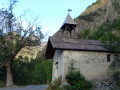
(5) From (roughly) the Béassac chapel, it’s a tarmac road – pleasant but it really makes your feet work – all the way to the Entre les Aygues car park.
(6) Head towards the Refuge des Bans / Col de l’Aup Martin and turn left before the footbridge towards the Col.
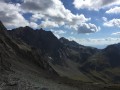
(7) Enter the Vallon de la Selle; the climb follows a very good path which is no longer signposted but is still theGR®54, though it can be a bit monotonous at times. The valley winds its way through the landscape; gradually, the valley floor comes into view until you can see the pass you need to climb in the distance.
(8) A sign marks the entrance to the Écrins National Park and the path crosses several small streams until it reaches the footbridge over the Ravin du Blanc stream
(9) The footbridge precedes the arrival at the Jas Lacroix shepherd’s hut
Stay on the left bank of the Selle torrent to reach the footbridge over the Chanteloube stream
(10) Continue southwards to approach two rock faces that will obscure the pass (at ‘La Saume’ on IGN maps).
(11) The first outcrop is approached from the right, via a path through scree that is easy to lose as it is poorly marked: the path is easier to find if you force yourself to stay on the right bank from the ruins onwards, ignoring the markings.
In any case, don’t panic: directly opposite you, on the hillside a few dozen metres higher up, you can clearly see the path you need to rejoin.
(12) Arrive at Champ Rond, a marmot paradise, at the foot of the second cliff face; go round it to the left, to the right of the Ravin de la Saume, along a steep but well-marked path, which levels out until you reach the Torrent de la Saume
(13) You can cross it on foot without any trouble.
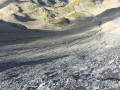
From here, take care: the path becomes increasingly narrow and schistose, slippery and difficult: you may need to use your hands and poles to keep your balance. Beware of vertigo.
The final half is very steep; the path alternates between narrow slopes and mini-steps, and is a bit slippery even in dry weather. But the reward awaits: the Col de l’Aup Martin
(14) Make your way to the Pas de la Cavale, taking great care, along an almost level path.
(15) Begin a long descent along a good, winding path, which leads towards the Cabanes de Rougnoux, following the left bank of the Rougnoux torrent.
(16) Cross the stream via a small footbridge to reach an area of raspberry bushes.
(17) You will then reach the Refuge du Pré de la Chaumette.
(18) Then look for a place to camp (E).



 Visorando Member
 Easy
Easy 

 Moderate

 Difficult