

 Country:
 City:


Starting point and access: Mairie de Montrouge station.
- Metro – Line 4. Take Exit 3 to Place Émile Creps.
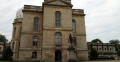
(S/E) Upon exiting the metro station, cross the square diagonally to the left (towards the statues of Lavoiriser and Denis Papin). Pass the ‘Le Beffroi’ building (cultural centre) on your right and turn right onto Rue du Colonel Gillon. At the traffic lights, cross Boulevard Romain Rolland, go over the ring road and you’ll find the cemetery entrance immediately on your left.
The route within the cemetery is a guide only and can be adapted in various ways. In the description that follows, the names appearing on the graves may be highlighted for three different reasons:
1) Graves of notable figures, in which case a lower-case letter in brackets refers to a short entry in the ‘Places to see’ section, where the names are listed in the order in which they appear on the route.
2) Particularly original monuments.
3) Useful landmarks on the ground.
(1) Enter the cemetery, walk between the reception area and the crypt, and head slightly downhill along a tarmac path. Take the first tarmac path on the right, the Allée du Calvaire (not signposted). After about twenty metres, turn left, leaving the Baladand grave on your right. Walk to the tomb of Georges Dumoulin (a), which is adorned with a full-height bas-relief.
Retrace your steps, cross the Allée du Calvaire and continue along the grassy path opposite, leaving the Viale grave on your left. At the end of the path, you will find on your left a clergyman’s grave bearing a long list of Franciscans buried here, including, as the first name on the slab, Corentin Cloarec (b).
Then turn right onto a grassy path running at right angles. At the end, facing a chapel, turn left. Note, on the left, several small children’s graves. Then turn left into a grassy path between sections 23 and 22. You will emerge onto a tarmac path (Allée des Chapelles) and follow it to the left. Note, on the left-hand side, the statue of a child at prayer.
At the foot of the sign for Section 24, take a grassy path to the right. Then turn left between the third and fourth rows of graves, leaving the Negret grave on your right. After about ten graves, you will find René Crevel’s grave on the right (c). Continue straight ahead to reach Albert Resdel’s pink granite grave (d). Then turn left to reach a rotunda, then immediately right into the Allée du Calvaire.
(2) Turn right at the corner by Marie-Claire’s grave and follow a grassy path lined with trees (Allée des Prunus). On the left, ignore a grassy path and note the medallion adorning Félix Fourdrain’s headstone (e). Continue straight ahead and, when you reach a sarcophagus decorated with a bas-relief depicting building tools, turn left onto a grassy path.
Then turn between the sixth and seventh rows, leaving the Volzard grave on your left. Note several graves on the left with no headstones and, on the right-hand side, the small pink granite headstone of Joselia (f). Continue straight on to the east wall (on the right, a small war memorial for the wars of 1870–1971). Then turn left and walk alongside the wall on your right.
Cross a tarmac path (gate on the right) and continue along the path opposite, still keeping the wall on your right. On the right-hand side, after about fifteen graves, you will findHenri Queffélec’s grave (g). Walk a little further, turn left at the corner of the Franck grave and immediately turn left again. Then turn right between the Grimaldi and Demailly graves. Opposite a cross-shaped stele, you will find (on the left-hand side) the weathered grave of Germaine Montero (h) and her last husband, Jean-Mario Bertschy (i).
At the end of the path, turn right onto a paved track. Shortly afterwards, turn left at the corner of the Mazery grave, then immediately right onto a paved path. Walk past the foot of the imposing Legrand-Raimon monument. You’ll come out onto a tarmac-surfaced avenue, the Allée du Maquis, and follow it to the left.
Shortly afterwards, turn right at the corner by the Ponserre grave. Walk past the sign for Section 68 and you will immediately find Michel Audiard’s grave (j) on your right. Retrace your steps and follow the tarmac path to the right. You will come to a small rotunda with a war memorial to those who died in the 1914–1918 war.
(3) Then turn right between Sections 11 and 9. On the right-hand side, you will find the grave of Tony Vergnolet (k) with its medallion. Retrace your steps back to the tarmac path.
(3) Turn right, take a grassy path and pass the war memorial on your right, followed by a clergyman’s grave. Walk along the right-hand side of Section 12, which appears quite open. Note the grave of Louis Désiré Rolland (l) on the left.
At the T-junction opposite a chapel, turn left onto a grassy path. Turn left again onto a grassy path, at the corner by the Thimbot-Astier grave. The second grave on the right after a chapel is that of the Martinie family, where Grégory Ken is buried (m).
Retrace your steps to the previous junction and turn left. Note, on the left, a monument in honour of those who donated their bodies to science.
Cross a tarmac path (Allée des Arbres) and continue straight ahead between sections 29 and 30. On the right stands a war memorial to those who died in the wars of 1870–1871 and 1914–1918. On the left-hand side, after a black sarcophagus, the second grave is that of the Bénard family, where Cécile Aubry (n) is buried. You will come to a junction, at the corner of the war memorial.
(4) Turn left onto a grassy path. Note, on the left in the second row, a sculpture depicting a crouching woman holding a bouquet of flowers in her hands. Further on, still on the left-hand side, there is a grave with a medallion surmounted by a statue of a woman wearing a laurel wreath.
At the junction just ahead, turn right, leaving the Tantot grave on your left. Turn right again at the corner by the Delpiroux grave. On your right, you’ll find the grave of Charles Clavier (o), adorned with a pair of wings crossed by a lightning bolt. At the next junction, turn right and you’ll soon reach a junction you’ve already passed.
(4) Then turn left and walk past the war memorial on your right. Note, on the left-hand side, the medallion adorning the grave of Adèle Faivre. At the next junction, turn left. On the left-hand side, a medallion adorns the grave (incorrectly positioned on the map) of Alphonse Kirchoffer (p). On the right-hand side, a bust adorns the grave of Andrée d’Orléans. Still on the right-hand side, opposite the Kirsch grave, you will find the graves of Marcel (q) and Cécile (r) Cerf.
You’ll come out onto a tarmac path (Allée des Chapelles) and follow it to the right. Just before a junction, note on the right a grave adorned with unusual plants, including an agave. At the junction, continue straight ahead and walk past a military plot on your left (Wars of 1939–1945, Indochina and Algeria). Continue straight ahead between sections 43 and 42.
Turn right between sections 45 and 42, leaving the Rebourg grave on your right. On the right-hand side, opposite the Nannonet-Belloche grave, you will find the grave of Paul-Pierre Henry (s). At the next junction (insect hotel), carry straight on. On the right-hand side, you will find the De Gennes family sarcophagus, including that of Pierre-Gilles (t). Then cross a tarmac path, continue along the path opposite and walk alongside section 47 on your left.
Turn left onto a paved path at the corner of the Maisonnier grave. On the left, you will find the grave of Ernest La Jeunesse (u), adorned with a medallion. Note the presence of a brother, Lucien La Jeunesse (1877–1928), not to be confused with Lucien Jeunesse (1918–2008), whose ashes rest in the cemetery of a small town in Morbihan.
At the end of the path, turn left at the corner by the Taurat grave. At the end, just before a tarmac path, turn right and then immediately right again onto a cobbled path, leaving the Marchand-Dideley grave on your left. The fourth grave on the right is that of Armand Dubarry (v). You will then find, on the left, at the foot of a tree, the grave of Albert Simonin (w).
Turn left at the corner of this grave, walk past the tree, turn right straight away and you will immediately find, on the left, the grave adorned with a portrait of Odile Astié (x). Continue straight on and, at the end, squeeze between two graves. You will come out onto a path; follow it to the left and walk along the north wall on your right.
Turn left onto a paved path, leaving the Laumonier grave on your right. Note, on the left, a weeping woman holding a laurel wreath. At the corner of the Monge chapel, first turn right then left. You’ll come to a tarmac path; follow it to the right. Immediately ignore another tarmac path on the left and walk between sections 56 and 55. Note on the left the somewhat ostentatious Franz family tomb, adorned with a bust featuring an impressive moustache.
(5) Then turn left between the Brocard-Bronard grave and a chapel. Immediately on the left, you’ll find the grave of Emmanuel Dolivet (y), adorned with a sculpture of his own design depicting a mourner. After passing a chapel, squeeze between two graves to emerge onto a grassy path and follow it to the right.
At a junction (with a tomb adorned with a blue ball opposite), turn right. Note a medallion of a woman on the left-hand side, then, on the right-hand side, the medallion adorning the tomb of Gabriel Cromer (z). Still on the right-hand side, just before a large black chapel, lies the tomb of Louis Noël (aa) and his pupil and son-in-law Jules Déchin (ab). Return to the tarmac path and follow it to the left until it ends, at the foot of the grave of Nicolas De Staël (ac) and Jeannine Guillou (ad), which is adorned with paintbrushes.
Then turn left onto a tarmac path. Further on, turn left onto this path and walk alongside the west wall. Take the first tarmac path on the left (Allée des Chapelles). Walk along the left-hand side of sections 60 and then 54. You will cross a tarmac path on the left (Allée des Houx) and, shortly afterwards, find the grave of Charles Pélissier (ae) on the right, adorned with a medallion.
With your back to this grave, take the grassy path opposite, between the Gregory and Chevalier graves. On your left, you will find the grave of Jean-François Dubreuil de Mazières (af). Continue straight on until you reach a grave adorned with vertical white tubes, that of Étienne Béothy (ag). Retrace your steps to the tarmac path and follow it to the left.
Shortly afterwards, at a small roundabout, turn right between a bench and the Laisné grave. At the end of the path, first turn right then left and climb a flight of steps. You will emerge onto a tarmac path (Allée du Four) and follow it to the left. Walk past sections 61, 62 and 63 on your right. When you reach the military plot seen earlier, turn right at the corner by the Busson grave, which is made of pink granite.
Between the second and third rows, turn right onto a paved path at the foot of the sign for section 64. Note, on the right-hand side in the third row, a grave adorned with two busts of children. Continue straight ahead and, at the junction with a grassy path, you will find, on the left-hand side, the grave of Lina Margy (ah).
Continue straight ahead along the paved path. The seventh grave on the left is that of Coluche (ai) and Véronique Colluci (aj). Carry on straight ahead and note, on the left-hand side, the grave of Pierre Clerget (ak) adorned with a medallion. You’ll come to a junction with a tarmac path; note on the right the grave of Maurice Arnoux (al) adorned with two enormous aeroplane wings.
Cross the tarmac path and continue straight ahead along a grassy path. At the end, turn left. The last grave on the right is that of Henri Courbeau (am). You’ll come to another tarmac path; follow it to the right, slightly uphill, until you reach the cemetery exit.
(1) Turn right, cross over the ring road and cross Boulevard Romain Rolland at the traffic lights. Continue straight on along Rue du Colonnel Gillonn. At the end, cross Place Émile Cleps diagonally to the right to quickly reach the metro station (S/E).
 Visorando Member

 Moderate