Country:

 City:
City:


Warnings (see the practical information section for further details):
- The IGN topographical map is completely incorrect in two places where navigation is difficult.
- A 30-metre rope may be useful for those who are not confident on the rock.
Park along the D106 opposite the Château Gaillard path at N 45.15616° / E 5.619211°.
By clicking on the Google or Waze link, you can enter these coordinates directly into your favourite sat-nav app.
The path heading straight up to the east towards the forest is clearly visible from the car park.
(S/E) From the car park, the path climbs straight up the eastern slope towards the forest. It is marked in yellow and green. Ignore the paths branching off to the left and right to stay on the main slope all the way, leading you to the Clots crossroads.
(1) At Les Clots, take the track, which descends slightly to the south on the right. The markings are yellow.
(2) A sign at the Bois des Mûres crossroads — elevation 1268 — points to the right towards the Pas de la Bergère. Head up in this direction, south-south-east, ignoring all the paths veering off to the right. The trail switches back to yellow-green markings. The slope becomes steeper and features a few small rocky outcrops before reaching the Pas de la Bergère.
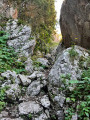
(3) Climb up through the rocky gorge of the Pas de la Bergère and, after a double hairpin bend, reach the plateau at the foot of the Combe de Saint-Nizier; continue climbing south-south-east along the edge of the forest until you reach the Combe Saint-Nizier junction (signpost).
(4) At the junction, cross theGR®®91track to take the wide path towards the Habert des Ramées. The path soon begins to descend towards the habert. Pass it on the left and continue downwards to the south along this track, through the forest.
(5) When you reach a clearing, look out for a blue mark on a rock on the left and a very faint track heading east into a meadow. Follow this track until you come to the eastern cliff face of the Vercors (if you lose sight of the blue marks, simply continue due east through the forest until you reach the cliff).
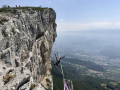
The entrance to the Trou Saint-Michel is situated about 10 metres back from the edge of the cliff. If you do not come across it straight away, scan the cliff for 50 metres either side of your current position. The entrance to the cave is at 45.125442°N 5.627858°E.
(6) You can descend the hole beneath the tree, which provides asecond belay point if you set up a abseil from the ledge fitted with a fixed cord. To descend without a rope, first descend beneath the tree along the right-hand (west) face of the hole, then swing round to the left-hand (east) face before reaching a ledge followed by another, easier descent. See the practical information section for equipment details.
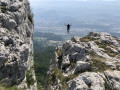
(7) Exit the hole onto the ledge to admire the view. This ledge is wide but very steep and does not lead to any slings on the cliff face.
Climb back up the cave and exit to the right (north) to follow the path, marked here and there with blue dots, which runs along the cliff face.
(8) Reach the summit of the Grande Roche Saint-Michel and continue to follow the blue dots along the ridge. Just before the secondary summit of the Moucherotte, head towards the track (GR®®91, the ‘Tour des 4 Montagnes’ route) and follow it for about 300 metres before turning right onto the path leading directly north to the summit of the Moucherotte.
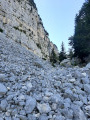
(9) At the summit, facing Grenoble (east), a path marked with yellow stripes branches off to the right (south) into the very steep foothills of the Moucherotte’s eastern face. Descend this winding path, which passes numerous rocky outcrops where you may need to use your hands on the rock to get down. After a final ledge and a descent eastwards over loose scree, you’ll reach a small pass on a ridge at the edge of the forest, at a place called Château Bouvier.
Take care here: the IGN topographical map is completely inaccurate in this area (paths either do not exist or are drawn haphazardly, a cave is incorrectly positioned, etc.) right up until you emerge from the forest at the Vallon des Forges. Switch to OpenStreetMap.
(10) At the small pass, do not follow the path marked with blue lines heading east-southeast. Instead, turn left down the very steep gully heading north, but do not follow the few tracks at the bottom of the gully (tracks left by walkers misled by the IGN map – there is no path to be found in that direction); instead, follow a narrow track crossing north-north-west across the steep, slippery slope. This track passes beneath the Vallier cave (a detour is possible – see GPS track) where it turns right to descend about twenty metres straight down the slope towards the east before turning left again towards the north to cross the Bessay stream ravine. Continue north along the faint track until you come to a better-defined path.
(11) Turn left onto this yellow and green-marked path, heading up to the Vallon des Forges, first through the forest, then over scree. Cross the valley northwards and follow the path at the foot of the cliff until you reach a track suitable for vehicles.
(12) Head down this track eastwards then northwards until you reach a 90° left-hand bend, just above the Trois Pucelles. After this bend, continue downwards westwards towards a junction (yellow sign) where the path turns left towards the south. Follow this path, which makes a wide hairpin bend back towards the north and leads to another yellow sign.
(13) At this sign, turn back to the left (no direction indicated on the sign) to descend onto the track that goes round the Rocher de l’âne and returns to Les Clots.
(1) Turn right onto the path leading down to the west-north-west towards the D106 road, which will take you back to the car park where you started (S/E).


 Visorando Member
 Moderate
 Difficult