Country:
 City:
City:


Park next to the well at the entrance to the path, opposite Kerséguin.
(S/E) Head towards the marsh. The path runs along the highest water line (which it sometimes crosses!), joining the various paths that come from the mainland. At each crossroads, always turn right.
(1) When you start to move away from the edge of the marsh and climb up between woods and farmland, continue along the path, passing two more turnings on your left. At the third turning, turn right, then left, right again, and finally left before joining the RD201.
(2) Cross the departmental road with caution and reach the village of Kerlieu via the small road opposite. When you reach the centre of the village, turn left. Despite recent construction, this village, with its many low, terraced houses, has retained its fishing village character.
Go through the village and turn right just before you leave it at a place called Keravelo. The small dead-end road continues as a cycle path. Be careful to share the path with cyclists. After passing the first path on your left, leave the cycle path by turning right at the next crossroads. After 140 metres, turn left and join the coastal road. Cross this road and take the road opposite that leads to Maresclé beach.
(3) In the lane leading to the beach, turn left onto the coastal path that climbs up the dune. It runs the entire length of the cove, from the top of the cliffs overlooking the sea. At the end of the beach, after going around the path that descends to it, turn right onto Allée des Courlis, which leads to the edge of Pointe de Loscolo. This small path offers views of the secluded, sheltered coves along this stretch of coastline. Do not attempt to climb down, as it is impossible and dangerous, and at high tide, the only way to reach them is by sea.
The path then cuts behind a beautiful stone house to reach Loscolo beach.
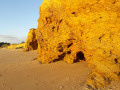
(4) Cross the car park and join the coastal road, leaving it as soon as it veers away from the coast. The coastal path follows the edge of the Lanchale cliff, which, at nearly 20 metres high, is the highest in Pénestin. At low tide, you can walk along the beach and climb back up the steps at its southern end. This route offers another view of the ochre cliffs.
Head to Pointe du Goulumer and its double beach on either side of the rock that extends from it.
(5) Continue along the coastal path after crossing the car park. It leads straight to the large Bile beach.
Important note: for the more adventurous, this section is also accessible at low tide by following the bottom of the cliffs, but you need to know where to find the natural tunnels that allow you to cross certain rough sections without getting your feet wet. This route is therefore only recommended for experienced walkers.
(6) The large Bile beach is accessible via a metal staircase. As before, it is possible to reach the point via the beach at low tide. At this point, there is nothing but sand, as the sea recedes to reveal two of the three islets that dot this part of the coast. The cliff here is particularly rugged and offers exotic views, especially in the morning at sunrise or in the evening at sunset.
For those who prefer to stay up high, the coastal path continues along the cliff. At the campsite, it is sometimes difficult to walk on as the sea washes over it when the tide is high.
(7) Pointe du Bile marks the southern tip of the Pénestin coastline and the northern entrance to Pont Mahé Bay.
Go around the point by following the road that serves the houses, then turn right at the crossroads. Go down to the dyke that separates the Baie du Bile from the Lesté marshes. This place attracts hundreds of birds that come here to feed and shelter.
(8) At the end of the sea wall and after the access ramp to the foreshore, continue along the road for eighty metres, then take the path on the right that climbs up the dune. This path leads to Pointe de l'Espernel, which you must reach before continuing along the beach on your left. Walk directly on the beach when the tide is not too high. During spring tides, it is advisable to consult the tide tables to ensure that the passage is safe. Otherwise, follow the winding road, which is busy in season, to Kerandré, then follow the path on the right in the village to reach the beach.
At the bottom of Kerandré is the large Palandrin beach, which you should walk along almost in its entirety (you can also follow the path on top of the dune or the path behind the trees).
(9) At the holiday centre, join the road and turn left towards Kerséguin.
When you reach the centre of the village, turn right onto Chemin du Pargo to rejoin the RD 201 and the starting point (S/E).

 Visorando Member
 Moderate