Pont Mahé Bay and Dunes

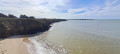
Straddling the departments of Morbihan and Loire-Atlantique, Pont Mahé Bay is a vast sandbank at low tide and a renowned spot for board sports once the sea has returned. Connecting the two headlands that mark its boundaries is a pleasant way to cross administrative borders

Details

810019
Creation:
Last update:
Last review:
  • Walking
    Activity: Walking
  • ↔
    Distance: 4.57 mi
  • ◔
    Average duration: 2h 10 
  • ▲
    Difficulty: Easy

  • ⚐
    Back to start: No
  • ↗
    Ascent: + 36 ft
  • ↘
    Descent: - 49 ft

  • ▲
    Highest point: 62 ft
  • ▼
    Lowest point: 3 ft
  • ⚐ Country: France
  • ⚐
    Area: Brière
  • ⚐ City: Pénestin (56760)
  • ⚑
    Start: N 47.443235° / W 2.482222°
  • ⚑
    End: N 47.426115° / W 2.452755°
  • ❏
    IGN map(s): Ref. 1022OT
  • Hour-by-hour weather

Description of the walk

Car park above the slipway at Pointe du Bile, Pénestin.

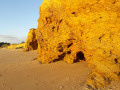
From the tip of this headland, you can enjoy the panoramic view over Pont Mahé Bay and the Traict de Rostu. The stretch of sea that unfolds before your eyes as far as Pointe de Merquel (opposite, with a small lighthouse at the end of the jetty) is fully revealed at spring tides. The black posts dotting this area are mussel beds where the mussels for which Pénestin is famous are cultivated. Pointe de Pen Bé (ochre cliffs, opposite, slightly to the left) will be your final stop before heading back.

(S) Head to the Espernel slipway by following the road that goes round the headland (anti-clockwise).

(1) Once you reach this point, and depending on the tide, head down to the beach, or a little further on, take the coastal path that runs along the top of the dune. At the Espernel rock, turn left towards Kerandré.
On this part of the route, the water level may force you to take off your shoes, as there is no alternative route. However, at the highest point, the sea level will not reach above your knees.

(2) At the bottom of Kerandré, continue along the beach, or go over the top of the dune, until you reach Le Palandrin. The coastal path then climbs up the cliff before descending a few hundred metres further on, after passing Le Palandrin mill.

(3) As you cross the channel linking the Pont Mahé marshes to the sea, you leave administrative Brittany and enter Loire-Atlantique, another Breton region often overlooked. Note here the quartz vein tumbling down the cliff. The string of white boulders piled up along the edge of the Aétier wasn’t brought here: it’s the cliff that contained them that has vanished under the sea’s onslaught. Continue along Pont Mahé Beach until you reach the entrance to the Moulin de l’Éclis campsite.

(4) When you reach the campsite, walk up the path leading to it and turn right towards the dunes. The grazed part of this area is fenced off, with gates allowing entry and exit. Follow the marked and clearly defined path until you come out onto the beach, just before the hamlet of l’Éclis. As you pass through the woods, don’t miss the pine tree that has a circular shape before reaching skywards.

(5) Once you reach the Éclis farm, the beach walk ends and the route continues along the cliff top. At mid-tide, take a moment to watch the waves roll in and break on the shore, following the shape of the bay. Follow the clearly marked coastal path to the right until you reach La Marche aux Bœuf.

(6) Between the car park and the beach access, take the path on the left which will lead you to the Pen Bé moors. This stretch of coastal moorland, covered in heather and gorse, is one of the best-preserved along the southern coast of Brittany. These moors overlook the ochre cliffs visible from the start of the walk, offering a panoramic view of the seascape of the Bay of Vilaine.

(7) The headland of Pen Bé, reached via a small road lined with villas, faces that of Merquel, situated on the other side of the Rostu (or Pen Bé) channel. Rather than mussel farming, local oyster farmers here favour oyster cultivation, yet the same tidal movement transforms the landscape. If you’ve walked here at low tide, come back at high tide: it’s a completely different place.

Continue along the small road that winds around the headland. Turn right behind the Café de la Marine, and head down to the mussel farmers’ car park. From there, simply continue on to the car park at the end of the route, on the other side of Anse de Pen Bé (E).

Waypoints

  1. S : mi 0 - alt. 26 ft - Pointe du Bile
  2. 1 : mi 0.56 - alt. 3 ft - Cale de l'Espernel
  3. 2 : mi 1.09 - alt. 16 ft - Below Kerandré
  4. 3 : mi 1.62 - alt. 10 ft - Pont Mahé channel
  5. 4 : mi 2.09 - alt. 20 ft - Camping du Moulin de l'Eclis
  6. 5 : mi 3.03 - alt. 13 ft - Ferme de l'Eclis, on the right
  7. 6 : mi 3.65 - alt. 43 ft - The Ox Walk
  8. 7 : mi 4.25 - alt. 30 ft - Pen Bé Headland
  9. E : mi 4.57 - alt. 13 ft - Pen Bé Cove

Notes

In season, there are places to eat and drink at Le Bile, Pont Mahé or Pen Bé.

(E) Return to the starting point: you can leave a car at the end of the walk, or do the route in the opposite direction. In this case, at the Café de la Marine, do not turn right towards Pen Bé cove, but continue straight on to rejoin the coastal path at the top of the cliffs.

With the ebb and flow of the tides, you’ll have the pleasure of seeing the sea transform the landscape until it’s almost unrecognisable. There’s another, far more original option: reaching Le Bile via the mussel beds. This should only be attempted on days with very high tides, and you must not stray more than an hour from low tide. The crossing is done barefoot, from Pen Bé to Cale de l’Espernel, in just under an hour. Be careful to keep your eyes open as you approach the finish; isolated oysters are within reach of an unwary foot.

Worth a visit

Pont Mahé Dunes: the newly developed route through this area, recently acquired by the Conservatoire du Littoral, offers a chance to explore a natural environment that has remained largely unspoilt until now. Work to thin out the woodland, the creation of ponds in the wettest areas, and grazing in the open spaces should enhance the already significant biodiversity in this Natura 2000-listed site, including the bay and the marshes further inland.

Traict de Rostu (or de Pen Bé): this spot is a haven for migratory birds, which gather here in their hundreds from October to March-April (greylag geese in particular). The sandy beds of the channel and Pont Mahé Bay provide a veritable feast for these birds, whether they are herbivores (feeding on eelgrass beds) or waders (feeding on organisms living in the mud). Upstream of the first dykes, at the far end of the channel, lie the salt marshes.

Reviews and comments

5 / 5
Based on 3 reviews

Reliability of the description
5 / 5
Ease of following the route
5 / 5
Route interest
5 / 5
jlisab56
jlisab56

Overall rating : 5 / 5

Date of your route : Oct 12, 2019
Reliability of the description : ★★★★★ Very good
Ease of following the route : ★★★★★ Very good
Route interest : ★★★★★ Very good

A pleasant, easy route with stunning views of Pont Mahé Bay and the tip of Pen Bé – a great spot for kitesurfing enthusiasts to take some lovely photos.

Machine-translated

gelinoto
gelinoto

Overall rating : 5 / 5

Date of your route : Mar 26, 2019
Reliability of the description : ★★★★★ Very good
Ease of following the route : ★★★★★ Very good
Route interest : ★★★★★ Very good

a lovely walk that’s always a pleasure along the coast

Machine-translated

pwetml
pwetml

Overall rating : 5 / 5

Date of your route : Oct 26, 2017
Reliability of the description : ★★★★★ Very good
Ease of following the route : ★★★★★ Very good
Route interest : ★★★★★ Very good

A very pleasant seaside walk; returning the same way but with the tide coming in changes the scenery. You can also extend the walk slightly along the cliffs towards Mines d'Or beach.

Machine-translated

Other walks in the area

For more walks, use our search engine .

The GPS track and description are the property of this route's author. Please do not copy them without permission.