Country:

 City:
City:


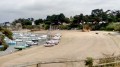
(S/E) Leave the Kercabellec car park by crossing the road bridge over the estuary and immediately turn right onto the path that runs along the left bank of the port. Before reaching the sea, turn left onto the path that follows the dune. Depending on the tide, it is also possible to follow the beach to the Merquel chapel.
(1) From the chapel, follow the coastal path that goes around the point. The jetty that extends from it is a popular spot when the sea is rough, as the waves crashing against it make for great photos. Behind it, the water remains calm for the boats sheltering there.
Continue along Sorloc beach and exit at its southern end. Follow the road to the left for about 150 metres.
(2) Turn right onto the path between the marsh and the campsite and follow it for about 1.3 km. This path may be flooded in places in rainy weather, but it is possible to walk along the sides to avoid getting your feet wet. After passing the footbridge, go around the last pond and join an unpaved path. Turn left to join the Quimiac-Kercabellec road and follow it to the bridge over the stream.
(3) If the previous section was passable without detours, turn left and follow the bank of the stream. Otherwise, there is no point in continuing along this path until the mud on the embankments has been covered with vegetation: without vegetation cover, it is like an ice rink. Continue along the road to the intersection where the normal path joins, when it is passable.
(4) If you have chosen the short circular, return to the car park at the start, which is about 200 m to the north.
If you prefer to complete the circular route, turn right before the first house, then right again to follow the road up towards the village of Mesquer. Turn left at the next crossroads and continue along the cycle path until the next bend.
(5) Before Clos du Moulin, turn left onto the path that leads into the woods, then follow it to the right until you reach another road. Turn left and follow this road for 500 metres. Take the second left to reach the village of Rostu.
(6) While the neighbouring residential area is of no interest, the old village is quite remarkable with its small terraced houses. Turn right in the middle of the village to go down to the fountain, a few dozen metres before reaching the marsh. It is now incorporated into a slope support structure, which has nevertheless preserved it in its original state. Take the path on the left that runs alongside the marsh and follow it until you reach the road again, at a pond. Take the road on the right.
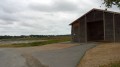
(7) After the tile-roofed salt shed (hangar à sel), you can take the path that leads to the Étier de la Barre. This watercourse is the outlet of the Mès, a small coastal river that collects water from a large part of the northern slope of the Guérande hillside and irrigates all the Mès marshes. A few fisheries are maintained in this area, where elver (small eel) fishing is still practised.
(8) Then return to the road and continue to the seashore.
(9) On the Rostu Dune, an enclosure may be temporarily closed. This is a measure to protect one of the rare breeding sites of the plover, which nests on the dune floor. The Merquel, Rostu and Pen Bé stretches, on the opposite shore, are rare and rich environments where birds come to take refuge and feed depending on the state of the sea and the tide.
Retrace your steps until you pass the large saltworks.
(10) After passing the salt store (another name for the building where the harvest was stored), take the path on the right that runs alongside the salt marshes and follow it to the first houses in Kervarin.
(11) If the tide allows, turn right to head back towards the shore. Then follow the beach to the port of Kercabellec.
Otherwise, return to the village where you started via the road. It's shorter, but also less interesting, to end your walk at the Kercabellec car park (S/E).


 Visorando Member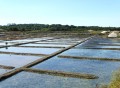
 Easy
Easy