Country:

 City:
City:


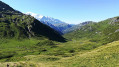
(S) Depart from the Moëde Anterne refuge (chalet-hotel). Head east towards Col de Salenton.
(1) At the Nant de Moëde signpost, turn right onto the GRP® Tour du Pays du Mont-Blanc trail. Climb up to Collet de l'Écuelle.
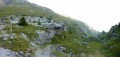
(2) Head north-northeast, follow the Diosaz valley down to the ruins of the Chalets d'Écuelle.
(3) The path continues downhill, north-northeast then north, to the Chalets de Villy.
(4) Continue north, then northeast, and begin the ascent to the Col de Salenton. The route begins to climb steeply after the hut on spongy ground.
(5) Turn right (east) and wind up under the foothills of Mont Buet. Reach the Col de Salenton.
Here, two options are available:
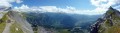
- Climb Le Buet (also known as Mont-Blanc des Dames, an exceptional view in fine weather), as shown on the map and described below (3h round trip).
- Descend directly to the Refuge de la Pierre à Bérard (then refer to the second passage at the pass).
(6) To Le Buet, continue north and, after a short crossing on a steep slope, resume the orginial route to Le Buet. Turn left into an almost always snow-covered valley, where caution is advised. The summit of Le Buet is now clearly visible on the right. More effort is required to reach a cairned panoramic flat overlooking the Diosaz valley.
(7) Bend right and follow the steep path leading to a belay point on the Arête de la Mortine. The progression is hard and you will have to slow down as you climb the very short, very steep switchbacks to the ridge.
(8) Pass the telecommunication relay. Follow the shallow ridge and reach the large cairn marking the summit of Le Buet, which is often covered by large patches of snow.
(9) Descend by the same route to the Col de Salenton.
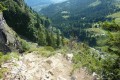
(6) Head west and begin the descent to the Pierre à Bérard mountain hut. The first part of the descent is practically rock-climbing, over huge boulders and on a very inconspicuous path. The route is marked with yellow dots and cairns, and is not always easy to follow amid the mass of boulders. At around 2200m, find a better-marked path that is very gullied in places, and arrive at the Refuge de la Pierre à Bérard, which is clearly visible from above (E).

 ).
).
 Visorando Member
 Moderate
  Very difficult
 Easy
Easy